Issued by the Catholic Center for Studies and Media - Jordan. Editor-in-chief Fr. Rif'at Bader - موقع أبونا abouna.org

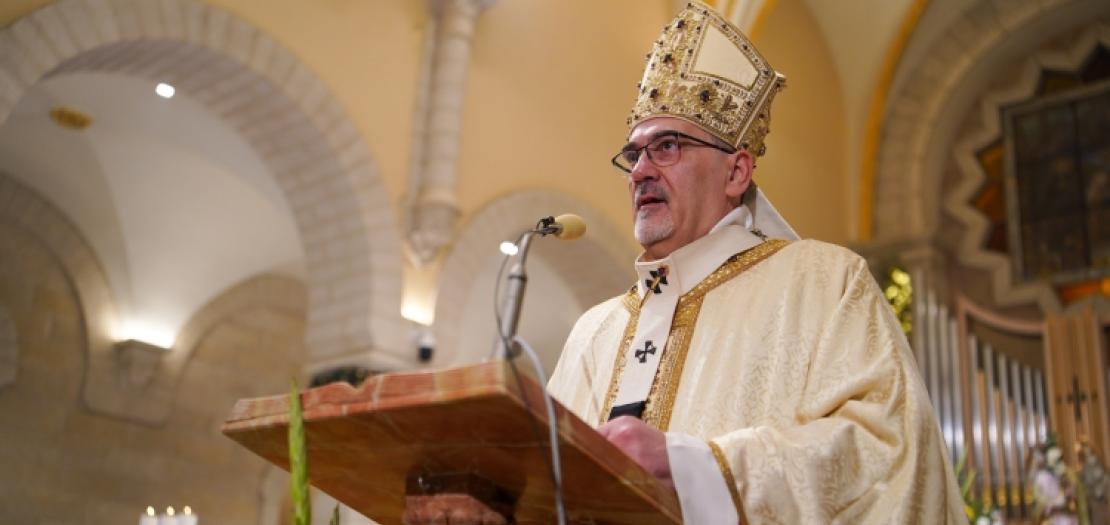
Dear brothers and sisters, may the Lord give you peace.
(Greetings to the civil and religious authorities)
The Gospel we have just heard opens with sober and precise words, “In those days a decree went out from Caesar Augustus that a census should be taken of the whole world.” (Luke 2:1) Luke places the birth of Jesus within the broader history of the world, marked by political decisions, balances of power, and logic that seems to govern the course of events. As then, history today is marked by decrees, political decisions, balances of power that often seem to determine the destiny of peoples. The Holy Land bears witness to this: the choices of the powerful have concrete consequences on the lives of millions of people.
Christmas, however, invites us to look beyond the logic of domination, to rediscover the power of love, of solidarity and of justice. It is not a tale suspended outside of time, but an event that happens as history proceeds along paths we do not always understand and often do not choose.
The beginning of the Gospel passage is not a simple detail in a narrative but rather a profoundly theological choice. Luke the evangelist, tells us that God is not afraid of human history, even when it appears confused, marked by injustice, violence and domination. God does not create a parallel history. He does not enter the world when everything is finally ordered and pacified. He enters real, concrete, sometimes harsh history and makes it His own from within.
Caesar’s decree seems to dominate the scene: the emperor who counts, records, organizes and governs.
Everything seems to be under control; everything seems to obey a logic of power which takes decisions in the peoples' stead. Yet, without knowing it, that very decree becomes an instrument of a greater design. The same history which claims to be self-sufficient becomes the very place where God fulfills His promise. This is one of the great announcements of Christmas: God does not wait for history to get better before He enters it. He enters while history is what it is. Thus, He teaches us that no time is definitively lost and no situation is too dark for God to dwell in.
That is why the Gospel begins not with a clamorous miracle, but with an administrative act, not with angels' song, but with a census. That is where God makes Himself close to us. Joseph and Mary set out not because of a plan they chose, but out of obedience to an order from above. They move within a history that they do not control, within decisions made elsewhere. Precisely by going through these circumstances, seemingly unrelated to the promise, God brings his Word to fulfillment.
At Christmas God does not surrender to the world, just as at Easter Christ is not defeated by evil. At Christmas God loves the world to the core, embraces it and takes it upon Himself. We could say that God, by becoming man, “marries” what is real. Everything human, for Him, has not ceased to be worthy of being inhabited. Sin has certainly disfigured our likeness to God, but it has not erased His image in us and in creation. That is why the world remains blessed, even when the song of praise for its beauty turns into a cry for salvation.
The Eternal, entering time, has made it pregnant with hope and future. He broke the sterile cycle of a chronicle that repeats itself, often bitterly, and transformed our fragile lives, our difficult moments, into places of salvation history. From that moment, history is always worth living, because an invincible seed of peace has been laid in it. By becoming a newborn child and by choosing to walk the full path of human life from birth to death, the Son of God tells us that it is worthwhile to be men and women, today and always, since human life, which the Eternal Word has made His own, has become the holy place in which God continues to work His wonders.
Jesus’ birth takes place in the night. Not only in the chronological night, but in the night of humanity: the time of limit, of uncertainty, of fear. Yet, it is precisely in this night that light is given. It is a light that does not eliminate the night but overcomes the darkness that accompanies it. God’s light does not blind or impose but rather lights the path and makes it possible to continue walking.
In Luke’s account a decisive contrast emerges, on the one hand the emperor who rules the peoples, on the other a child who is born without power. The empire issues decrees, but God gives a Son. While history follows the logic of force, God acts discreetly and fulfills His promises through ordinary events.
This contrast is not only to move us, but to convert us. This contrast reveals to us the way in which God chooses to be present in the world and, consequently, the way in which we too are called to remain in history. Christmas is not a spiritual shelter that removes us from the strain of the present time. Christmas is a school of responsibility. It teaches us that the fullness of time is not an ideal condition to wait for, but a reality to welcome. It is Christ Himself who imbues time with fullness. He does not wait for circumstances to be favorable: He inhabits and transfigures them.
“Glory to God in the highest and on earth peace to those on whom his favor rests.” (Luke 2:14) The peace announced by the angels is to be understood in this light. It is not a mere equilibrium or the result of fragile agreements. It is the fruit of God’s presence in history. It is a peace that comes from above but does not impose itself. It is given but is also entrusted. God plays His part to the endl: He enters history, becomes a Child and shares in our condition. He does not replace man’s freedom. Peace becomes real only if it finds hearts willing to welcome it and hands ready to keep it safe.
For this reason, Christmas entrusts us with a great and real responsibility. Every gesture of reconciliation, every word that does not fuel hatred, every choice that centers on the dignity of the other, becomes the place where God’s peace takes flesh. Christmas does not distance us from history but profoundly engages so that we are not neutral, but partakers.
Here, in the Holy Land, this truth resonates with special force. To celebrate Christmas in Bethlehem is to recognize that God has chosen a real land marked by wounds and expectations. The holiness of the places coexists with wounds that are still open. We come from years of great hardship, in which war, violence, hunger and destruction have deeply marked the lives of so many, especially the little ones. The situation has become too heavy, relationships too conflicting. Starting over and rebuilding has become too hard. In these years, history has shown all its contradictions, reality has come to us with its heavy, complicated and sad side. However, what is concrete and painful evidence for us is also felt elsewhere in the world. There is a widespread desire to escape from reality. People flee from responsibilities that are too heavy, flee from caring for the common good in order to retreat into their own private interests, flee from ties that are too demanding, in order to move from one distraction to another, in a climate of general disengagement. A little bit everywhere, one senses great unease, sometimes even spiritual, unable as we are to understand all this violence, and the culture that feeds it or ignores it.
The difficult situations of this time are not the result of destiny, but of political choices, of human responsibilities, and of decisions that often put the interests of a few before the good of all. The Holy Land, a crossroads of peoples and faiths, continues to be the scene of tensions and conflicts that call into question the responsibility of local leaders, the international community, but also religious and moral authorities.
Everywhere in our Diocese, we have had and continue to have challenges. Clearly, despite the cessation of the war, suffering is still present in Gaza, families live in the rubble, and the future appears fragile and uncertain. The wounds are deep, yet here, too, the proclamation of Christmas resounds. When I met them, I was struck by their strength and desire to start over, their ability to rejoice again, their determination to rebuild devastated lives from scratch. I think they are really having their own special Christmas of new birth and life right now. They are a beautiful testimony to us today. They remind us how we too are called to stand within our own history. They challenge us to strongly ask for itineraries of justice and reconciliation, which heed the cry of the poor, so that peace may not only be a dream, but a concrete commitment and responsibility for all.
“Now there were shepherds in that region living in the fields and keeping the night watch over their flock.” (Luke 2:8) This universal call immediately finds a concrete face in the Gospel: after Jesus’ birth, the gaze shifts from the powerful in history to the shepherds in the fields, simple, often invisible men who represent ordinary life and daily toil. God does not reveal Himself to the privileged, but to seekers; not to those who possess, but to those who keep vigil and who face the strain of daily life.
Here and now, we are all called to become first fruits of the coming Kingdom. Not elsewhere, not in an ideal time. Here, bravely taking on the challenges of often problematic coexistence and slow and arduous reconstruction, we are sent by the Father, with the Son, in the power of the Spirit, to repair ruins, to restore hope, to communicate life. Following Joseph and Mary, we are invited to re-enter our reality with confidence, certain that God precedes us on the journey.
Dear brothers and sisters,
History does not change overnight. Yet, it can change direction when men and women allow themselves to be enlightened by a light greater than themselves. Tonight’s Gospel also challenges us here present from different countries, cultures and histories. It asks us not to remain neutral, not to run away from the complexity of the present, but to navigate it in the light of the Child. The worlds' night may be deep, but it is not definitive.
The light of Bethlehem does not blind us; rather it lights the way. It spreads from heart to heart, through humble gestures, reconciled words, daily choices of peace made by men and women who allow the Gospel to take flesh in their lives.
In this holy night, the Church proclaims that hope has not been disappointed. God has entered our history and has not left. He chose to inhabit human time so that no one would feel excluded, no life would be discarded, no night would be without light.
May the Child born in Bethlehem bless this land and all its peoples. May He bless every family in difficulty, every wounded child, every man and woman weary from the burden of the present.
In this holy night, let us proclaim with joy: Light shines in darkness and darkness has not overcome it. To God who made Himself near, who chose the poverty of a manger to inhabit our history, be glory for all ages.
Holy Christmas to you all, to the Holy Land, to the Church and to the whole world.
Amen.
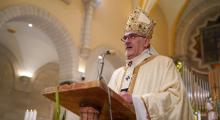
+Pierbattista Card. Pizzaballa
Latin Patriarch of Jerusalem