Issued by the Catholic Center for Studies and Media - Jordan. Editor-in-chief Fr. Rif'at Bader - موقع أبونا abouna.org

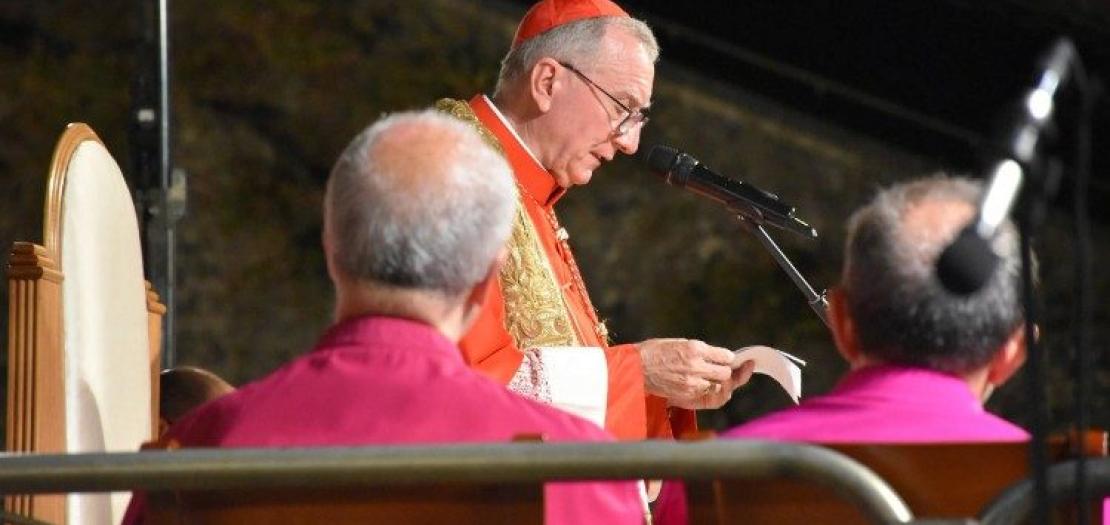
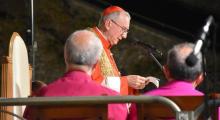
Cardinal Pietro Parolin delivers homily
Cardinal Pietro Parolin, Holy See Secretary of State, presided over Mass on the evening of August 17 at the culmination of the Jubilee dedicated to Saint Agatha.
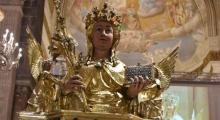
The Eucharistic Celebration in the cathedral dedicated to the Saint commemorated the ninth centenary of the translation of her relics from Constantinople to Catania.
He brought “to this beloved land of Sicily” the Pope’s blessing and affection, as the Pope spiritually joined in the joy of the citizens gathered around an ancient devotion to their patron saint.
“Celebrating this anniversary,” the Cardinal stressed, “means recognizing that the Lord has been faithful to his Church throughout the centuries, sustaining her in times of trial, purifying her in difficulties, and continually making her flourish anew through the witness of the saints.”
In his homily, the Holy See Secretary of State made a strong appeal to pray for the many “brothers and sisters of ours scattered throughout the various parts of the world who suffer persecution for the name of the Lord and for his Gospel.”
Following the celebration, a procession with the saint’s relics took place along some of the main streets of the historic city Centre.
A holiness that does not belong in museums of memory
“Saint Agatha does not simply belong to the history of Catania: she belongs to God’s today and continues to walk with her people,” Cardinal Parolin continued.
Citing Saint Augustine and Tertullian, he recalled the importance of martyrs, who should be praised not so much because of their suffering, but because they persevered, as the Saint of Hippo taught. “The blood of the martyrs,” explained the Christian apologist from Carthage, “is not a sign of defeat, but the seed from which the Church continually flourishes anew.”
Hence the papal legate’s invitation to look to Agatha as a woman who can inspire faith today, because she embodies “a holiness that does not belong in the museums of memory, but continues to generate faith, hope, and charity.”
God remains faithful even when everything seems lost
Commenting on the biblical readings of the day’s liturgy, the account of the martyrdom of the seven Maccabean brothers and their mother, and the Letter of the Apostle Paul, Cardinal Parolin emphasized that belonging to Christ goes beyond every temptation to compromise.
This was evident in Agatha, whose martyrdom “is not first and foremost the account of violence suffered, but the manifestation of a love that no violence was able to extinguish.” It was also evident in Paul, who experienced misunderstanding, persecution, and frailty, yet continued to “proclaim Christ with a serenity that is astonishing.”
Power belongs to God, not to human beings
Cardinal Parolin’s reflection turned to the Church herself, which, he explained, “does not live by her own efficiency, but by the grace of God; she is not founded on the abilities of her members, but on the faithfulness of the Lord, who continues to work through human weakness.”
He then returned to the call that runs throughout Scripture: “Do not be afraid.” “This is not simply psychological encouragement, but the very foundation of our Christian life. Jesus does not promise an existence free from trials and tribulations; he promises something much greater.”
Cardinal Parolin then focused on Christians persecuted in many parts of the world: “Let us therefore remember and pray at this moment for all these brothers and sisters of ours scattered throughout the various parts of the world who suffer persecution for the name of the Lord and for his Gospel. But let us not forget that there is also, so to speak, a bloodless martyrdom to which we too are called,” he added.
Everyday holiness, the martyrdom of fidelity
There are therefore two ways of manifesting unconditional love for Christ: the martyrdom of blood, and the perhaps less visible form that each person may experience in daily life, “the daily martyrdom of fidelity,” as the Cardinal described it.
He referred, by way of example, to spouses who preserve their love amid difficulties; parents who raise their children in the Christian faith; young people who refuse to give in to a culture of appearances; priests and consecrated men and women who generously devote their lives; elderly people who offer their sufferings with trust; and all those who, in silence, choose justice over compromise, truth over convenience, and forgiveness over revenge each day.
This, the Holy See Secretary of State insisted, is the everyday holiness of which the Second Vatican Council spoke.
Evil is not overcome with more evil
In conclusion, Cardinal Parolin observed that Catania possesses an immense heritage of faith, culture, popular piety, and charity, saying this heritage must not be squandered or rendered sterile, but safeguarded so that it may bear fruit.
Thus, by keeping firmly in view the teaching of the saints, namely that evil is not overcome with more evil, but with the charity born of the Cross, which transforms history from within, it will be possible to confront the territory’s many challenges: poverty, inequality, the plight of many young people forced to seek their future elsewhere, the struggles faced by families, and the phenomenon of new forms of material and spiritual poverty.