Issued by the Catholic Center for Studies and Media - Jordan. Editor-in-chief Fr. Rif'at Bader - موقع أبونا abouna.org

Following is the text of the meditation by His Beatitude Cardinal Pierbattista Pizzaballa, Latin Patriarch of Jerusalem, marking the 29th Sunday of ordinary time, dated October 18, 2026:
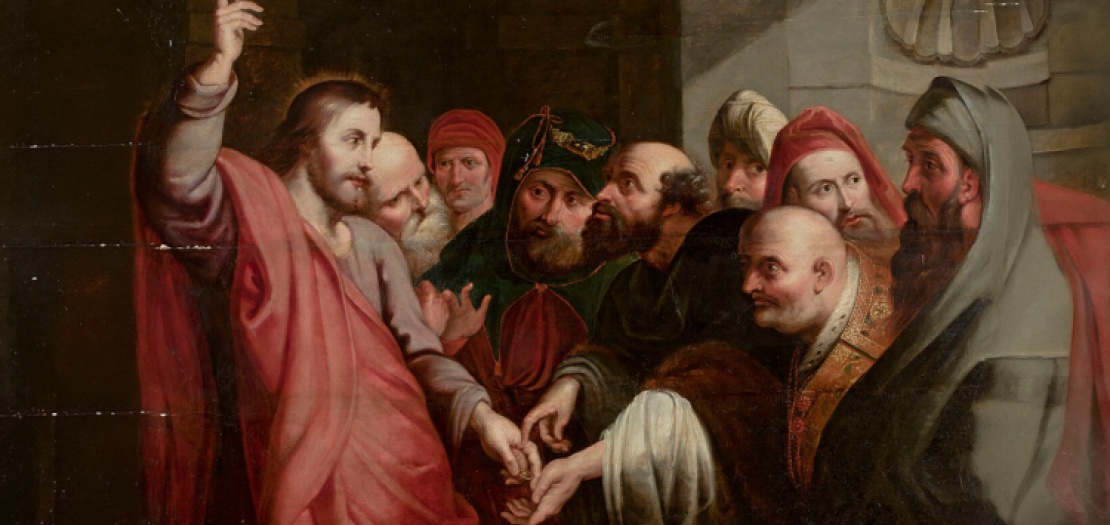
iThe Gospel passage we hear today (Matthew 22:15–21) presents us with a trap that the Pharisees and Herodians—allied together out of convenience—carefully devise to try to put the Lord Jesus in a difficult position.
The question they hope to trap him with has an obvious political implication: “Is it lawful to pay the census tax to Caesar or not?” (Matthew 22:17) It is a tricky question: if Jesus says yes, he appears to be a collaborator; if he says no, he comes across as a political subversive.
The question, however, is preceded by a compliment that is as impressive as it is suspicious: “Teacher, we know that you are a truthful man and that you teach the way of God in accordance with the truth. And you are not concerned with anyone’s opinion...” (Mt 22:16) From a narrative perspective, the reader already knows that the Pharisees have come to “entrap Jesus.” (Matthew 22:15) Therefore, every word of praise, immediately comes across as false. And yet, those who seek to trap Jesus describe Him perfectly, and in trying to test him, they ultimately give Him the opportunity to confirm their perception of Him.
The question is a trap because it is phrased in such a way that there are only two possible answers: either yes or no. The trap, however, works only if Jesus accepts the terms of the dispute and remains within the boundaries set by His interlocutors: but Jesus does not allow himself to be confined to a political either-or; he does not remain a prisoner of this false alternative and immediately shifts the discourse towards what is close to His heart, towards what is essential.
First of all, He does not answer immediately, as He sometimes does in other Gospel passages. Often, when faced with questions like these, Jesus responds with a parable. Here, however, He begins directly with something concrete, with reality itself: the coin. And once He looks at the coin, everything becomes clear. Jesus brings to light an obvious fact, or perhaps an oversight: the coin clearly belongs to the imperial world.
Above all, Jesus escapes the trap because He does not choose either of the two opposing sides. Instead, He shows that the question itself is too narrow. The issue is not whether to stand with Caesar or against him, because, for Jesus, Caesar is not the ultimate horizon of the question. Jesus introduces a third element: the Father.
Caesar may claim his image on a coin, but he cannot claim it on a human being.
He may demand tribute, but not adoration. The Father, on the other hand, can, because he human person does not belong to Caesar, but to God.
God and Caesar, therefore, are not two rivalry rulers on the same level. One has relative power; the other has absolute power, since the beginning and forever. Jesus’ answer is not a separation of powers, but a liberation from a false dichotomy.
The matter does not end there. In their question, the representatives of the Pharisees and the Herodians had asked whether it was lawful to pay the tax. In His response, Jesus does not use the verb to pay, but to give back: “Then repay to Caesar what belongs to Caesar and to God what belongs to God.” (Matthew 22:21) The issue is not about paying, but about giving back to each what belongs to them.
To pay means to carry out a transaction, settle a debt, or complete an operation that brings a relationship to a close. It is a gesture that does not involve the heart: it concerns only the object and its value. To give back is a gesture that opens one to relationship, that recognizes and honors the other, and that embraces the truth of who one is.
This, indeed, was precisely the problem with the murderous tenants in the parable we heard two Sundays ago (Matthew 21:33–43): they failed to give back, that is, to acknowledge that they we are not the absolute masters of reality. Neither are we, nor is Caesar.
Only the Father is, He who is good, and who makes everything His own a total gift, like the owner of the vineyard who calls his workers and gives everyone the same wage, the same gift. (Matthew 20:1–16)
Jesus, therefore, does not answer the Pharisees’ question, but answers the question they did not ask. For the real question is: to whom does our heart belong? Our freedom begins when we return to God that which bears His image: ourselves.
+Pierbattista