Issued by the Catholic Center for Studies and Media - Jordan. Editor-in-chief Fr. Rif'at Bader - موقع أبونا abouna.org

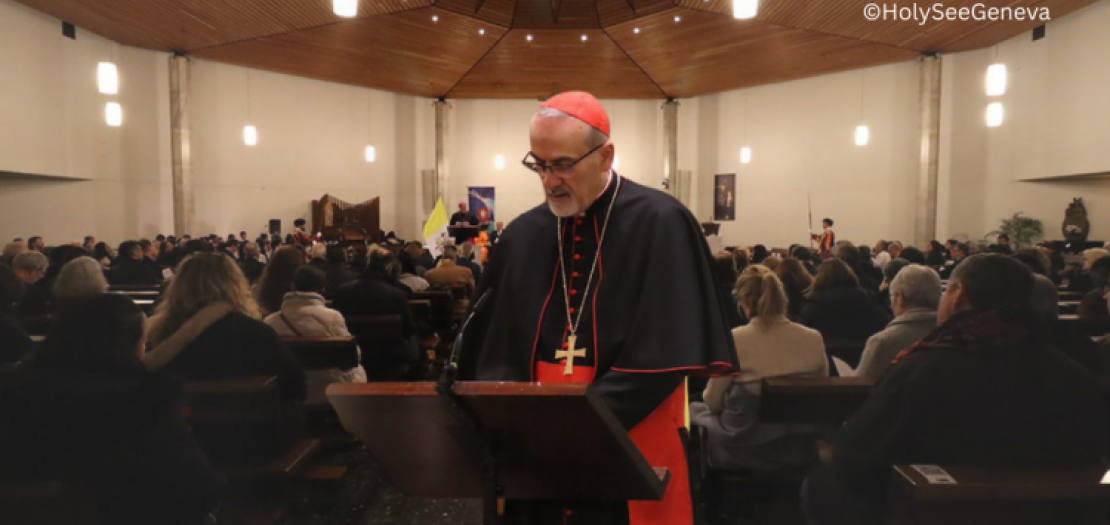
In a global context marked by escalating conflicts and growing fragmentation, His Beatitude Cardinal Pierbattista Pizzaballa, Latin Patriarch of Jerusalem, renewed a strong appeal not to surrender to resignation, but to persevere in the demanding work of peace.
Speaking in Geneva on 29 January 2026, during the 17th Annual Interreligious Service for Peace, hosted by the Permanent Mission of the Holy See to the United Nations, the Cardinal welcomed Pope Leo XIV’s Message for the 2026 World Day of Peace, “Towards an ‘Unarmed and Disarming’ Peace,” describing it as “a timely and necessary word for the moment we are living.”
Resisting the normalization of war
Cardinal Pizzaballa stressed that the Pope’s Message does not offer simplistic solutions, but challenges the international community to resist the dangerous normalization of war.
“Giving up on peace,” he warned, “would mean accepting war as the ‘normal language’ in human and international relations.”
“To welcome Pope Leo XIV’s message is not naïve optimism,” he added, “but a demanding hope that refuses to let wounds, trauma, and fear have the final word.”
The Holy Land: beyond violence and ceasefires
Referring to the situation in the Holy Land, the Latin Patriarch spoke of violence that has not only destroyed cities, but has also wounded consciences, poisoned language, and weakened the ability to recognize the other as a partner in dialogue rather than an enemy. In this context, he cautioned that even the end of violence does not automatically mark the beginning of peace.
“Peace is not a moment,” Cardinal Pizzaballa explained. “It is not simply the outcome of a ceasefire or a treaty. It is a long and difficult process that requires time, patience, and consistency, as well as deep work on consciences, relationships, and the structures that govern our common life.”
Justice and the dignity of the other
Justice, he affirmed, remains inseparable from peace.
“There is no lasting peace without justice, but there is no real justice unless the other is recognized as a person, not a tool or an obstacle.”
The Cardinal called on the international community to move beyond emergency responses and humanitarian management. True commitment to peace, he said, requires long-term investment in education, dialogue, and social and institutional reconstruction, even when results are not immediate.
Highlighting the role of religion in conflict contexts, Cardinal Pizzaballa echoed Pope Leo XIV’s appeal to religious leaders and communities to safeguard a language that does not fuel fear or hatred, but instead opens paths toward conversion, responsibility, and the recognition of human dignity.
Jerusalem and the witness of the Church
Jerusalem, he noted, remains a powerful and dramatic symbol. To reduce it to an object of contention or to claim it as the exclusive possession of one identity is to betray its deepest vocation: coexistence founded on mutual respect and the recognition of the other.
“The witness of the Church in the Holy Land,” he concluded, “is that of a small and fragile community, without political power, yet called to safeguard a vision of humanity that makes peace possible.” To continue working for peace today, he said, remains a moral and political responsibility, and an act of fidelity to God, to humanity, and to humanity’s deepest calling.