Issued by the Catholic Center for Studies and Media - Jordan. Editor-in-chief Fr. Rif'at Bader - موقع أبونا abouna.org

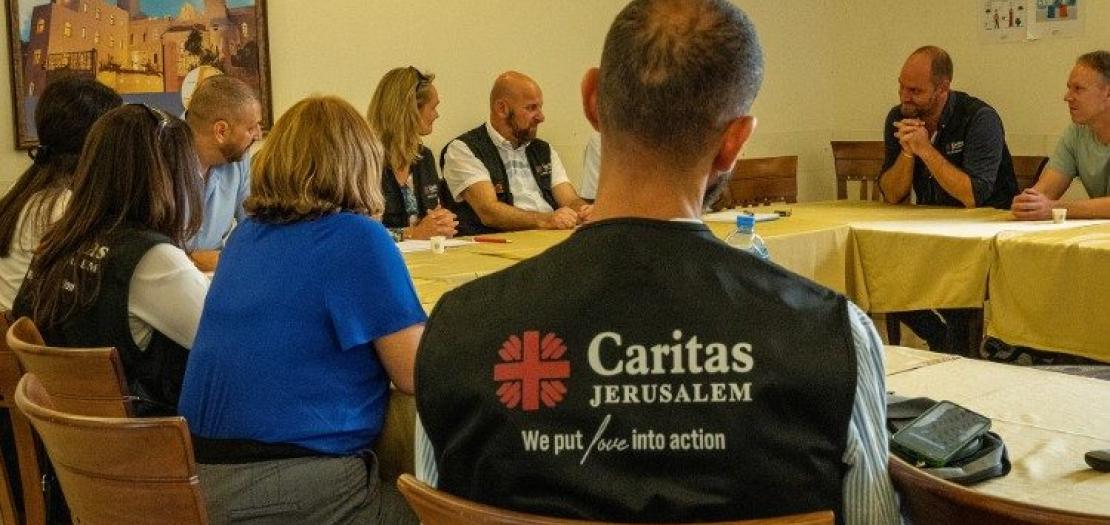
Israel confirmed on Thursday, January 1, 2026 a ban on operating in the Gaza Strip and the West Bank for 37 humanitarian organizations if they refuse to comply with new registration requirements imposed by the Ministry for Diaspora Affairs and Combating Antisemitism.
The measure has been criticized by much of the international community and has prompted a response from the Latin Patriarchate of Jerusalem.
According to the Israeli Ministry for Diaspora Affairs, NGOs that have not met the requirements set by the authorities will see their permits expire and will be required to cease operations in the Gaza Strip by March 1, 2026.
The decision has been rejected by numerous international organizations, which warn it could worsen the grave humanitarian crisis in the Palestinian enclave, where access to essential services—such as medical care, food, and water—remains insufficient.
Israel’s list includes Caritas Jerusalem, Médecins Sans Frontières, the Norwegian Refugee Council, Care International, Oxfam, and ActionAid.
Latin Patriarchate of Jerusalem’s response
Regarding the failure to renew Caritas Jerusalem’s permit, the Latin Patriarchate of Jerusalem issued a statement upholding the agency’s legal status.
“Caritas Jerusalem is a humanitarian and development organization operating under the aegis and governance of the Assembly of Catholic Ordinaries of the Holy Land,” explained the statement. “In Israel, Caritas Jerusalem is an ‘ecclesiastical legal person,’ whose status and mission have been recognized by the State of Israel through the 1993 Fundamental Agreement and the subsequent 1997 Legal Personality Agreement, signed between the Holy See and the State of Israel.”
The statement further clarifies that “Caritas Jerusalem has not initiated any procedure of new registration with the Israeli authorities and will continue its humanitarian and development operations in Gaza, in the West Bank, and in Jerusalem, in accordance with its mandate.”
Caritas Italiana’s solidarity
The measures issued by the Israeli government reportedly surprised Caritas Italy’s leadership, which says its support for Caritas Jerusalem will not waver.
“Caritas Jerusalem,” stressed deputy director Silvia Sinibaldi in an interview with Vatican News, “is a humanitarian organization that operates under the governance of the Assembly of Catholic Ordinaries of the Holy Land and operates according to a legal status that is the result of agreements between the State of Israel and the Holy See, whereas Caritas Internationalis, which is also included on the Israeli authorities’ list, is not an organization that carries out direct interventions within the country. In short, there was no registration process underway, so this decision is absolutely surprising and unexpected.”
Essential, indispensable interventions
Caritas Jerusalem immediately affirmed its determination to continue its mission in both Gaza and the West Bank.
Ms. Sinibaldi called this move “a necessary clarification which, however, does not exclude the concrete difficulties that characterize daily work in the field, which is always very uncertain and unstable.”
“As the Caritas network, we stand alongside Caritas Jerusalem not only with support and daily accompaniment in prayer, but also by supporting interventions both in the Gaza Strip and in the West Bank,” she said.
These are essential and indispensable interventions, the deputy director said, especially in areas ranging from healthcare to psycho-social support.
Tangible support
Caritas Jerusalem is currently dealing with several emergencies afflicting people in the Holy Land during the difficult winter months, in part thanks to donations to the Caritas network, according to Ms. Sinibaldi.
She recalled a project to provide support for families in the West Bank during the Christmas period.
“The project provides economic, community-based, and outreach support to 250 families in these territories, while in the Gaza Strip we support projects linked to maternal and pediatric health and to mental health,” she said.
Ms. Sinibaldi pointed to the donation of Pope Francis’ former popemobile, which Caritas Jerusalem has transformed into a mobile pediatric clinic.
“Supporting this initiative in a place where nothing exists anymore is like keeping a torch of hope lit,” she said.