Issued by the Catholic Center for Studies and Media - Jordan. Editor-in-chief Fr. Rif'at Bader - موقع أبونا abouna.org

Miral Atik/ lpj.org
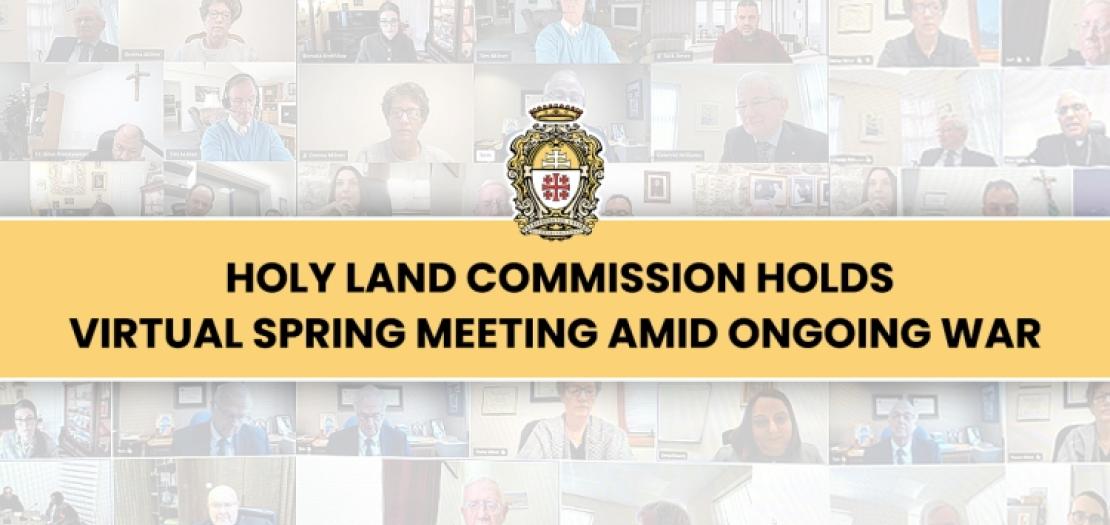
Originally scheduled for March 15–20, 2026, the annual spring site visit of the Holy Land Commission (HLC) was moved online due to the sudden outbreak of war in the region. Held virtually from March 16 to 20, the meetings focused on reviewing ongoing initiatives and assessing the growing humanitarian, pastoral, and economic needs of the Christian community across the Diocese of Jerusalem.
The Commission members—Prof. Bartholomew John McGettrick (President of the Holy Land Commission), Tim Milner, Mrs. Milner, Dr. Donata Maria Krethlow-Benziger, Mr. Gearoid Williams (Lieutenant of Ireland), and Mr. Tom Pogge (Vice Governor for North America)—reaffirmed their steadfast commitment to supporting the Latin Patriarchate of Jerusalem, particularly in light of the sharp increase in needs witnessed over the past month.
His Beatitude Cardinal Pierbattista Pizzaballa, Latin Patriarch of Jerusalem, opened the meetings with an overview of the current situation, emphasizing the urgent need for economic support and job creation programs to sustain the Christian presence. According to recent data from Aid to the Church in Need (ACN), unemployment among Christians in the West Bank and Jerusalem has reached 72 per cent, largely due to the collapse of the tourism sector, loss of work permits, and movement restrictions. With 62 per cent of Christians relying on tourism and hospitality for their livelihood, the Commission highlighted the importance of supporting small businesses and providing vocational training to ensure stable income sources.
Prof. McGettrick reflected on the broader challenges facing the population, noting: “This is a time when we witness all people struggling—health-wise, economically, socially, and educationally—while trying to maintain hope in an environment of considerable uncertainty. The Church continues to work tirelessly to sustain the Christian presence despite the surrounding conflict.”
A central part of the meetings included discussions with the leadership of the Latin Patriarchate, led by CEO Sami El-Yousef, alongside department heads who presented updates on operations, development, and financial realities. The Commission also met with directors of the Latin Patriarchate schools, reviewing progress on the “Ensuring the Future” Capital Campaign, initiated by the North American Lieutenancies. To date, 60 projects have been completed across two phases, with 34 more underway, directly benefiting approximately 19,500 students across Jordan, Palestine, and Israel. Beyond infrastructure improvements, the initiative was noted to have a significant psychological impact, reinforcing a sense of care and solidarity among students, teachers, and families.
Regional updates were provided by the Patriarchal Vicars and key pastoral leaders. Mgr. Iyad Twal (Jordan) and Mgr. Rafiq Nahra (Israel) outlined ongoing initiatives and emerging needs within their respective vicariates. Fr. Ramez Twal presented the work of youth chaplaincy, parish life, and the Family Center, while Fr. Bernard Poggi, Rector of the Seminary of Beit Jala, addressed seminary life, including the reopening of the minor seminary and the role of the Spiritual Formation Center in preparing future clergy.
The Commission also explored long-term development strategies, dedicating a session to the potential establishment of an Economic Development Council within the framework of the Order of the Holy Sepulchre. Discussions highlighted the possible collaboration between the Latin Patriarchate and Bethlehem University, building on existing initiatives such as the AFAQ (“Horizons”) program, to promote training, entrepreneurship, and sustainable income-generating projects.
Humanitarian concerns featured prominently, particularly regarding Gaza and vulnerable communities across the region. Fr. Gabriel Romanelli provided an update on the situation in Gaza, alongside a humanitarian briefing by Dima Khoury. Special attention was given to education initiatives for disadvantaged children, including plans to accommodate up to 1,000 students. The Commission also heard from representatives of the Vicariate for Migrants and Asylum Seekers, who shared the difficult realities faced by marginalized groups.
Discussions further underscored urgent issues related to housing and displacement, especially in Gaza and parts of the West Bank, where many families are living in precarious conditions. Concerns were also raised about ongoing political developments, including proposed legislation that could impact land ownership in the West Bank, potentially exacerbating existing vulnerabilities.
The meetings concluded with a summary session led by CEO Sami El-Yousef, reaffirming the shared commitment to sustain the mission of the Church in the Holy Land. Key priorities included expanding humanitarian assistance, strengthening job creation programs, continuing support for schools and infrastructure projects, and increasing investment in pastoral activities. Particular emphasis was placed on continued support for Gaza in the areas of education, housing, and livelihoods.
Despite the inability to meet in person, the virtual format enabled meaningful dialogue and ensured continuity in collaboration. The meetings stood as a sign of resilience and solidarity, affirming that the bonds between the local Church and its international partners remain strong and steadfast.
Prof. McGettrick concluded by expressing sincere gratitude to the staff of the Latin Patriarchate for their dedication and perseverance during these challenging times, assuring them of the Commission’s continued support through financial assistance, solidarity, and prayer.
In a final message addressed to the Christian community of the Holy Land, the Commission acknowledged that the past five years have seen the local community move from one crisis to another. Yet, they reaffirmed a firm conviction that the Christian presence must remain, as a vital and enduring witness in the land. “You are an inspiration to us all,” they noted, emphasizing that Christians around the world care deeply, continue to pray, and remain committed to offering their support.
They further stressed that the mission of the Order of the Holy Sepulchre is to sustain this presence, even in moments that may seem marked by hopelessness, by bringing and nurturing hope. “We will stand with you and help you through this crisis,” they affirmed, concluding with a message of closeness and faith: “We pray for you and with you… You are not alone, and you are not forgotten.”