Issued by the Catholic Center for Studies and Media - Jordan. Editor-in-chief Fr. Rif'at Bader - موقع أبونا abouna.org

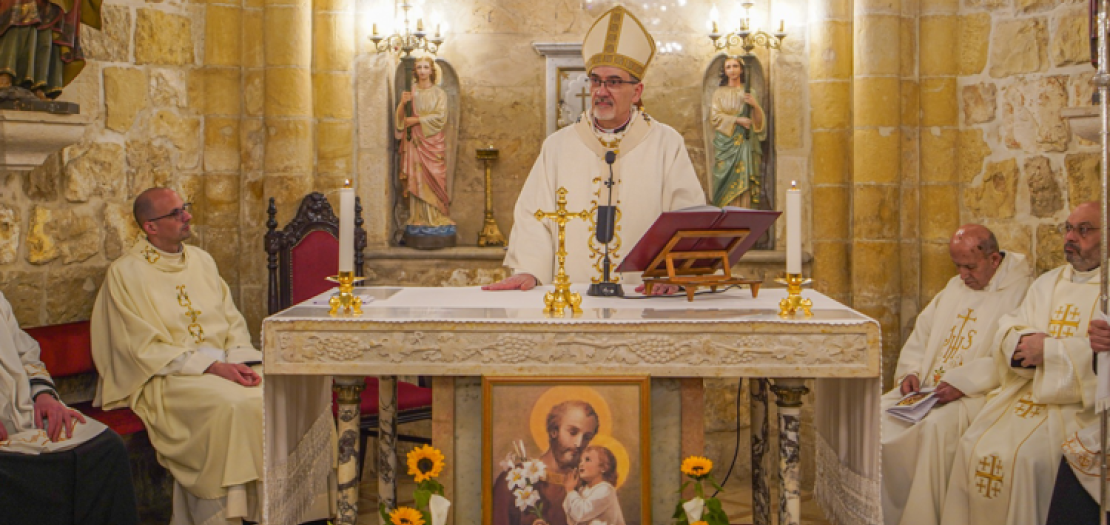
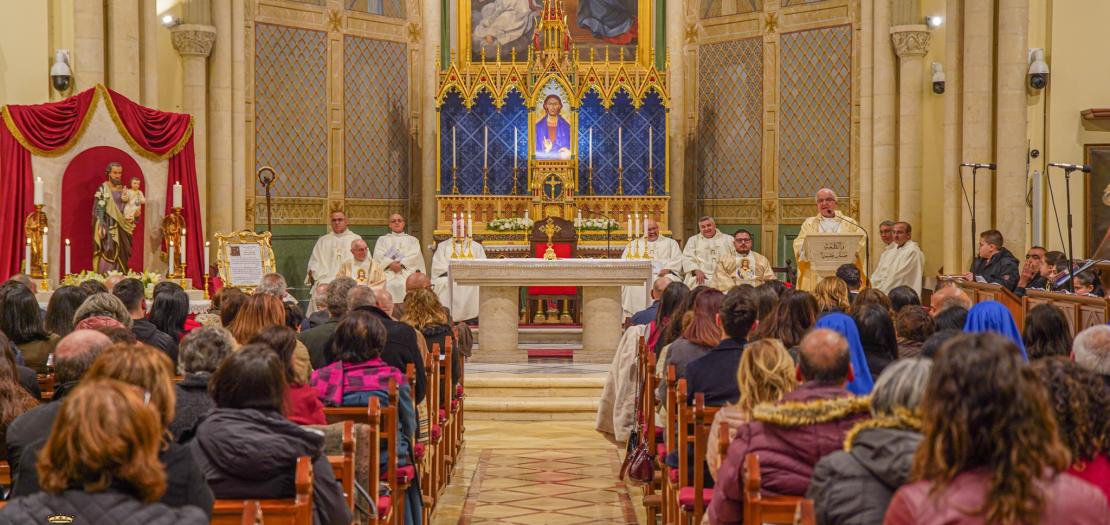
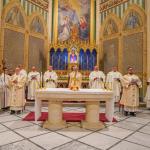
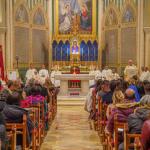
On Thursday, March 19, 2026, the Diocese of Jerusalem marked the Feast of St. Joseph with Eucharistic celebrations across its parishes. Particular solemnity was observed at the Latin Parish of Jifna and the Seminary of Beit Jala, both of which honor St. Joseph as their chosen patron saint.
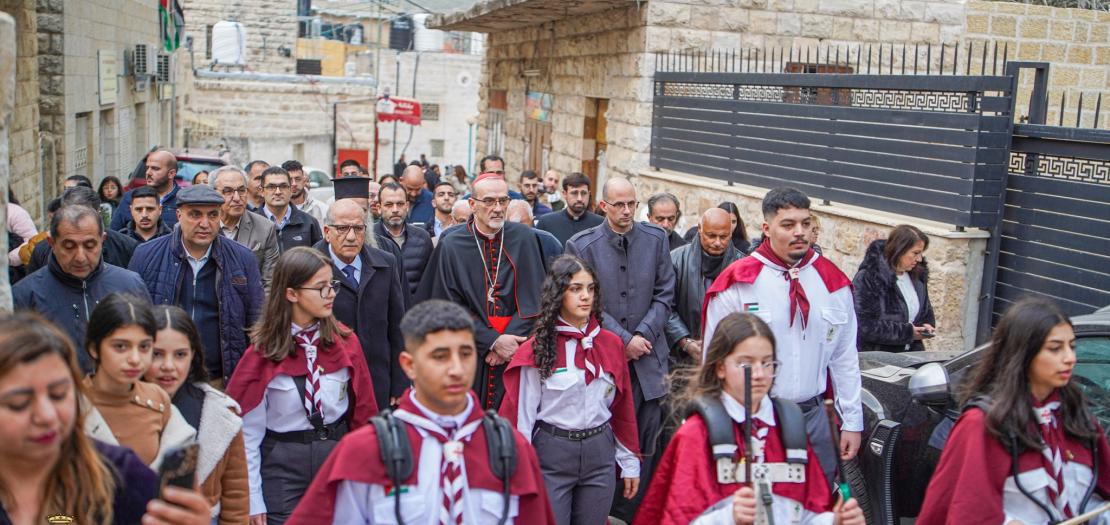
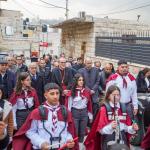
At the entrance of the village of Jifna, His Beatitude Cardinal Pierbattista Pizzaballa, Latin Patriarch of Jerusalem, was welcomed by Fr. Nadim Giacaman, the parish priest, accompanied by Fr. Ioannis Antoniou, pastor of the Greek Orthodox church, and Mr. Amjad Qarawi, the Chairman of Jifna Village Council. The community accompanied him in a solemn procession to the church, as parish scouts played symphonies.
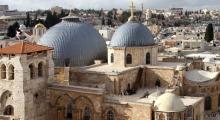
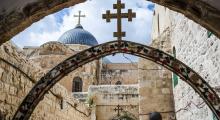
Before reflecting on the Gospel, the Patriarch noted that the celebration of the Mass brought to mind the experience of prayer at the Holy Sepulcher, where the liturgy is traditionally celebrated in Latin. He expressed his sorrow that, during this Lenten season, the Christian community has been unable to gather there due to its closure amid the ongoing war. “In Jerusalem,” he said, “Lent is marked by prayer at the Holy Sepulcher—it engages all the senses: the scent of the ancient stones, the touch of the oil, all of which help us to meditate on the Passion and prepare to celebrate the Resurrection. This year, however, we are experiencing another dimension of Lent—that of penance.”
He added that, in these prolonged and difficult times, it is essential to nourish one’s spiritual life and to guard the heart from being overwhelmed by the violence witnessed daily. “We must keep our hearts open to God and to others,” he urged, “That is why we must fix our gaze on Jesus, in order to remain steadfast.”
Turning to the figure of St. Joseph, the Patriarch reflected on how Joseph, like any man, had his own plans for life: he was betrothed to the Virgin Mary and had established his work as a carpenter. Yet these plans were suddenly overturned by the Annunciation of the Angel. “What is remarkable about St. Joseph is that he accepted to enter into a plan that was not his own,” he said.
He emphasized that, while much attention is often given to the obedience of the Virgin Mary, the obedience of Joseph is equally essential in the mystery of salvation. By accepting God’s plan, Joseph protected the Holy Family and remained faithful even in the face of trials. “Our lives, too, can be disrupted by circumstances we did not choose,” the Patriarch continued, “not only on a broader political level, but in our daily lives. The call is to remain faithful to God’s plan within them.”
He concluded by noting that such fidelity is not achieved by human strength alone, but through openness to the Word and the presence of God at work within us. In this Lenten season, he said, it is a grace to walk with the example of St. Joseph, who teaches us to trust in God’s providence in every circumstance.
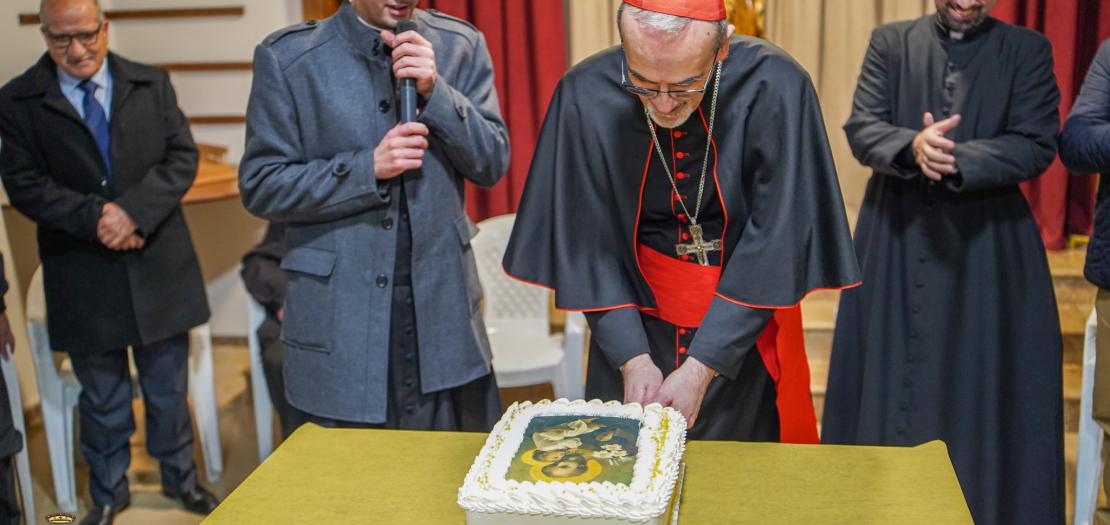
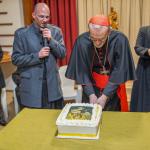
After the Mass, a small reception was held, during which the community had a time of communion with the patriarch and the clergy.
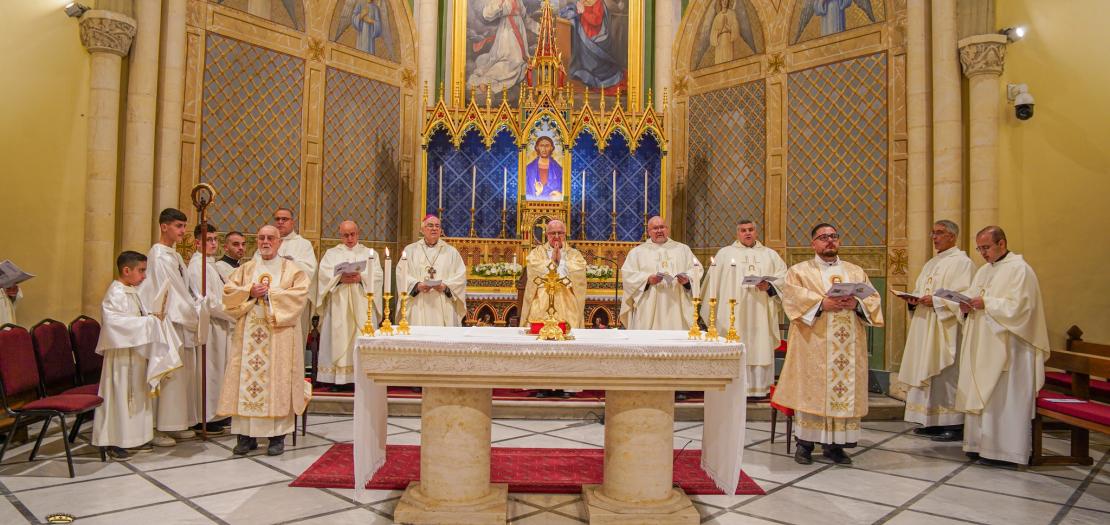
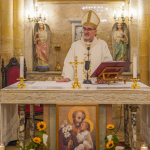
Meanwhile, at the church of the Annunciation in Beit Jala, Mgr. William Shomali, Patriarchal General Vicar, presided over the Mass, which was concelebrated by Mgr. Giacinto-Boulos Marcuzzo, Fr. Bernard Poggi, Rector of the Latin Patriarchal Seminary of Beit Jala, Fr. Hanna Mas’ad, parish priest of Beit Jala.
Recalling how St. Joseph became Patron of the Seminary, Fr. Poggi recalled that during the Gulf War in 1991, the bishops called for a time of prayer and fasting for peace. In response, the seminary students gathered the offerings they had set aside through their fasting and used them to create the now well-known mosaic depicting St. Joseph with the Child Jesus, with the seminary building in the background, invoking his intercession for the seminary and the wider region, marking the beginning of his patronage over the seminary.
Echoing that time, the faithful today once again invoke the intercession of St. Joseph, praying for peace to prevail in the region and for an end to violence.
In his homily, Mgr. Shomali emphasized that the example of St. Joseph is especially needed in this time, inviting the faithful to look to him and learn from his humility, hard work, obedience, and attentive discernment of the Word of God. He described Joseph as a man of action, who, upon hearing the voice of the angel, responded without hesitation. In this, he noted, Joseph reflects the constant call throughout the Old and New Testaments to listen to God’s voice.
“God still speaks to us today,” he said, “in many ways: through the Mass, the homily, moments of prayer, His providential care, and the people we encounter.” Echoing the words of the Patriarch, he went on to highlight Joseph’s profound obedience, describing it as a sign of true wisdom, an openness to God’s will, which always seeks our good. Joseph, he explained choosing not to follow the law rigidly, but to obey God’s voice even when it surpassed human understanding.
At the end, he underlined the strength of St. Joseph’s intercession for the Church, noting that although no words of his are recorded in the Gospels, his silent witness continues to speak powerfully, as he now watches over the Church with the same faithful care with which he protected the Child entrusted to him, from whose pierced side the Church was born.
In Galilee, Mgr. Rafiq Nahra, Patriarchal Vicar, presided over the Mass at the Latin Church of St. Joseph in Shafa’amr, concelebrated by Fr. Ramez Twal, with a limited number of faithful in attendance, in accordance with current government guidelines restricting gatherings to no more than 50 people.
All Masses were offered for peace, and for all families of the Diocese, especially for the fathers, whose role the Patriarch emphasized as crucial in the family, noting that a father is called not only to provide, but also to be a source of stability. He further underlined the importance of fathers who listen to the voice of God and act in obedience to it, particularly in these challenging times of war.