Issued by the Catholic Center for Studies and Media - Jordan. Editor-in-chief Fr. Rif'at Bader - موقع أبونا abouna.org

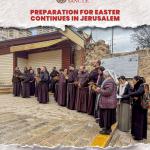
While the war in the Middle East imposes severe restrictions on the normal course of religious ceremonies, the Catholic community continues, within the permitted limits, to live the Lenten celebrations and pilgrimages in preparation for Easter.
On Wednesday, March 19, the stational Mass took place at the Shrine of the Flagellation. The following day, Thursday 19 March, Solemnity of Saint Joseph, some friars and faithful went to Nazareth to celebrate the patron saint of the universal Church.
Saint Joseph, a just and silent man, occupies a discreet yet essential place in the history of salvation. "He is not at the center of the scene, yet he is fundamental," was recalled by the Father Custos, Fr. Francesco Ielpo, during the homily, without his yes, without his concrete and obedient faith, the Son of God would not have found a home, a family, a name. Venerated also as a consoler of the poor and the suffering, Joseph continues to be for the local community a model of humility and trust.
The church dedicated to him in Nazareth is also known as the "Church of the Nutrition", because, according to tradition, it is the place where Joseph and Mary raised and cared for Jesus, in the simplicity of daily life.
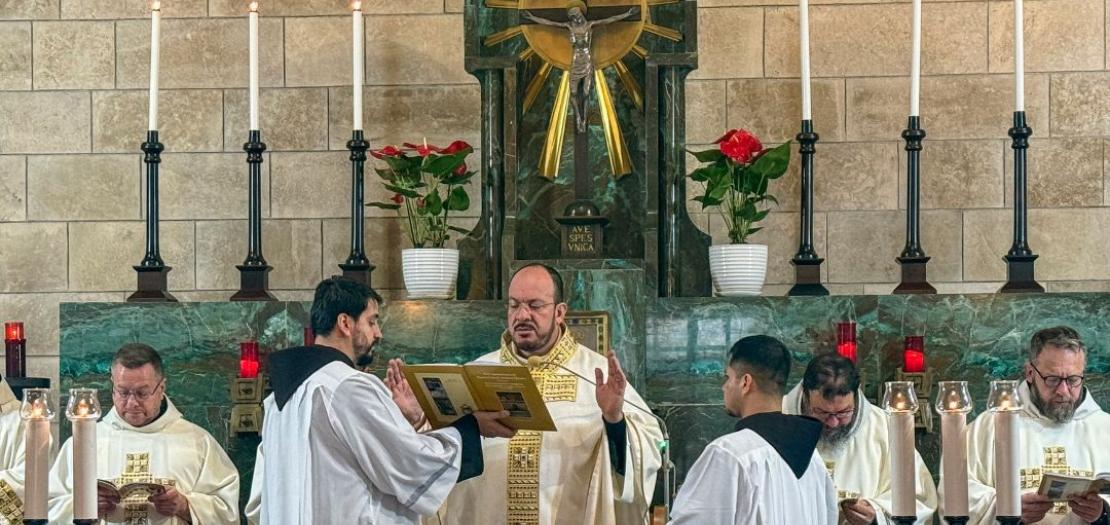
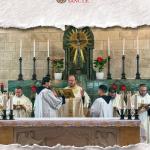
The Eucharistic celebration was presided over by Fr. Francesco Ielpo, who in his homily strongly recalled the words addressed by the angel to Joseph, "Do not be afraid." An invitation that, as was emphasized, God continues to address even today, in a time marked by war, fear and suffering. Like Joseph, people today often find themselves facing situations that are incomprehensible and not chosen, but it is precisely there that they are called to listen and to trust.
"Do not be afraid" thus becomes a living word for the communities of the Holy Land, for families marked by anguish and for hearts that struggle to hope. Joseph’s faith, which is expressed in simple and concrete obedience, "he did as the angel of the Lord had commanded him", indicates a possible path even today, that of making space for God’s action in one’s life.
In the current context, marked by ongoing conflicts, a strong invocation for peace was also raised. It was recalled that one must not resign oneself to violence nor become accustomed to the language of death, but must continue, without growing weary, to seek paths of dialogue, reconciliation and justice, placing at the center the dignity of every person, especially the weakest and most innocent.
On Friday 20 March, at dawn, the pilgrimage began toward the village of Bethany, traditionally identified as the village of Jesus’ friends, called in Arabic Al-Lazariye, from the name of Lazarus, as can be seen from the common root. Situated on the slopes of the Mount of Olives, along the road connecting Jerusalem to the Judean desert and to Jericho, Bethany preserves the memory of a deep friendship and of one of the most significant passages of the Gospel.
At the heart of the village stands the Franciscan church, which recalls the home of the Lord’s friends, while a few meters away is the tomb of Lazarus. As per tradition, the first Mass of the day was presided over by the Secretary of the Custody of the Holy Land, Fr. Alberto Joan Pari. Following this, the community gathered for the Eucharistic celebration presided over by Fr. Piermarco Luciano, preacher of the Lenten stational Masses for this year.
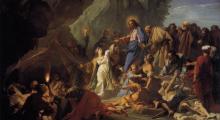
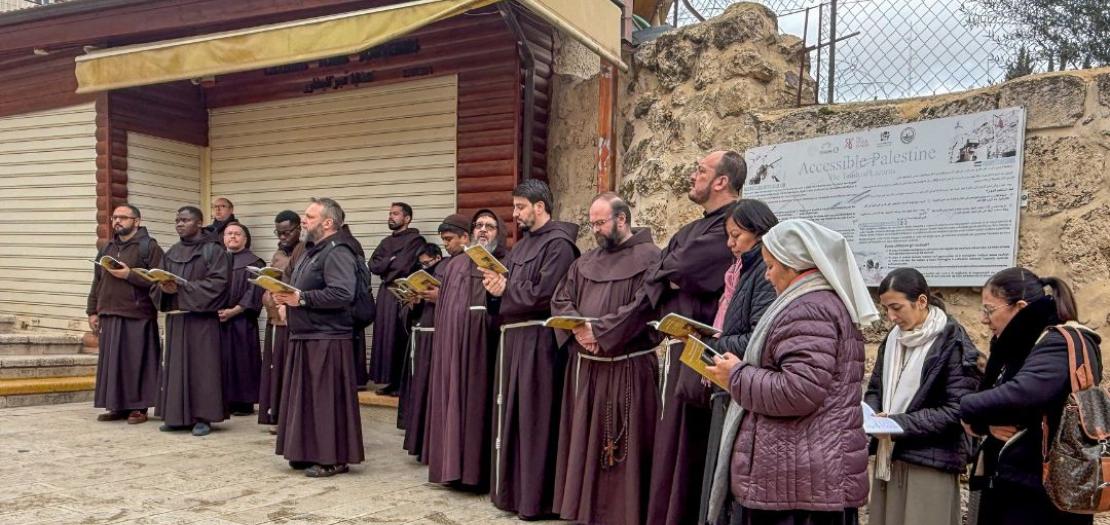
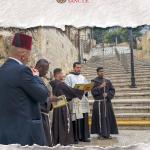
After the Mass, the friars and some religious sisters went in procession to the tomb of Lazarus, where the Gospel of his resurrection, (John 11,1-45) was proclaimed, a sign of hope and life even in the most trying situations.
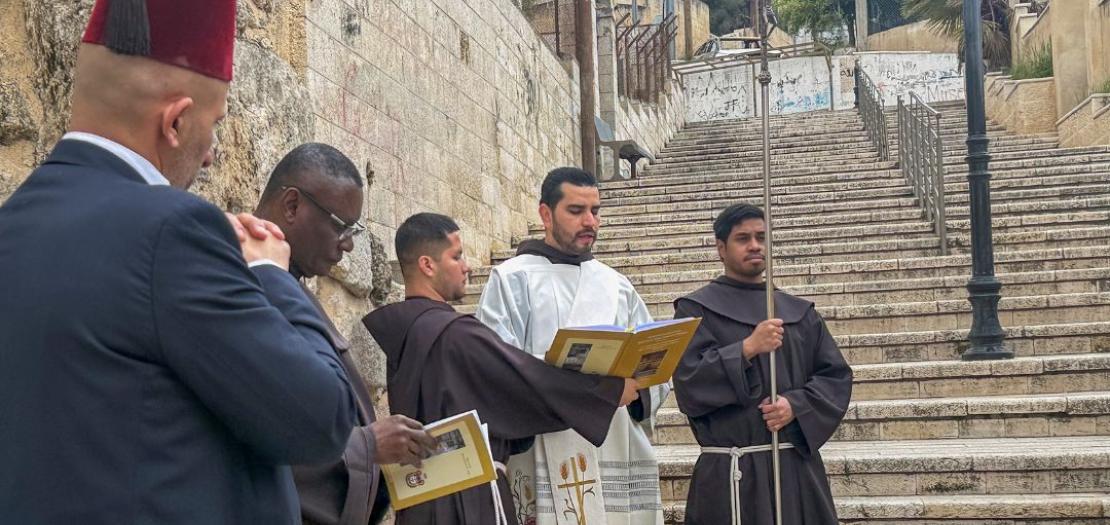
The pilgrimage then continued with visits to the sanctuaries of the Ascension and the Pater Noster, on the Mount of Olives, where the Gospel passages linked to these places were read. In the past this route was done on foot, since Bethany was only a few miles from Jerusalem. (John 11,18) Today, however, the separation wall has divided the territories of the West Bank, including Bethany, from Jerusalem, to complete this short itinerary it is necessary to travel several kilometers by car and pass through a checkpoint before reaching the Mount of Olives again.
In this journey marked by limits and difficulties, the witness of Saint Joseph continues to indicate a path, that of trust, courage and silent fidelity, while the Christian community perseveres in prayer and hope, invoking for the Holy Land and for the whole world the long-awaited gift of peace.