Issued by the Catholic Center for Studies and Media - Jordan. Editor-in-chief Fr. Rif'at Bader - موقع أبونا abouna.org

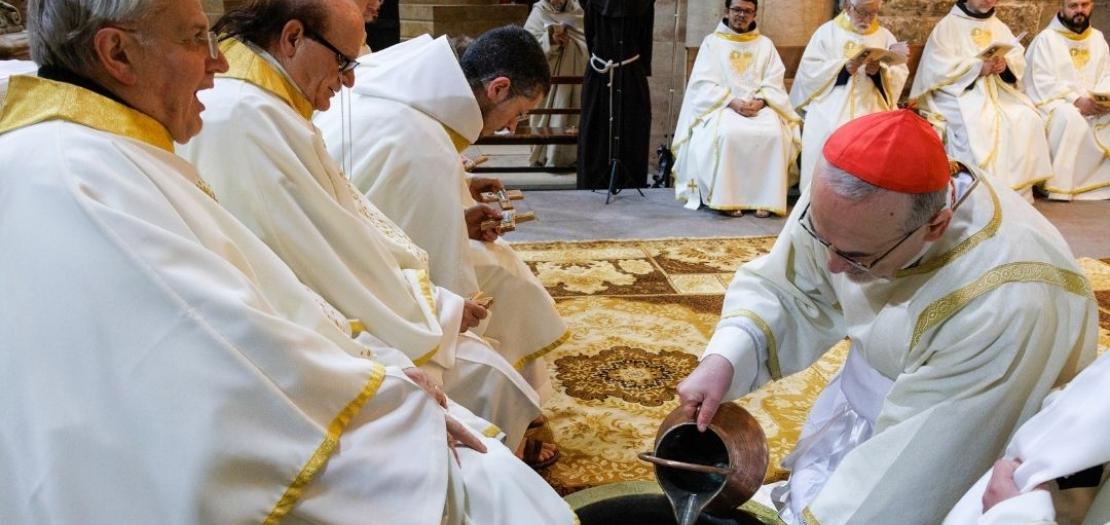
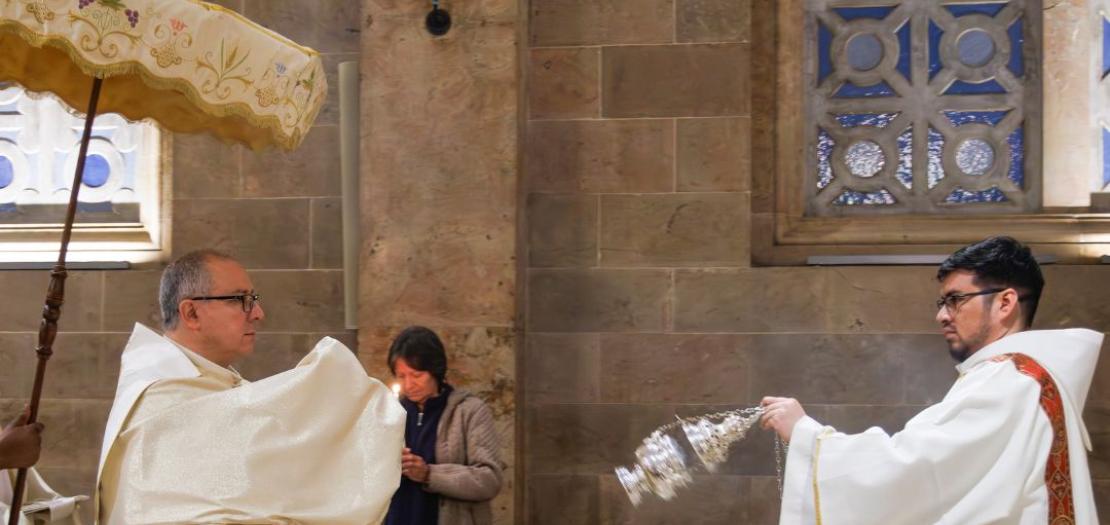
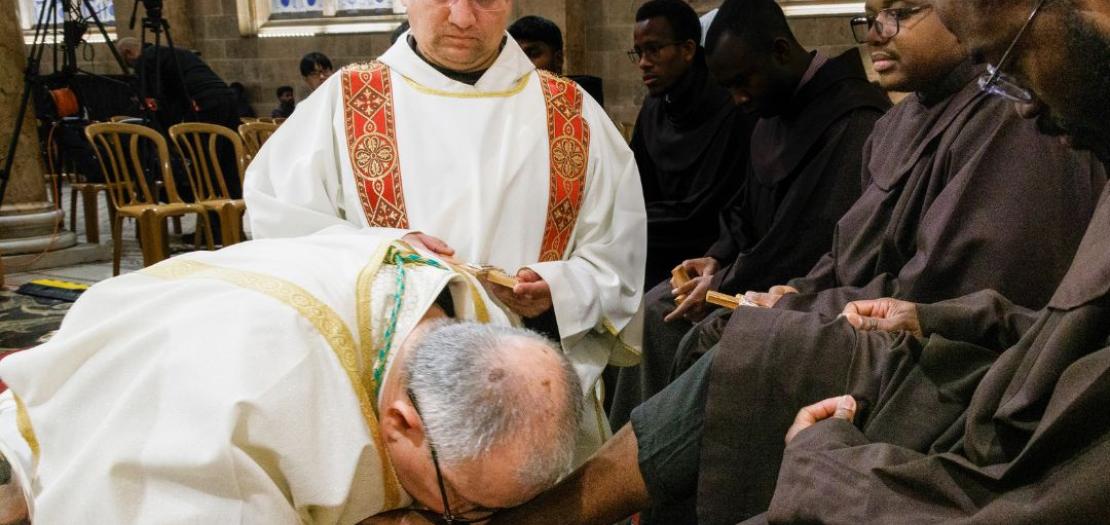
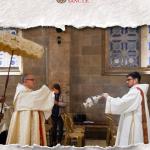
With Holy Thursday, in Jerusalem, the Sacred Paschal Triduum begins in the places of Redemption. According to the ancient norms regulated by the Status Quo, the Catholic community of the Latin rite celebrates a particularly long and intense liturgy in the morning, which combines in a single celebration the Chrism Mass of the Bishop with his clergy and the Mass in Cœna Domini, which in the rest of the world usually takes place in the evening.
This tradition, preserved over the centuries, arises from the need to respect the times historically granted to the Latin Church to celebrate in front of the Tomb of Christ, in the heart of the Basilica of the Holy Sepulcher.
It is in this context that, every year, the friars of the Custody of the Holy Land accompany and introduce the Latin Patriarch of Jerusalem, Cardinal Pierbattista Pizzaballa, called to preside over the celebration. At the entrance of the Holy Sepulcher, the President of the place, Fr. Giuseppe Gaffurini, welcomed him as prescribed by the Status Quo.
This year, however, the exceptional circumstances linked to the ongoing war and the security measures imposed by the local authorities, tightened after the events that occurred on Palm Sunday, have profoundly modified the course of the day. Access to the Basilica was strictly limited: only the Patriarch and four religious were able to enter and take part in the celebration, joining the friars who live in the Holy Sepulcher and who celebrated only the Mass in Cœna Domini.
The Chrism Mass, which the Patriarch celebrates together with all the diocesan clergy as a sign of communion and unity of the Church of Jerusalem, has been postponed to a date to be determined. It will be celebrated when the situation in the Country will again allow for a wider and safer participation.
In a climate of sobriety and prayer, the Holy Sepulcher nonetheless welcomed the beginning of the Triduum: an essential but profoundly significant liturgy, which renewed the mystery of the Eucharist and the love of Christ, in the very place of His Passion, Death, and Resurrection.
Another important appointment for the norms of the Status Quo was the delivery of the key of the Holy Sepulcher to the Vicar of the Custody, Fr. Ulize Zarza, by the Muslim families who keep it. This took place in the early afternoon at the headquarters of the Custody in the convent of Saint Savior, in fact, the friars have the right to keep the key and regulate access to the Basilica from the afternoon of Holy Thursday until the conclusion of the morning liturgy of Good Friday.
The representatives of the families who are custodians of the key, the Vicar, the Custodial Secretary, and the person responsible for the Status Quo then went down to the Basilica to await the entrance of the friars for the afternoon celebration in front of the tomb.
Unable to celebrate the great liturgies of the Paschal Triduum in the Basilica of the Holy Sepulcher, due to the limitations imposed in these days, the different religious communities present in Jerusalem organized more intimate celebrations in their own churches and in the places entrusted to their care.
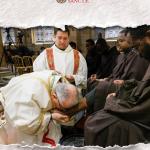
The friars of the Custody of the Holy Land, guided by the Custos, also chose to live the Sacred Triduum at the Basilica of Gethsemane, in the place where the Lord began His Passion with prayer and trustful abandonment to the Father. On the afternoon of Holy Thursday, at 5.30 pm, in an atmosphere of silence and deep prayer, the Franciscan community celebrated the Mass in Cœna Domini, with the rite of the washing of the feet, a sign of love that becomes service and of the humility of Christ, who bends over His disciples, as the Custos recalled in his homily.
At the end of the eucharistic celebration, the friars gathered for the traditional Holy Hour, keeping watch in prayer in memory of that dramatic hour in which the disciples were unable to stay awake beside the Master. The Custos, Fr. Francesco Ielpo, introduced the moment of prayer with these words: "After having recently celebrated the Lord's supper, we now enter with Jesus into the Garden of Olives. Ideally, in the Upper Room, we experienced a moment of great intimacy: Jesus at the table with His own, a friendship that reaches its peak just as the shadow of betrayal appears.
A love “to the end” that becomes even more true and stubborn because it is consumed in the context of betrayal; a gesture, that of the bread and wine, so great that the disciples cannot yet fully understand it. Yet, Jesus, precisely in this context, desires to be with them, with His disciples, with His friends. And now, in Gethsemane, He takes with Him the three closest, those who had been with Him on the mountain of the Transfiguration, and addresses to them and to us tonight a simple request: “Remain here and watch with me.” A request that surprises.
Does Jesus really need the company of men? Does He need men like us, who often do not understand, who get distracted, who get tired, who are fragile? Does He need men who shortly thereafter will flee, who will leave Him alone at the decisive moment? In the Garden of Olives, Jesus does not present Himself as a solitary hero, a strong leader who needs no one, but as a man who lives His humanity to the full.
Like every man who, in the hour of trial, feels the need for the closeness of a friend. He does not seek men to give Him the right advice, He does not ask for men capable of freeing Him from the trial, He does not demand the presence of strong men to protect Him: He simply asks not to be left alone.
This is perhaps one of the most surprising revelations of this night: God needs the company of man. He needs us, just as we are. And so we too can enter into this moment without masks, without pretending to be different from what we are. We can bring here our fatigue, our distraction, our fears, even our sleep.
We can bring a heart that perhaps has not yet understood everything, but that desires to stay. Because what matters, tonight, is not understanding everything, but being there. Remaining." Before the mystery of the agony of Jesus, who in Gethsemane pronounced His full and obedient "yes" to the will of the Father, the community entrusted the Holy Land and all those who suffer because of the war to the Lord, invoking the gift of peace.