Issued by the Catholic Center for Studies and Media - Jordan. Editor-in-chief Fr. Rif'at Bader - موقع أبونا abouna.org

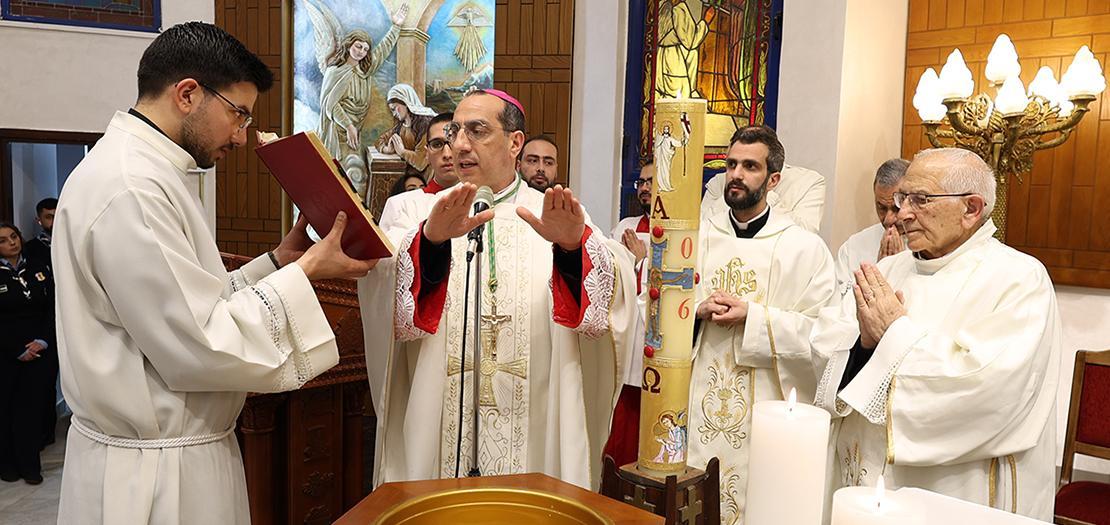
Churches in Jordan have celebrated the glorious Feast of Easter, with Holy Masses and prayers held marking Holy Saturday and Easter Sunday across various parishes, in the presence of large numbers of the faithful. The celebrations included readings and prayers that focused on the significance of the Resurrection as a call to hope and a renewal of life.
Latin Patriarchal Vicar for Jordan Bishop Iyad Twal celebrated the Easter Sunday Mass, which was concelebrated by parish priest, Monsignor Hanna Kildani, at the Church of St. Mary of Nazareth in Sweifieh, western Amman.
In his homily, bishop Twal said that “the Resurrection” is not merely a memory, but rather “a living reality capable of transforming our lives and the lives of our families.” He added that this represents “a transcendence from despair to hope, and from the old self into the new self in Lord Jesus Christ.”
Stressing that family is “the first place where we experience the Resurrection,” he called for turning homes into sites of hope by choosing dialogue over division, forgiveness over stubbornness, and love over indifference, as well as by preserving core values such as respect, solidarity, hospitality, commitment, and unwavering commitment to faith.
Concluding his homily, Bishop Twal offered a prayer for Jordan, asking the Almighty God to protect His Majesty King Abdullah II Ibn Al Hussein, His Royal Highness Crown Prince Hussein Ibn Abdullah II, and the extended Jordanian family, as well as to grant the homeland the continued grace of security and stability. He also called for prayers for the Middle East so as to transcend “from violence to peace, from injustice to justice, and from the culture of death to the culture of life.”
In a related context, Fr. Rif’at Bader, director of the Catholic Center for Studies and Media and pastor of the Sacred Heart of Jesus Church in Tla’ Al-Ali, celebrated Easter prayers, which were concelebrated by Fr. Ya’coub Dainuti in the presence of a large congregation of worshippers. In his homily, he stressed that “the commemoration of the death of Lord Jesus Christ and His glorious Resurrection constitutes the foundation of the Christian faith and its ever-renewing source.” He also noted that, during his visit to Turkey last December, His Holiness Pope Leo XIV emphasized that the eyes of the world would turn towards Jerusalem as the year 2033 approaches, marking the 2,000th anniversary since the Resurrection of Lord Jesus Christ, which gives the Holy City a renewed global spiritual significance.
Fr. Bader also referred to the recent closures affecting Jerusalem, especially amid the war, which impacted the Church of the Holy Sepulcher and Al-Aqsa Mosque, noting that opening the doors of these holy sites to worshippers is “a fundamental right for all believers.” He praised Jordan’s unstinting efforts to protect Islamic and Christian holy sites in Jerusalem in accordance with the Hashemite Custodianship, describing it as a “safety valve and protection for these sacred places.”
Speaking about Jordan, Fr. Bader noted that this year marks the 50th anniversary of the standardization of feast celebrations between Catholic and Orthodox churches. He described this as “a uniquely Jordanian distinction on a global level,” with many countries looking to this experience as a model to be emulated. He also commended the Jordanian government’s decisions to grant Christian citizens holidays marking Palm Sunday and the Feast of Easter, as well as the efforts of the Ministry of Higher Education to avoid scheduling examinations during these occasions, which reflects genuine respect for religious diversity.
He concluded his homily by adding that Jordanians, Muslims and Christians alike, live in unity and solidarity under the Hashemite leadership, led by His Majesty King Abdullah II Ibn Al Hussein and His Royal Highness Crown Prince Al-Hussein Ibn Abdullah II; and accentuated the importance of preserving and enhancing the blessing of security and stability through a shared sense of responsibility. He also praised the efforts exerted by the security forces stationed at church entrances to share in the joy of the blessed feast celebrations.