Issued by the Catholic Center for Studies and Media - Jordan. Editor-in-chief Fr. Rif'at Bader - موقع أبونا abouna.org


The rebirth of Notre Dame has unfolded not only as a chapter of architectural restoration but also as a cultural and spiritual resurgence that few in Paris anticipated with such magnitude. Twelve months after the cathedral’s long-awaited reopening, the unmistakable verdict of the public has emerged: the restored monument now stands as the most visited site in the French capital, surpassing the Louvre, the Eiffel Tower, and every other emblem of the city’s heritage.
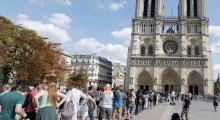
The reopening late last year was not merely a ceremonial moment. It marked the end of a long, painstaking reconstruction effort following the 2019 fire that had shocked France and drawn the gaze of the world. On the evening of December 7, 2024, Archbishop Laurent Ulrich presided over the solemn liturgy that returned the cathedral to active life. What followed in the months after speaks to something larger than tourism: over 11 million people crossed its threshold between December 2024 and December 2025, a number Paris had never before witnessed for any cultural or religious site.
The daily influx has averaged more than 30,000 visitors, an extraordinary flow reflecting a diversity of motivations—pilgrimage, curiosity, architectural fascination, or the simple desire to stand once more in a place that embodies centuries of French history. Before the fire, Notre Dame drew approximately 9 million visitors per year. Its renewed vitality now surpasses even that record, and by a wide margin.
Part of this renewed energy arises from a decision that was far from unanimous within political circles: to keep admission entirely free. Despite pressure from Culture Minister Rachida Dati, who advocated for a ticketing system to offset state-funded restoration costs estimated at 700 million euros, the Church maintained that a cathedral cannot operate as a conventional museum. Its doors, Church leaders argued, must remain open in the fullest sense—spiritually accessible, culturally available, and economically barrier-free.
The rebirth of Notre Dame has unfolded not only as a chapter of architectural restoration but also as a cultural and spiritual resurgence that few in Paris anticipated with such magnitude. Twelve months after the cathedral’s long-awaited reopening, the unmistakable verdict of the public has emerged: the restored monument now stands as the most visited site in the French capital, surpassing the Louvre, the Eiffel Tower, and every other emblem of the city’s heritage. The reopening late last year was not merely a ceremonial moment. It marked the end of a long, painstaking reconstruction effort following the 2019 fire that had shocked France and drawn the gaze of the world. On the evening of December 7, 2024, Archbishop Laurent Ulrich presided over the solemn liturgy that returned the cathedral to active life. What followed in the months after speaks to something larger than tourism: over 11 million people crossed its threshold between December 2024 and December 2025, a number Paris had never before witnessed for any cultural or religious site. The daily influx has averaged more than 30,000 visitors, an extraordinary flow reflecting a diversity of motivations—pilgrimage, curiosity, architectural fascination, or the simple desire to stand once more in a place that embodies centuries of French history. Before the fire, Notre Dame drew approximately 9 million visitors per year. Its renewed vitality now surpasses even that record, and by a wide margin.
Part of this renewed energy arises from a decision that was far from unanimous within political circles: to keep admission entirely free. Despite pressure from Culture Minister Rachida Dati, who advocated for a ticketing system to offset state-funded restoration costs estimated at 700 million euros, the Church maintained that a cathedral cannot operate as a conventional museum. Its doors, Church leaders argued, must remain open in the fullest sense—spiritually accessible, culturally available, and economically barrier-free.
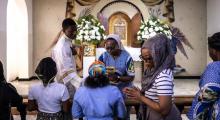
For many believers, these moments testified that the cathedral had regained not only its architectural integrity but its spiritual role as a place where France and the wider Catholic world gather in prayer during significant events. The balance between its religious vocation and its cultural magnetism—always delicate in a site with global visibility—has taken on a renewed clarity now that the restoration is complete.
Yet the most striking aspect of Notre Dame’s return is perhaps the simplest: after years of scaffolding, debate, and uncertainty, the people came back in greater numbers than ever. The cathedral has resumed its place not merely as a masterpiece of Gothic architecture, but as an essential landscape of collective memory, a space where tourists and pilgrims cross paths without needing to explain why they came.
Its sudden ascent to the top of Paris’s most visited destinations is therefore more than a statistical curiosity. It signals the restoration of a symbol—one that Parisians and visitors alike are determined to reclaim, inhabit, and keep alive.
Notre Dame is once again the beating heart of the city.