Issued by the Catholic Center for Studies and Media - Jordan. Editor-in-chief Fr. Rif'at Bader - موقع أبونا abouna.org

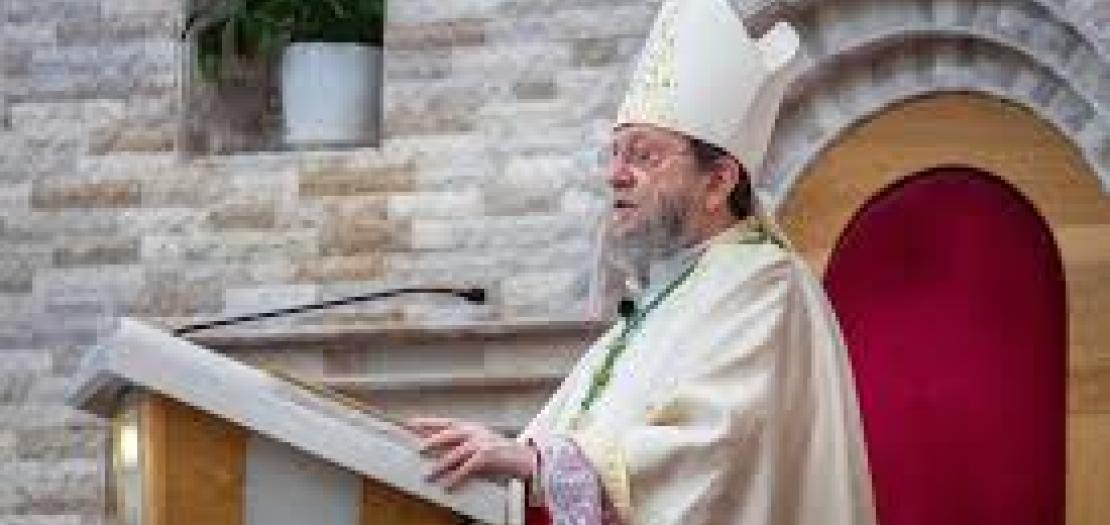
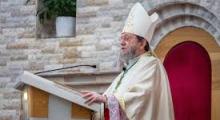
Following is the text of the homily by Bishop Paolo Martinelli marking the Feast of the Assumption in the UAE, dated March 25, 2026:
Dear faithful,
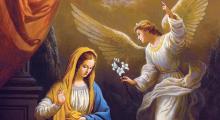
Having almost reached the end of my pastoral visit, today we celebrate the solemnity of the Annunciation of the Lord. It is a truly radiant feast and a source of consolation. Indeed, today we celebrate the moment when the Word of God, through the angel's announcement, bowed before the Virgin Mary and knocked on the doors of freedom of this woman of Nazareth, betrothed to Joseph.
The dialogue between Mary and the Angel Gabriel moves us deeply because it manifests God's love for humanity, the tenderness and closeness of the Almighty toward humanity in our painful condition.
In Mary, the prophecy uttered by Isaiah is fulfilled: a virgin will conceive a son. It is a sign of God's intervention, which, on the one hand, fulfills the promises and, on the other, constitutes a new beginning in the history of salvation.
Mary is surprised by the words of Angel Gabriel. She is full of Grace, beloved by God, filled with his favor and predilection. Mary is chosen to be the mother of the Savior. But the angel's words trouble her; she wonders what they mean. They are not ordinary words. They are words that mark a calling, a vocation, a responsibility in the history of salvation.
When the angel reveals to her God's plan and that she will be the mother of the Son of God, Mary does not doubt; she asks the angel because she wants to understand how it is possible. She knows, in fact, that she is only a humble servant. But the angel reassures her: do not be afraid; he reveals to her the working of the Holy Spirit within her. Mary has found grace with God. Then the angel tells her about her cousin Elizabeth, who was thought to be barren, but is now six months pregnant; in her womb she carries John, the precursor of Jesus. At this point, Mary appears convinced. She saw that truly nothing is impossible for God. Her freedom opens up and takes the form of total surrender, of unconditional acceptance of the Word of God. Mary thus becomes Mother of God through the power of the Holy Spirit.
Jesus takes his human nature from Mary, takes her son's body. That body he will one day give in the Eucharist, the same body that will be given on the altar of the Cross for us, comes from Mary. In this way, God and humanity will be forever united. Divinity and humanity will forever be indivisible, without confusion. He is our savior, because in Jesus, as we confess in the Creed, is true God and true man. He took upon himself our human nature through the Virgin Mary's "yes."
Therefore, dear faithful, we look towards Mary with immense gratitude because from her came our savior. Furthermore, the Virgin Mary upheld our freedom so that we may accept God's will. Mary is full of Grace, the Immaculate One, the first redeemed, and for this reason she was able to pronounce her "yes" so fully and completely.
Our freedom, however, is always wounded, marked by sin, often filled with doubts and fears that hold us back. Therefore, we ask Mary to support our fragile freedom so that we too may pronounce our "yes" that makes us participants in redemption and make us witnesses of Jesus in the world.
I invite you to recite the Angelus prayer every day, even three times a day. It is the prayer with which we remember the moment when the Word of God entered the world, in the womb of the Virgin, to make his home among us forever.
The words of Sacred Scripture are repeated in this beautiful prayer. First, we recall the announcement: The angel of the Lord declared to Mary. This reminds us that the initiative is God's. We reply by saying, 'and She conceived of the Holy Spirit.' Everything is grace! Then we remember Mary's response: 'Behold, the handmaid of the Lord; be it done onto me according to your word.' We can see here the deep and simple availability of Mary. Her freedom is completely open before God.
And finally, we remember the solemn words from the beginning of the Gospel of John: 'and the Word was made flesh. And since then, he has dwelt among us:' as then in Mary's womb, so today he is among us in the Eucharist, in the unity of the Church, among all believers, in the poor, and in the hidden folds of history.
Saint Francis of Assisi, whose relic in Saint Joseph’s Cathedral is accompanying us in these days of pastoral visits, affirmed that every day the Son of God humbles himself; just as in the Annunciation he descended from the Father's bosom into the Virgin's womb, so every day he descends onto the altar into the hands of the priest.
By celebrating the feast of the Annunciation, we celebrate God's presence among us; just as the Word became flesh through Mary's "yes," so today his presence continues through all who recognize and welcome him.
May the Virgin Mary help us to say our 'Yes' so that through us the word of God may continue to be announced in the world.