Issued by the Catholic Center for Studies and Media - Jordan. Editor-in-chief Fr. Rif'at Bader - موقع أبونا abouna.org

Following is the text of the meditation by His Beatitude Cardinal Pierbattista Pizzaballa, Latin Patriarch of Jerusalem, marking the 19th Sunday of ordinary time, dated August 9, 2026:
This Sunday’s Gospel reading (Mt 14:22–33) concludes with a solemn profession of faith: "Truly, you are the Son of God." (Mt 14:33)
Yet this profession of faith comes at the end of the second account by the evangelist Matthew, which recounts a storm on the Sea of Galilee, a storm in which the disciples and Jesus find themselves caught up. The first account of the storm ended with a question: "What sort of man is this, whom even the winds and the sea obey?" (Mt 8:27) The second account offers an answer to that question: He is truly the Son of God!
From this we can deduce that faith has a great deal to do with storms. And that one storm is not enough to arrive at the answer; at least two are needed, where "two" stands for many. The first storm serves to prompt us to ask the right question; all the others bring us closer to the answer. The storm, therefore, is an important stage in the lives of the disciples.
Proof of this can be found in the first verse of our passage, where we read that Jesus "compels" the disciples to get into the boat ("Then he made the disciples get into the boat". (Mt 14:22) Why does he compel them? Perhaps because, on their own, the disciples would never have decided to cross the lake, let alone face the storm. Yet it is precisely the storm that is necessary for their growth: it is not enough to have witnessed the miracle of the loaves; (Mt 14:13–21) now they must learn to recognise the Lord in the darkness; they must learn to trust.
But how does one arrive at this profession of faith? How does one come to believe? It seems to me that today everything revolves around one word: to dare. To dare does not refer to a heroic gesture or a leap into the unknown. To dare is the response to a presence, to the presence of the Lord who draws near.
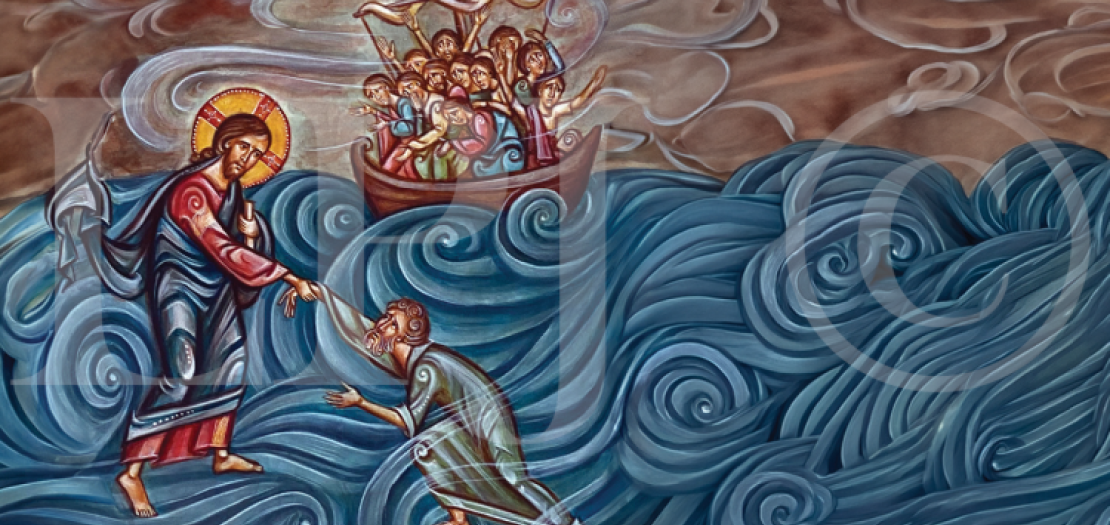
The one who dares, in this passage, is Peter. Like the others, he is in the midst of the storm; like the others, he cries out in fear when he sees Jesus coming towards them; like the others, he mistakes him for a ghost; and like the others, he hears the words with which Jesus reaches out to them: "Take courage, it is I; do not be afraid." (Mt 14:27)
Peter’s daring springs precisely from this word of the Lord, from recognizing the One who is approaching the boat by walking on the water. Peter dares, first and foremost, to step outside the logic of fear. For fear, in Scripture as in life, is not merely a feeling, but a way of interpreting reality. It does not merely describe how one feels or what the heart experiences; it also shapes one's understanding of the world. Peter does not remain a slave to fear; he does not allow the threat of the storm to determine his life, and he trusts the Lord’s voice more than the voice of the waves.
Then Peter dares to ask: he dares to ask an impossible question, one that pushes the limits of human nature a little further. Peter dares to ask to share in God’s life, in his victory over death: "Lord, if it is you, command me to come to you on the water." (Mt 14:28) He does not merely ask to be saved from the storm; rather, he asks, in the midst of the storm, to live as the Lord lives.
Then Peter dares to take a step out of the boat. He leaves the boat—that is, the place of his abilities and skills. He leaves what is familiar, he leaves the strategies he knows so well, and he dares to do something seemingly impossible, something truly new. And when, in the midst of this journey of daring, Peter allows himself to be overcome by fear and begins to sink, even then he dares. He dares to believe that the Lord can always save him, in the midst of any storm, and he dares to cry out in prayer: "Lord, save me!" (Mt 14:30) He dares to believe that the Lord will not abandon him in his unbelief.
In the disciples’ final profession of faith there is an important expression: truly. "Truly, you are the Son of God!" (Mt 14:33) Those who remain on the shore, those who do not dare to set sail into the open sea, those who do not face the storm, can at best say, "perhaps", "it seems to me", or "I have heard it said". The "truly", by contrast, is born of experience—of those who dare to believe and to trust, of those who are not content with what is already known, and of those who do not remain prisoners of the logic of fear.
Those who dare discover that the Lord’s presence is stronger than evil, and they come to recognise him as the Son of God, the Saviour of their own lives and of the lives of all people.
+Pierbattista