Issued by the Catholic Center for Studies and Media - Jordan. Editor-in-chief Fr. Rif'at Bader - موقع أبونا abouna.org

Following is the text of the meditation by His Beatitude Cardinal Pierbattista Pizzaballa, Latin Patriarch of Jerusalem, marking the 22nd Sunday of ordinary time, dated August 30, 2026:
Today’s Gospel reading (Mt 16:21–27) concludes with an important verse, which serves as a key to understanding the rest of the passage.
The context follows immediately from last Sunday’s events: at Caesarea Philippi, Jesus asks his disciples what people think of him and what they themselves think. And it is Peter, speaking on behalf of all, who recognizes Jesus as the Christ, the Son of the living God. (Mt 16:16)
At this point, a new phase in the relationship between Jesus and his disciples begins: today, we see that Jesus begins to speak to his disciples about the painful death that awaits him (“he must go to Jerusalem and suffer greatly from the elders, the chief priests, and the scribes, and be killed and on the third day be raised.” (Mt 16:21) This is the first of the three announcements of the Passion and Resurrection that Jesus will make on his journey to Jerusalem.
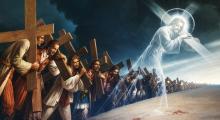
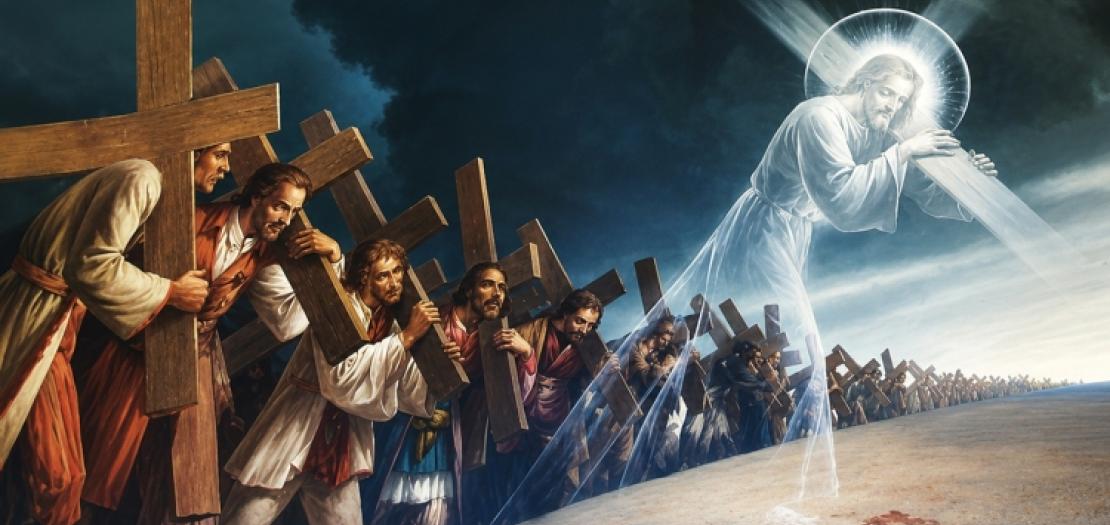
Now, following Peter’s negative reaction—he cannot even imagine this possibility (“God forbid, Lord! No such thing shall ever happen to you,” (Mt 16:22) Jesus broadens the discussion to explain that the way of the cross, the way of a life given in love, is not just for Jesus: it is for all who follow and love him; it is the way of the disciple and of the Church; it is the way of life.
And so he adds this concluding sentence, on which we shall dwell: “For the Son of Man will come with his angels in his Father’s glory, and then he will repay everyone according to his conduct.” (Mt 16:27)
There is something strange about this: Jesus is present, and yet he says that he is to come. He speaks of a new coming, in which it will not simply be he who comes, but he will come in the glory of the Father, with his angels. And that is not all. He also states that this coming will mark a turning point in the whole of history, and will be a time of judgement in which people’s deeds will be revealed and each person will receive according to their deeds.
This means that this mysterious and painful death of which Jesus is speaking will not be the end of history, but rather its fulfilment. Jesus has just spoken of his death and Resurrection, and immediately goes on to speak of his coming, as if to say that it is precisely this death that will make his definitive coming into history possible. Furthermore, he adds that this coming will make it possible to judge the truth of every event.
For it is precisely Easter that will be the criterion for discerning what enters into Life and what remains outside; what endures forever and what, on the other hand, cannot endure for eternity.
Jesus explains this a few verses earlier: everything that has been lost for love’s sake will enter into life, and therefore will not know death: “For whoever wishes to save his life will lose it, but whoever loses his life for my sake will find it” (Mt 16:25).
Anything that is kept for oneself out of fear of losing it will bear no fruit.
Anything that is given will not, in reality, be lost, for the Father, who sees in secret, will safeguard every act of love and, as we have seen in verse 27, will reward it, giving to each according to their deeds.
Reward according to one’s deeds is not an accounting statement. It is the revelation of what each person has built through their freedom, the manifestation of what a person has become by following Jesus and embracing his logic, which is the logic of Easter.
This image of reward is often found in the Gospel according to Matthew.
We find it in Matthew 6:1–18, where the Father “sees in secret and will reward you”. Here, the reward is the manifestation of the heart, of what has been lived before God, and not before men.
We find it in Matthew 10:40–42, where we read that “whoever gives even a cup of cold water… will not lose their reward”. The reward is the revelation of every act of mercy, even the smallest.
And we find it in Matthew 25:31–46, in the great scene of the judgement.
In all these cases, the reward is the truth of love which, quite simply, comes to light in the end.
It is the fulfilment of what we have begun to experience of God in this life: not something that comes later, but what blossoms from what is now beginning to grow.
One final point: in Matthew, the reward is always described as a form of participation: it is a matter of entering into the joy of the Lord, of sitting at the table of the Kingdom, of being called “blessed by my Father”… It is not a prize: it is a communion that opens up and is fulfilled.
And those who, like Peter and like each one of us, struggle to embrace this logic of gift-giving remain, in some way, outside the relationship with the Lord and must set out once more on the journey, following him (“…turning to Peter, he said, ‘Get behind me…’” (Mt 16:23), to learn the logic of Easter, to see where the path of those who lose their lives for love leads.
+Pierbattista