Issued by the Catholic Center for Studies and Media - Jordan. Editor-in-chief Fr. Rif'at Bader - موقع أبونا abouna.org

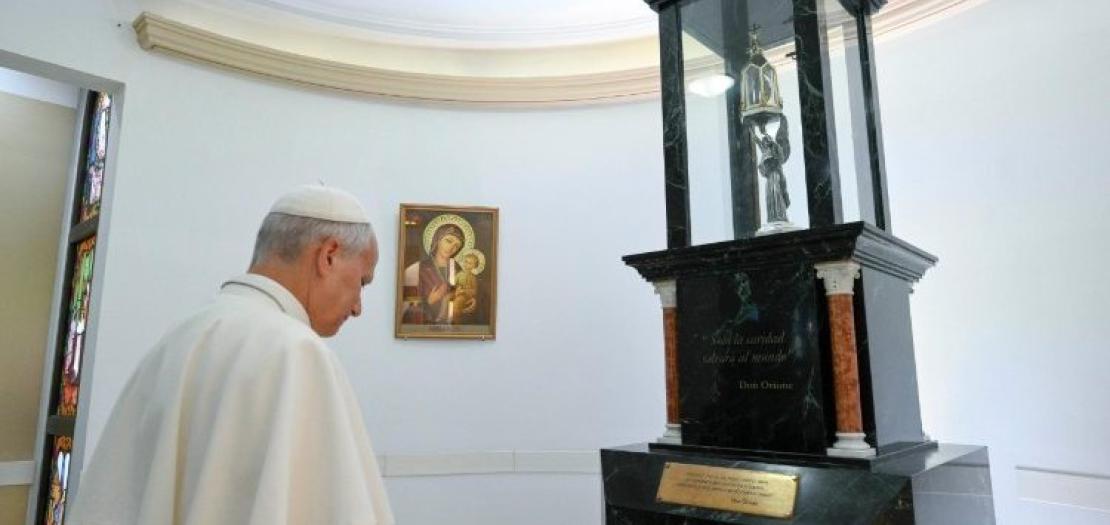
The logo chosen for the Argentine leg of Pope Leo XIV’s Apostolic Journey to Latin America gives visual expression to the many Saints and the Blessed of a country with a long Christian tradition and a history of welcoming others.
Small, stylized human figures of different shapes, sizes, and shades of color form a ring like the petals of a flower. They all turn toward the white cross at the center, a symbol of the kerygma that the people of God believe and proclaim.
This unity in diversity inspires a Church that continues to say “Bienvenidos a todos” (“Welcome, everyone”), as the motto of the visit puts it. It extends that welcome especially to the poor, the sick, migrants, and the weak, whom the Pope calls “rejected stones” in his encyclical Magnifica humanitas.
Enrique Ernesto Shaw: Bringing Gospel into industry
At his meeting with the world of work on Monday, November 9, at the Catholic University of Argentina in Buenos Aires, the Pope recalled the Venerable Servant of God Enrique Ernesto Shaw, describing him as a “Catholic businessman who experienced conversion after discovering the beauty of the Gospel.”
Born in Paris on February 26, 1921, into a deeply devout Argentine aristocratic family, Venerable Shaw lost his mother at just four years old. He joined the Navy at 16 and in 1943 married Cecilia Bunge, with whom he had nine children.
During a trip to the United States in 1945, he discerned a particular vocation to bring the Gospel into the world of industry, in which his family was involved through the company Cristalerías Rigolleau.
After becoming its managing director, he became known for his personal rapport with workers. “To judge a worker, you must first love him,” he would say.
In 1952, he founded the Christian Association of Business Executives and worked to promote a Christian understanding of the economy and social responsibility. He was also active in Catholic Action, the Christian Family Movement, and numerous works of apostolate and solidarity.
In 1957, he was diagnosed with a malignant tumor. Despite his illness, he continued working tirelessly in business, the Church, and society until his death in Buenos Aires on August 27, 1962, at just 41.
Mamerto Esquiú: Service in diocese and in politics
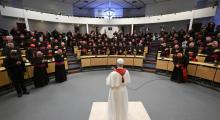
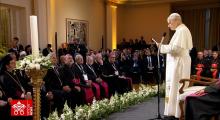
At Vespers on November 9 with the Bishops and synodal teams at the Metropolitan Cathedral of the Most Holy Trinity, the Pope spoke of “the witness of distinguished Argentine Bishops who devoted themselves to working for unity and peace.”
Among them was Blessed Mamerto Esquiú, who was born on May 11, 1826, in San José de Piedra Blanca.
In 1841, he entered the novitiate of the Friars Minor of the Province of the Assumption, making his religious profession a year later. He was ordained a priest on October 18, 1848.
Esteemed for his piety and moral integrity, he served as a deputy and a member of the governing council of Catamarca between 1855 and 1862.
In 1862, he moved to Bolivia as a missionary. Two years later, he was called to teach at the seminary in Sucre. In 1880, Pope Leo XIII appointed him Bishop of Córdoba, bringing him back to Argentina. He was ordained a bishop on December 12 of that year.
In the diocese, he was known for his deep life of prayer, his spiritual and material assistance to the poor, and his pastoral zeal and charity.
He trained seminarians, founded confraternities and associations of the faithful, preached retreats in the Spiritual Exercises, and led missions for the people. He died on January 10, 1883, in Posta del Suncho.
Enrique Angelo Angelelli Carletti: A voice against exploitation
At Vespers on November 9, the Pope also recalled Blessed Enrique Angelo Angelelli Carletti, who was killed along with three religious companions because of his tireless efforts to promote Christian justice.
Angelelli Carletti was born on July 17, 1923, in Córdoba. He entered the seminary in 1938 and continued his formation in Rome, where he was ordained a priest on October 9, 1949.
On returning to Argentina, he taught canon law and public ecclesiastical law at the seminary and carried out pastoral work at the Cathedral of Córdoba. He also provided spiritual support to young workers through his work with the Young Christian Workers.
He was appointed Auxiliary Bishop of Córdoba in 1961, and in 1968 St. Paul VI appointed him Bishop of La Rioja.
In his pastoral work, he paid particular attention to the poor and the rural community. He readily denounced injustice, abuse, and exploitation in public, often coming into conflict with those who wanted to protect their privileges and drawing fierce opposition and criticism as a result.
During his ad limina visit to Rome in October 1974, Pope Paul VI encouraged him to continue his work and make public gestures of clemency to help ease tensions. After the military coup in 1976, the persecution of Angelelli and his collaborators grew more overt and violent.
He died on August 4 as a result of a car crash near Punta de los Llanos. His death was long presented as an accident.
On July 4, 2014, however, an Argentine criminal court found that it had been a murder carried out as part of the military dictatorship’s repression.
Eduardo Francisco Pironio: A champion of World Youth Day
The third Argentine Blessed mentioned by Pope Leo XIV at Vespers on November 9 was Cardinal Eduardo Francisco Pironio.
He was born on December 3, 1920, in Nueve de Julio, into a family of Italian immigrants. He entered the seminary in La Plata in 1932 and was ordained a priest on December 5, 1943, at the Shrine of Our Lady of Luján, where the Pope celebrates Mass on November 11 in the square in front of the basilica.
Blessed Pironio studied in Rome at the Pontifical University of St. Thomas Aquinas. After returning to Argentina, he was appointed Auxiliary Bishop of La Plata in 1964 and was ordained a bishop in the Basilica of Luján on May 31 of that year.
He went on to hold important posts in the Church in Latin America, serving first as secretary and then as president of CELAM, the Latin American and Caribbean Episcopal Council.
He contributed significantly to the preparation and proceedings of the 1968 Medellín Conference in Colombia, which was crucial to the renewal of the Church in Latin America.
In 1972, he became Bishop of Mar del Plata. He then returned to Rome at the request of Pope Paul VI, who appointed him Pro-Prefect of the Congregation for Religious and Secular Institutes in 1975.
Pope Paul VI created him Cardinal in 1976, and St. John Paul II later confirmed him in his post at the Congregation.
In 1984, he was appointed President of the Pontifical Council for the Laity and focused its work on formation, communion, and participation. He took a particular interest in young people and played a decisive role in the beginnings and development of World Youth Day.
That same year, he was diagnosed with prostate cancer. Despite his illness, he continued his ministry with great dedication. He died in Rome on February 5, 1998. His remains were later transferred to the Marian shrine in Luján, Argentina.
José Gabriel del Rosario Brochero: The priest of the Sierras Grandes
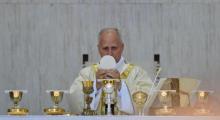
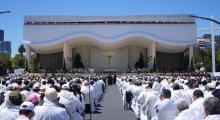
Córdoba featured repeatedly in the Pope’s remarks and in the lives of the saints he cited. It was fitting, then, that Pope Leo XIV celebrated Mass on November 10 on the grounds of the Military Aviation School and recalled many other distinguished figures of the Argentine Church.
Among them was St. José Gabriel del Rosario Brochero, whom Pope Leo’s predecessor, Pope Francis, canonized in St. Peter’s Square on October 16, 2016.
Pope Francis said of him, “He stayed with the people and tried to bring many of them to the Spiritual Exercises. He traveled mile after mile through the mountains on his mule.”
The Saint was born in the province of Córdoba, in Carreta Quemada, on March 16, 1840. The fourth of ten children, he grew up in the countryside and farmed with his family.
In 1856, he entered the Seminary of Our Lady of Loreto and was ordained a priest on November 4, 1866. After his first pastoral assignments at the Cathedral of Córdoba, he was appointed parish priest of the vast San Alberto region in the Sierras Grandes. Its 4,336 square kilometers were home to just over 10,000 people, isolated from one another at elevations above 2,000 meters.
The cura, or parish priest, devoted himself entirely to his people, bringing men and women to take part in the Spiritual Exercises. The 200-kilometer journey took three days on muleback. The caravans often numbered more than 500 people and were caught in severe snowstorms on several occasions.
After nine days of silence, prayer, and penance, the faithful would return with changed lives, following the Gospel and working for the region’s social and economic development.
In 1875, he promoted the construction of a retreat house for the Spiritual Exercises, which welcomed more than 40,000 people over the years. He also worked to secure postal services, telegraph links, and new infrastructure.
Through his frequent contact with the sick, he contracted leprosy. He died from the disease on January 26, 1914, in Villa del Tránsito, the town now named Villa Cura Brochero in his honor.
Héctor Valdivielso Sáez: First Argentine saint
In Argentina, the Pope also recalled the example of the country’s first saint, Héctor Valdivielso Sáez. He was born in the capital on October 31, 1910, into a Spanish immigrant family of modest means.
He was baptized at the Church of Saint Nicholas of Bari in central Buenos Aires, on the site now occupied by the famous obelisk that has become a symbol of the city.
He discerned his religious vocation in Spain, where his family had returned because of financial difficulties. He joined the Congregation of the Brothers of the Christian Schools, founded by Saint John Baptist de La Salle, and attended its missionary novitiate in Lembecq-lez-Hal, Belgium. He took the religious name Benito de Jesús and was first assigned to the Lasallian school in Astorga, in the Spanish province of León.
From there, he was transferred to Asturias, where the religious community of Turón fell victim to the violent unrest of the 1934 revolution.
St. Héctor Valdivielso Sáez was imprisoned with seven other Brothers of the Christian Schools and the Passionist priest Manuel Canoura Arnau. They were shot on the night of October 9–10 by a firing squad brought in from far away for the purpose, as no one in the country was willing to commit such a crime.
María Antonia de Paz y Figueroa: Argentina’s first woman saint
At Mass, Pope Leo XIV also mentioned Argentina’s first woman saint, María Antonia de Paz y Figueroa, known as “Mama Antula.”
She was born in 1730 in the province of Tucumán, into a prosperous and deeply Christian family. She was drawn to Ignatian spirituality from a young age.
In 1745, she took the habit of a Jesuit “beata” and made private vows. She devoted herself to spreading the Spiritual Exercises, traveling from village to village and organizing them with great care and effectiveness.
Her work bore fruit chiefly in changes in conduct, as people gave up vices and vanities. It also encouraged the growth of the priesthood and of both men’s and women’s religious life. In just eight years, she offered the Spiritual Exercises to 70,000 people.
In 1779, after traveling 3,000 kilometers on foot among the cities of Jujuy, Salta, Tucumán, Catamarca, La Rioja, and Córdoba to prepare the Spiritual Exercises, Mama Antula settled in Buenos Aires.
She walked about another 1,500 kilometers to reach the city and soon earned the esteem and trust of the bishop, who granted her several broad faculties. She introduced devotion to Saint Cajetan, which is widespread in Argentina today.
Through her perseverance and the help of many benefactors, she established a house in Buenos Aires for the Spiritual Exercises that still exists today. Her work was entrusted to a group of consecrated women who went on to found the Institute of the Daughters of the Divine Savior. She died in Buenos Aires on March 7, 1799.
Nazaria Ignacia March Mesa: Initiatives ahead of their time for women and the poor
Speaking about peace, a subject dear to him, Pope Leo XIV mentioned the Blessed martyrs of the Spanish Civil War and those of the Argentine provinces of La Rioja and Salta.
He also recalled St. Nazaria Ignacia March Mesa, who was born in Madrid, Spain, on January 10, 1889. From childhood, she showed a deep religious sensibility, though she faced temptations and difficulties in adolescence.
After spending time in Mexico with her family, she met the Sisters of the Abandoned Elderly. Moved by their vocation, she decided to enter the institute. After overcoming her family’s opposition, she began her religious life on December 7, 1908. She completed her novitiate in Palencia, Spain, and made her first vows on October 15, 1911.
The following year, she was sent with nine other sisters to the community in Oruro, Bolivia. For more than 12 years, she devoted herself entirely to caring for the elderly, while the social conditions in Bolivia stirred a new calling in her.
At the time, the country had few priests and no locally founded religious communities. There were religious sects, and the country faced a complex economic, political, and social situation.
After years of discernment, the future saint left the institute and, at the direction of the Bishop of Oruro, went to the Beaterio of the Nazarene Sisters to found the Institute of the Missionary Crusaders of the Church.
Mother Nazaria added two particular commitments to the three traditional religious vows. She pledged love and obedience to the Pope and total dedication to spreading the Kingdom of Christ. Her initiatives were ahead of their time, including soup kitchens for people who had lost their jobs.
When the war with Paraguay claimed Bolivian lives from 1933 to 1935, she and her sisters stayed close to soldiers, the wounded in hospitals, and orphans in residential schools, sustaining their faith with the sacraments.
In 1934, she founded the first women’s trade union, the Society of Catholic Women Workers. The institute’s work expanded as new communities opened in Bolivia, Uruguay, Spain, and Argentina. In 1932, she endured violent persecution in Oruro because of her work for the Church. During the Spanish Civil War in 1936, she and her sisters were in danger of being shot by a firing squad.
Although her health was very fragile, Mother Nazaria sailed for Buenos Aires on October 6, 1942, to attend her institute’s general chapter. She died in the Argentine capital on July 6, 1943.
María del Tránsito Cabanillas: Serving children in need
The Pope recalled the work of Blessed María del Tránsito Cabanillas, who was born on August 15, 1821, in Santa Leocadia, now Carlos Paz, in the province of Córdoba. The third of eleven children, she grew up in a deeply devout family and showed a particular religious sensibility from a young age.
After her father’s death in 1850, she moved permanently to Córdoba with her family and often visited the poor and the sick. After her mother died in 1858, she entered the Secular Franciscan Order.
In 1872, she moved to Buenos Aires and entered the Carmelite monastery. The rigorous ascetic practices and her physical difficulties took a toll on her health, forcing her to leave the cloister in 1874. Encouraged by several Franciscans and supported by benefactors, she took up again her plans to found a congregation dedicated to educating and caring for children in greatest need.
On December 8, 1878, in San Vicente, Córdoba, she founded the Congregation of the Franciscan Missionary Sisters of Argentina. It grew quickly and opened several schools and other educational institutions.
Worn down by her daily labors and rigorous ascetic practices, she died on August 25, 1885, at the age of 64.
Catalina de María Rodríguez: The “rebel” who founded first women’s congregation devoted to apostolic life
“She was married first. After she was widowed, she consecrated herself to God and devoted herself to the spiritual and material care of the poorest and most vulnerable women.”
That is how Pope Francis, who beatified her on November 25, 2017, described St. Catalina de María Rodríguez, whom Pope Leo XIV also recalled on his journey to Argentina.
Born on November 27, 1823, in Córdoba, she grew up in an aristocratic family that was very active in politics. From a young age, she developed a deep religious sensibility that took shape in a dream of founding the country’s first women’s congregation devoted to apostolic life.
At the time, the only institutes for women were contemplative. She had to wait several years to follow her vocation. She married a widower in the military and lost a daughter in childbirth. She lovingly cared for her husband’s first two children as their mother until he too died.
Her desire to consecrate herself to the Lord returned with renewed fervor. At 42, she began an entirely new life, which is why she is remembered as a “rebel.” Shortly before she died on Easter night in 1896, Mother Catalina told her sisters in the Congregation of the Handmaids of the Heart of Jesus, which she had founded, “My daughters, I commend to you peace, obedience, and holy charity.” By then, she had fulfilled her dream.
María Ludovica de Angelis and the call to “do good, whoever it’s for”
The Pope mentioned Blessed María Ludovica de Angelis, who was born on October 24, 1880, in San Gregorio, in the Italian region of Abruzzo. She entered the Congregation of the Daughters of Our Lady of Mercy on November 14, 1904.
In 1907, she sailed for Argentina, where she was assigned to the Children’s Hospital in Buenos Aires. She devoted herself entirely to caring for sick children and was known for her kindness, generosity, humility, and tireless spirit of service.
That spirit is reflected in a saying attributed to her, “Do good to everyone, whoever they may be.” She secured substantial funding for operating rooms and for the young patients, as well as new equipment, a building in Mar del Plata for children to recover, a church that now serves a parish, and a thriving farm in City Bell.
She died on February 25, 1962. The hospital was later named in her honor.
María Angélica Pérez: “Sister Dulzura,” and her care for people with tuberculosis
Pope Benedict XVI described Blessed María Angélica Pérez, whom Pope Leo XIV mentioned, as a “model of Gospel gentleness animated by faith.”
She was born on August 17, 1897, in San Martín, into a deeply religious family of Spanish immigrants. Educated by the Sisters of Mary Most Holy of the Garden, she developed a strong faith and felt drawn from a young age to consecrate her life to God.
That desire was fulfilled in 1915, when she entered the congregation. After making her perpetual vows in 1919, she was transferred to Mar del Plata, where she spent three years caring for girls with tuberculosis. She was then sent to Vallenar, Chile, where she continued to serve with generosity and humility, helping in various aspects of community life.
Although her health deteriorated after she contracted tuberculosis in 1930, she continued to live her consecration with serenity, gentleness, and love. Her gentle nature and kindness earned her the affectionate name “Sister Dulzura” (“Sister Sweetness”).
She died on May 20, 1932, at just 34. In 1986, her remains were transferred to the chapel of Our Lady of the Garden School in Pergamino.
Artemide Zatti: The nurse who reached the poor by bicycle
The Pope also recalled the example of St. Artemide Zatti, who was born on October 12, 1880, in Boretto, in the Italian province of Reggio Emilia.
As a child, he learned the value of sacrifice. Financial difficulties led his family to emigrate to Argentina, where they settled in Bahía Blanca. There he discerned his Salesian vocation and joined the Bernal community.
When he contracted tuberculosis, he entrusted himself to Mary Help of Christians and promised to devote his life to caring for the sick. He recovered unexpectedly.
He acted on that intention on February 8, 1911, when he made his perpetual profession as a Salesian lay brother. He kept his promise by devoting himself entirely to the mission hospital in Viedma, where he became a nurse, then deputy director, and finally head of the hospital.
His mission extended beyond the hospital. He cycled to the poorest and most isolated homes, bringing medicine and care to anyone who needed them. He offered his services free of charge and made himself available at any time of day and in any weather. He lived by the Salesian motto “Work and temperance.”
In 1950, he was diagnosed with a serious form of cancer. He continued his mission for as long as his strength allowed, facing his suffering with faith and serenity. He died in Viedma on March 15, 1951, surrounded by the affection and gratitude of the people.
Ceferino Namuncurá: The first Indigenous Blessed in Latin America
The Pope also recalled Blessed Ceferino Namuncurá, the first Indigenous person in Latin America to be beatified.
He was born in Chimpay on August 26, 1886, and was baptized two years later by the Salesian missionary Father Milanesio. The priest had mediated a peace agreement between the Indigenous Mapuche people and the Argentine army, enabling Ceferino’s father to keep his title of “Grand Cacique” and retain the territory of Chimpay for his people.
After first attending a state school in Buenos Aires, he went to the Salesian Pius IX School, where he developed a deep Christian faith.
Two experiences were decisive for his spiritual growth. The first was reading the life of Saint Dominic Savio, whose example he followed fervently. The second was receiving his First Communion, through which he developed a deep friendship with Jesus.
“What would I like most? To be a priest,” he said of his hopes. Tuberculosis, which he contracted during his Salesian formation, prevented him from fulfilling that wish. In the hope of finding suitable treatment, he was accompanied to Italy by Cardinal Archbishop Giovanni Cagliero, a missionary of Don Bosco’s congregation.
The young man’s presence attracted considerable interest. Pope Pius X received him in a private audience and gave him a medal as a sign of his goodwill. Despite treatment, the illness prevailed. He was admitted to Fatebenefratelli Hospital in Rome and died on May 11, 1905, at just 18.
Laura Vicuña: “Death rather than sin”
Another young Blessed honored by the Pope was Laura Vicuña, born in Santiago, Chile, on April 5, 1891. After losing her father at the age of two, she moved to Argentina with her mother and attended a school run by the Salesian Sisters.
In 1902, she privately took vows of poverty, chastity, and obedience. “Death rather than sin,” she would say firmly, impressing others with her extraordinary determination.
She died very young on January 22, 1904. Her remains are venerated in the chapel of the Daughters of Mary Help of Christians in Bahía Blanca, Argentina.