Issued by the Catholic Center for Studies and Media - Jordan. Editor-in-chief Fr. Rif'at Bader - موقع أبونا abouna.org

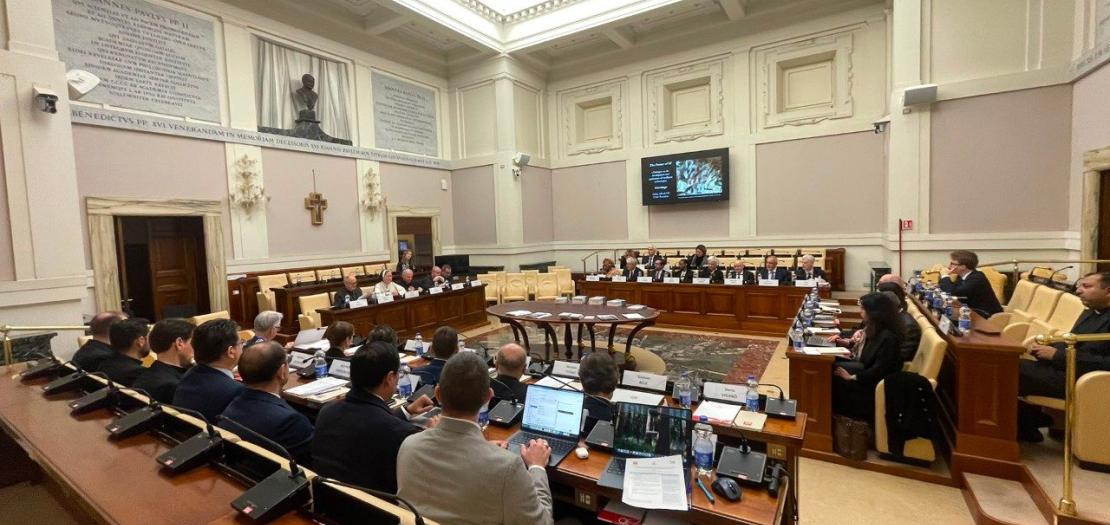
International experts on artificial intelligence joined representatives of the Holy See at the Vatican on Friday, October 30, for a dialogue on the future of AI and its implications for human dignity.
Meeting at the Casina Pio IV on October 30, participants examined how to preserve human control over increasingly autonomous systems and ensure technological progress remains at the service of the human person and the common good.
The meeting, entitled The Future of AI: A Dialogue Between the Vatican and the Scientific World on the Developments and Applications of Intelligent Technologies, was organized by the Pontifical Academy for Life and the Future of Life Institute, an independent organization that studies the risks of advanced technologies.
Its aim was to foster dialogue between the scientific community and the Interdicasterial Commission on Artificial Intelligence, chaired by Cardinal Michael Czerny, on the anthropological, ethical, and social consequences of innovation.
The dialogue followed the approach of Magnifica humanitas, the encyclical Pope Leo XIV published on May 15 on safeguarding the human person in the age of artificial intelligence.
The encyclical calls for technological progress to be regarded as something other than an end in itself, and for the primacy of human conscience and freedom to be protected.
The proceedings were opened by Sister Helen Alford, President of the Pontifical Academy of Social Sciences, and Cardinal Czerny. Archbishop Renzo Pegoraro, President of the Pontifical Academy for Life and the RenAIssance Foundation, introduced the scientific session.
Sr. Helen Alford gave a brief review of the warning from Catholic social teaching against concentrating AI’s technological and economic power in only a few people.
"Social justice is not only a goal to be safe after technologies are deployed, but a condition that must shape their very design from the outset," she said.
Cardinal Czerny emphasized the need for the Commission to engage with the scientific world and with Church communities already affected by the transformations brought about by AI.
“We are very keen to pass from words and ideas to possible policies and actions,” he explained, identifying two fundamental questions: “Who should do what? How can we encourage and even help them to do it?”
For Archbishop Pegoraro, the challenge is to preserve “clearly identifiable human responsibility” and translate ethical principles into concrete mechanisms for verifying and governing technologies. Underlying these concerns are questions about work, freedom, inequalities, and the relationship between innovation and human dignity.
The dialogue brought together scholars with differing assessments and proposals.
They included Max Tegmark, a physicist at the Massachusetts Institute of Technology and Chair of the Future of Life Institute; Stuart Russell, a professor at the University of California, Berkeley; Gary Marcus, a cognitive scientist at New York University; and Valerie Pisano, President and CEO of Mila, a Canadian artificial intelligence research institute.
Mr. Russell issued a particularly stark warning about the direction taken by leading developers, who are working to create machines with capabilities exceeding those of human beings.
According to the scholar, this trajectory poses extreme risks to our survival. We must therefore “turn aside from this trajectory before it is too late” and develop systems guaranteed “to remain under control.”
Mr. Tegmark warned against transferring decision-making power to machines, recalling predictions by some leading technology executives that “AI will be in charge, not humans.”
The MIT physicist acknowledged that, through “strong moral leadership,” the Vatican could help steer technological development onto a “better pro-human path.”
Among the points raised was the need to ensure systems are safe by design, with binding rules and independent assessments, accompanied by international coordination to prevent differences in legislation from enabling irresponsible behavior.
Participants also stressed the importance of involving governments, the scientific community, young people, and civil society in decisions, preventing control of AI from remaining concentrated in a few companies.
Fr. Paolo Benanti, a professor at LUISS University and Scientific Director of the RenAIssance Foundation, addressed this point.
“For years we have agreed on principles,” he observed. What is needed now are “rules that bind, institutions able to verify, and a person who answers for every decision a machine helps to make.”
Another central theme was the value of “living intelligence”: creativity, emotions, relationships, memory, compassion, and moral responsibility, all dimensions of human experience that cannot be reduced to an algorithm’s performance.
Concern was expressed about the use of autonomous weapons, the possible attribution of consciousness, legal personhood, and rights to artificial systems, and the risk of developing intelligences capable of escaping human control.
In this context, the Church is recognized as having a role in providing ethical guidance, translating the principle of human dignity into concrete technological and political choices.
The aim is not to halt progress but to guide it, so that humanity retains its freedom, responsibility, and ability to decide.
The conference concluded with a screening of Moloch, a short film written and directed by Tom Cozens and produced by Owl In Space in association with the Future of Life Institute.
The film explores the risks of a race to develop artificial intelligence in which economic competition takes precedence over consideration of the human consequences.
As the director explained, the film’s “villain” is not artificial intelligence itself, but the incentives that drive individuals and companies to develop and deploy it even when they recognize its dangers.