Issued by the Catholic Center for Studies and Media - Jordan. Editor-in-chief Fr. Rif'at Bader - موقع أبونا abouna.org

After visiting Lebanon: "I want to visit Algeria," Pope says
After several days of being away from Italy, Pope Leo XIV returned to Rome following days he spent in Turkey and Lebanon. In Turkey, he commemorated the 1,700th anniversary of the convening of the Council of Nicaea, the first gathering that brought together bishops from around the world, at the time which obviated a doctrinal schism in the Church. The Pope and his accompanying group left for Iznik, the current name of Nicaea where he met with Church leaders, crowds of the faithful, monks, and nuns, as well as with Muslim brethren during his visit to the Blue Mosque (or Sultan Ahmad Mosque.
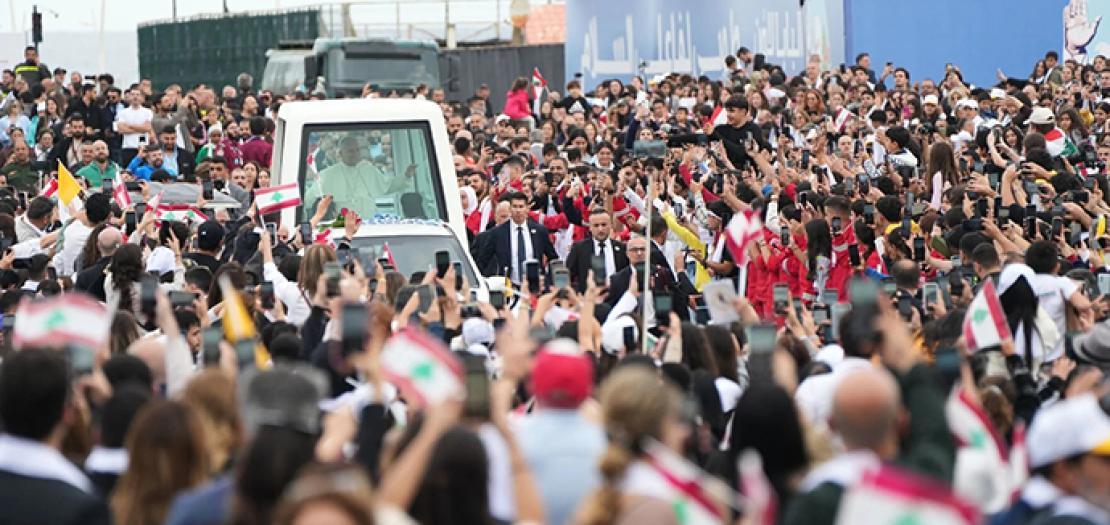
However, the most impressive part of the trip was his arrival in fraternal Lebanon, where he spent three days sowing seeds which call for activating "courageous "pastoral work within churches, and "courageous" common living between Christians and Muslims, and "courageous" arduous work for peace, as the theme of the visit was quoted from the Holy Bible: "Blessed are the peacemakers."
The enthusiasm was gargantuan at every carefully chosen venue for the Pope's visit, namely from the airport to the Presidential Palace, to the Apostolic Nunciature, to the Grotto of Saint Charbel, to the Grotto of Our Lady of Lebanon in Harissa, to the Maronite Patriarchate in Bkerke, to downtown Beirut, to the Port of Beirut, and to the Holy Mass at the waterfront.
I had the honor to greet His Holiness the Pope and to tell him, "The next visit will be to Jordan, God willing." He smiled and said, "I hope so." This took place in Martyrs' Square in Beirut, where the ecumenical meeting was held which brought together patriarchs of Catholic and non-Catholic Churches, as well heads of followers of religions in the presence of Sunni, Shiite, Druze, and Alawite communities. Every leader addressed the gathering, which was enlivened by Muslim and Christian children singing songs of love and peace, during which the Pope made an address emphasizing common living and its importance for building the Lebanon of tomorrow and the future.
This gathering was a source of pride, as we witnessed a motley of communities of Lebanon expressing unity, positivity, and loving towards one another. Many whispered to me, wishing that the Lebanese would always remain as such, and I replied that God is all-mighty. The Pope did not solve all the complexities of political and economic life with a magic wand, but at least he sowed good seeds. After having offered a silent prayer at the site of the Beirut Port explosion which took place years ago, he met with several families of the victims, as well as with the sick who were suffering both physically and spiritually at the Monastery of the Cross. He concluded his homily at the Mass, attended by over 150,000 people, by saying: "O “Lebanon, stand up. Be a home of justice and fraternity. Be a prophetic sign of peace for the whole of the Levant,”
Many thanks are conveyed to the Lebanese brethren who mapped out a magnificent image by preparing for and holding this historic visit. Many thank are also conveyed for the dignified welcoming and farewell extended to the Pope. Many thanks are also conveyed for the warm welcome extended to the Jordanian delegations participating in the meeting who accompanied His Excellency Jordan's Ambassador Walid Al-Hadid to greet President General Joseph Aoun and First Lady Nemat Aoun, who played a prominent role in preparing for the visit, as well as other political and religious leaders in Lebanon, during which the expression of love for Jordan, its leadership, and its people was palpable.
We will meet again on a papal visit to another Arab country, which the Pope alluded to during his return journey, namely our sister nation, Algeria, to resuscitate the brilliance of the thought of the Algerian, one of the most important philosophers and theologians in history, namely Saint Augustine. This is something that I anticipated several months ago as, hardly any speech by Pope Leo, who for many years was head of the Augustinian Order, is devoid of a quote from Saint Augustine, bishop of Annaba (formerly known as Hippo Regius), and referred to as the Jewel of the Algerian East.