Issued by the Catholic Center for Studies and Media - Jordan. Editor-in-chief Fr. Rif'at Bader - موقع أبونا abouna.org

Human fraternity in the thought of Pope Francis and Sheikh Al-Azhar
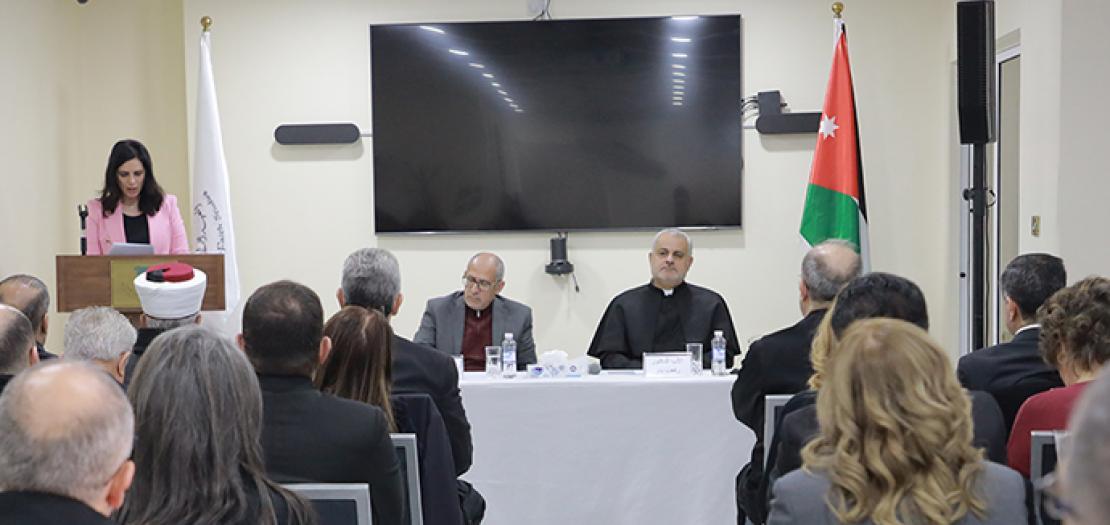
At a seminar marking the International Day of Human Fraternity and the World Interfaith Harmony Week, organized by the Royal Institute for Inter-Faith Studies (RIIFS), I delivered a speech reflecting on the late Pope Francis’ vision of human fraternity based on my own experience and on my follow-up of current Church affairs, particularly its openness towards followers of other religions, and the Islamic religion in particular.
The opening of the seminar included a welcoming address by RIIFS Director Dr. Taghreed Oudeh who greeted the attending bishops, priests, religious leaders, Muslim scholars, and all those committed to interfaith dialogue. Next to me, Dr. Amer Al-Hafi spoke about fraternity in the thought of Grand Imam of Al-Azhar Dr. Ahmed Al-Tayeb.
I noted in my address that Pope Francis’ views on fraternity is based on a fundamental conviction, namely that all human beings share a common origin and equal dignity which transcends the value of the human person beyond religious, national, or cultural affiliations. This fraternity is not merely a moral sentiment, but rather a practical commitment that is necessitated to be translated into policies, economics, and culture that enhance justice and dignity for all. I illustrated this through two pivotal documents, namely the Document on Human Fraternity for World Peace and Living Together (Abu Dhabi, 2019) and the encyclical Fratelli Tutti (2020).
I then referred to the context in which these initiatives emerged, namely a world torn apart by wars, the rise of terrorist groups, mass migrations, widening economic and social inequalities, as well as periods of estrangement in dialogue between the Vatican and Al-Azhar following statements perceived as interference in internal affairs. Then, dialogue resumed in 2017 and followed a deepening of relationship between Pope Francis and Grand Imam Ahmed Al-Tayeb. In this context, I quoted Cardinal Jean-Louis Tauran, a pioneer in interreligious dialogue, who once said: “Every time we freeze dialogue, we offer a gift to terrorism; and every time we continue dialogue, we offer a gift to humanity.”
The Document on Human Fraternity, in its capacity as a moral and religious project, affirms the sanctity of life, rejects violence justified in the name of religion, and reinforces a culture of dialogue and common living, while linking fraternity to issues such as education, migration, and the environment. While “Fratelli Tutti” transcends the idea into social and political spheres, while condemning the individualism of globalization and widespread indifference, as well as calling for a humane economy that places the human person at its center of interest in addition to protecting the poor, the migrants, and the marginalized.
I also shed light on the political significance of human fraternity, while considering that when politics is truly at the service of the common good, it becomes one of the highest expressions of love; and that the measure of fraternity should rectify economic and social policies. I also highlighted the essential role of sincere dialogue in defusing conflicts by respecting differences and seeking common ground, not otherwise.
I stressed during the seminar that the legacy of the late Pope Francis continues through religious and civic leaders who continue to build upon it, and that human fraternity is not a romantic dream but rather a practical choice and a global necessity. The seminar called for safeguarding this project through education, media that complies with human dignity, and public policies based on justice and compassion in the heart of public work. It is worth noting that the anniversary of Human Fraternity has become an international day that coincides with the World Interfaith Harmony Week, namely the first week of February—an initiative proposed by Jordan, by His Majesty King Abdullah II Ibn Al-Hussein, and was adopted by all UN member states, as well as marked this year its 15th anniversary. It is truly a gift to humanity, one that Jordan chose to offer in support of dialogue and fraternity among all people.
I express my admiration for the views expressed by Dr. Amer Al-Hafi, professor at the faculty of sharia at Al al-Bayt University and senior advisor of the Royal Institute for Inter-Faith Studies, when he talked about the dignified and enlightened stand of the Grand Imam of Al-Azhar. He said, “The grand imam, Dr. Ahmed Tayeb views this historic document as becoming a model and a guiding framework for building peace, harmony, mutual respect, and tolerance among people. I also quote the imam’s words the “the document is “a comprehensive human project and an umbrella that brings together the entire humanity.” How impressive was the sheikh’s description of Pope Francis as “a dear brother, a strong partner in the attainment of fraternity, and a man of peace par excellence.”
Truly, the Document on Human Fraternity reminds us that “one hand cannot clap alone.” This is why Pope Francis chose the Sheikh of Al-Azhar to be the second hand. This is how humanity complements its civilizational fraternity.