Issued by the Catholic Center for Studies and Media - Jordan. Editor-in-chief Fr. Rif'at Bader - موقع أبونا abouna.org

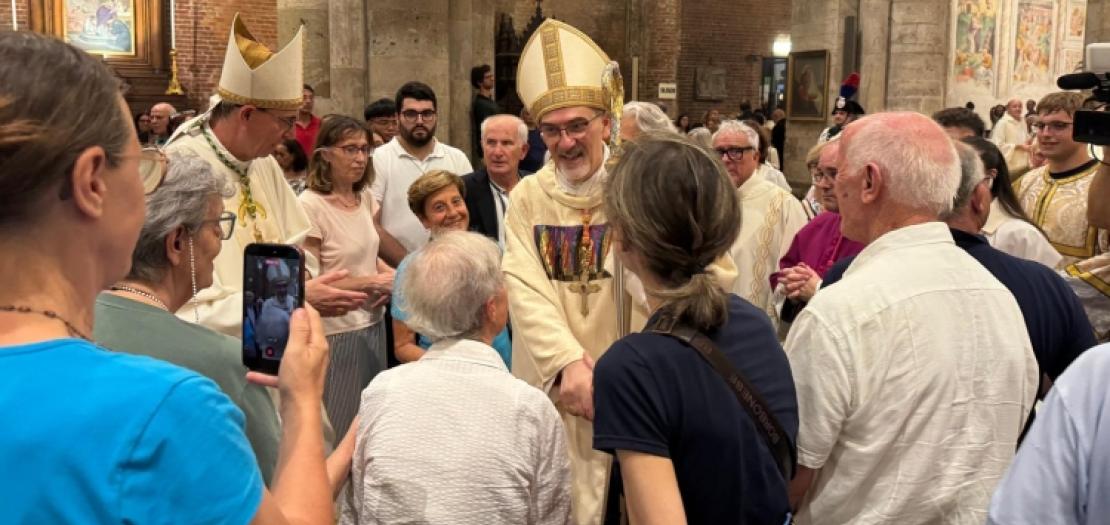
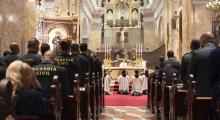
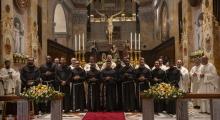
On the occasion of the Feast of St. Augustine in Pavia, Patriarch Pierbattista Pizzaballa’s homily is deeply intertwined with the thought of the Bishop of Hippo, and from this harmony emerges a spiritual and prophetic journey that rejects peace as merely the absence of war, presenting it instead as the order of the heart, the justice of institutions and a path leading towards the heavenly Jerusalem.
A comparison between the Augustinian vision of peace and the words spoken by the Patriarch in Pavia, together with his pastoral letter, opens us up to a reflection of extraordinary depth and relevance. Both refuse to reduce peace to a mere absence of conflict or to a balance founded on fear, interpreting it instead as a demand of conscience, a divine gift, and a pilgrimage. And as Patriarch Pizzaballa recalled today whilst reflecting on the arrival of the Saint’s relics in Pavia, ‘in this pilgrimage we already see an icon of our faith: we are pilgrims. We do not have a permanent city here, to use Augustine’s image, but we seek the one to come’.
For Saint Augustine, Bishop of Hippo, Christianity condemns the evils of conflict and the disordered passions that dwell in the human heart; man inevitably experiences an inner division, and true conversion is above all a transition from hatred to charity. This perspective is directly reflected in Patriarch Pizzaballa’s analysis of the Holy Land, a place marked by deep wounds and resentment, where he stated: ‘In the Holy City today, deep wounds, fears, resentment, desires for justice — and at times even for revenge — coexist alongside hopes that seem continually dashed by reality. Precisely where the Lord died and rose again, we learn that no victory of one over another can bring us peace. Christian victory is of a different nature.’
Patriarch Pizzaballa, following in the footsteps of Augustine, teaches that any logic of opposition, without a radical purification of the heart, opens up an abyss of violence and highlights how in the Holy Land ‘everyone feels like a victim: the Israelis are victims, the Palestinians are victims, the Christians are victims, and so on’; yet in the face of such polarization, Augustine’s warning reminds us that the Kingdom of God does not coincide with any earthly faction: the Christian ‘works for justice and peace, but rejects the idolatry of all power and all allegiance. His hope is greater than any earthly victory.’
In Augustine’s thought, the Civitas Terrena and the Civitas Dei are intertwined in history and rooted in the innermost being of humankind; and as Patriarch Pizzaballa emphasizes, drawing on Augustine’s work, ‘two loves build two cities: the love of self to the point of self-enclosure, and the love of God to the point of self-giving’. These two cities, as Patriarch Pizzaballa pointed out, ‘run through the heart of every person and the history of all peoples. We see this very clearly in the Holy Land: it is not a case of everyone being “white” on one side and everyone “black” on the other; the contradictions lie within the life of every community’.
Augustine’s famous definition of peace as ‘the tranquility of order’ is confirmed in the Patriarch’s appeal to re-establish relations founded on respect and gentle justice, shunning the logic of oppression. Precisely where the Lord died and rose again, we must recall the words of Augustine cited by the Patriarch: ‘Vicit enim in eis, qui vixit in eis — He who lived in them has triumphed in them. It is Christ who triumphs when his love takes up residence in the human heart; when the logic of oppression is replaced by that of the gift, vengeance by forgiveness, and fear of the other by the ability to recognise them once more as a brother.’
Humanity’s ultimate goal remains inscribed in eschatology and in the contemplation of the heavenly Jerusalem. Human restlessness finds fulfilment only when it is directed towards God. At the conclusion of his homily, Patriarch Pizzaballa posed a fundamental question to everyone: ‘Perhaps the deepest question that Augustine poses to the Church and the world today is not, first and foremost: “What do you think?” Whose side are you on? Who are you with? But: What do you love? For it is our loves that shape our hearts, our relationships, our societies and even our conflicts. What do we truly love? Our security, our identity, our causes, our victory? Or are we still capable of loving a Truth greater than ourselves, a justice that is not just for us, a peace that also embraces the other? This is why the Church is not called first and foremost to conquer the world, but to listen to the anxieties that dwell in the hearts of the men and women of our time. Within every sincere quest, within every desire for truth, justice, peace and love, there is already a trace of God who calls’.
Let us cherish an unshakeable hope that becomes prayer, and ‘before the relics of this great Father of the Church, let us ask for the grace to become men and women with open hearts, capable of not being content with what is fleeting and of directing our whole lives towards the One who alone can give rest to human longing. Thus, as we walk through the city of men, we may already have a foretaste of the joy of the heavenly Jerusalem: the goal of all hope and the fulfilment of all authentic love’.