Issued by the Catholic Center for Studies and Media - Jordan. Editor-in-chief Fr. Rif'at Bader - موقع أبونا abouna.org

How should Christians live in the midst of the conflict currently afflicting the Holy Land?
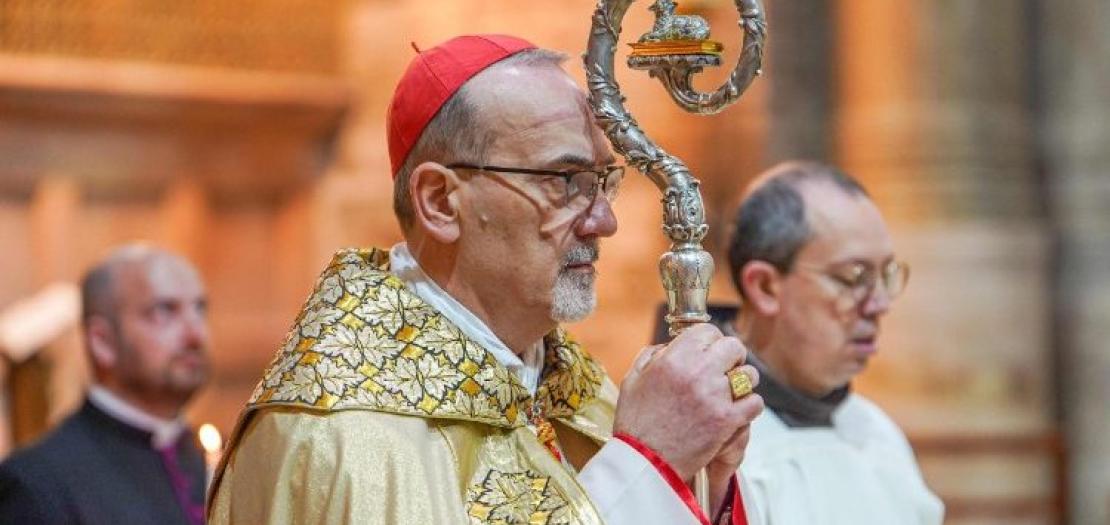
That is the question at the heart of a new pastoral letter from the Latin Patriarch of Jerusalem, Cardinal Pierbattista Pizzaballa. Released today, Monday 27th April, the letter is entitled “They returned to Jerusalem with great joy: A proposal for living the vocation of the Church in the Holy Land.”
To heal the world’s wounds
The vocation of Jerusalem, Cardinal Pizzaballa observes in the text, is to heal the world’s wounds. The Patriarch’s reflection revolves around the image of the Biblical city of Jerusalem, which “signifies coexistence and relationship, both civil and religious.”
The letter is structured in three parts: the first is an assessment of the current state of the region, the second a vision for the Church of Jerusalem, and the third reflects on the pastoral implications on parishes, families, schools, and institutions.
Pizzaballa emphasizes that the letter does not contain strictly political analysis: it is “political” only in a broader sense, insofar as it concerns our remaining, as Christians, within the polis, or actually existing world, while always oriented toward the true and definitive Polis, the heavenly Jerusalem.
Watershed events
Patriarch Pizzaballa begins with October 7 and the war in Gaza — “watershed events that brought one era to a close and opened another, doing so in the worst possible way.”
“What we are experiencing is not merely a local conflict,” he says. “The local conflict is the symptom of a much deeper crisis, a global paradigm shift. For decades, the international community, and particularly the Western world, believed in an international order based on rules, treaties, and multilateralism … Today, everyone seems to have woken up to the weakness in this system.”
“We are witnessing a renewed reliance on the use of force as a decisive means for resolving disputes,” Pizzaballa writes. “War has become the object of an idolatrous cult”.
The consequences of chaos
In a war also waged with words and images, the Patriarch notes, it is increasingly difficult to distinguish “news from propaganda”.
The Patriarchate of Jerusalem has experienced the consequences of this chaos, he writes, in the dissolution of relationships poisoned by hatred and mistrust, and fragmentation into enclaves and identity bubbles amplified by social media algorithms.
Among the negative effects is also a crisis of interreligious dialogue: “The Holy Places, which should be spaces for prayer, are becoming battlegrounds about identity. Sacred texts are invoked to justify violence, occupation, and terrorism.”
“I believe this abuse of God’s name is the gravest sin of our time,” Pizzaballa writes.
The image of the Holy City
In response to the situation, Pizzaballa says, the Church of Jerusalem “has made its voice heard, attempting to speak a word of truth – honest, clear, with parrhesia (boldness) – even amidst this chaos, often at the cost of misunderstanding.”
But, he adds, he wonders if this has been enough – or whether, “in this most challenging period, have we at times chosen prudence and sought institutional survival, sacrificing our prophetic witness? … It is a question that haunts me every day, and one that is never easy to answer.”
One must also ask what God’s will for Jerusalem is, Pizzaballa writes. Jerusalem is “not just a matter of political boundaries or technical arrangements”, but “its main identity – the most important characteristic of the city and of the entire Holy Land – is that of being the place of God’s revelation, the place where faiths are at home.”
Ignoring this “vertical” dimension of the Holy Land, the “religious and spiritual sensitivity of the communities that belong to it” is “the deepest reason for the failure of the coexistence agreements that have taken place in recent decades,” the Patriarch emphasizes.
Pastoral implications
At the pastoral level, Pizzaballa stresses the primacy of liturgy and prayer. Equally fundamental is the role of families as workshops of education in coexistence and respect, where the past can be transmitted to children in sorrow and truth, without inculcating feelings of hatred and revenge.
Christian schools should be understood as “workshops of a new humanity”, where children are educated to reread history with eyes free from resentment, Cardinal Pizzaballa writes. Hospitals and social services—places where welcome, dialogue, and healing are already lived realities—must be supported.
The Patriarch says that an important role also belongs to the elderly, who are living memory; to the young, who are prophecy; and to priests and religious, who are faithful points of reference for the community and models of possible coexistence.
Finally, Cardinal Pizzaballa says, interreligious dialogue also remains “a vital necessity.”
Like the disciples after the Ascension
Bringing the letter to a close, Patriarch Pizzaballa writes that it is essential to reject “any complicity with the culture of violence,” while making room for trust. How is all this possible? The answer is simple: it is not - "At least, not alone. But we are not alone.”
Jesus awaits us, the Patriarch says, in our parishes, in our faith communities, in our groups and ecclesial movements. “In the end, what sustains us is not our own strength, but the joy of the Gospel,” he emphasizes.
“Let us return to Jerusalem with joy,” Pizzaballa concludes. “Let us return to our lives with passion. Let us carry in our hearts God’s dream for God’s City, and let us allow that dream to become, step by step, day by day, our very lives.”