Issued by the Catholic Center for Studies and Media - Jordan. Editor-in-chief Fr. Rif'at Bader - موقع أبونا abouna.org

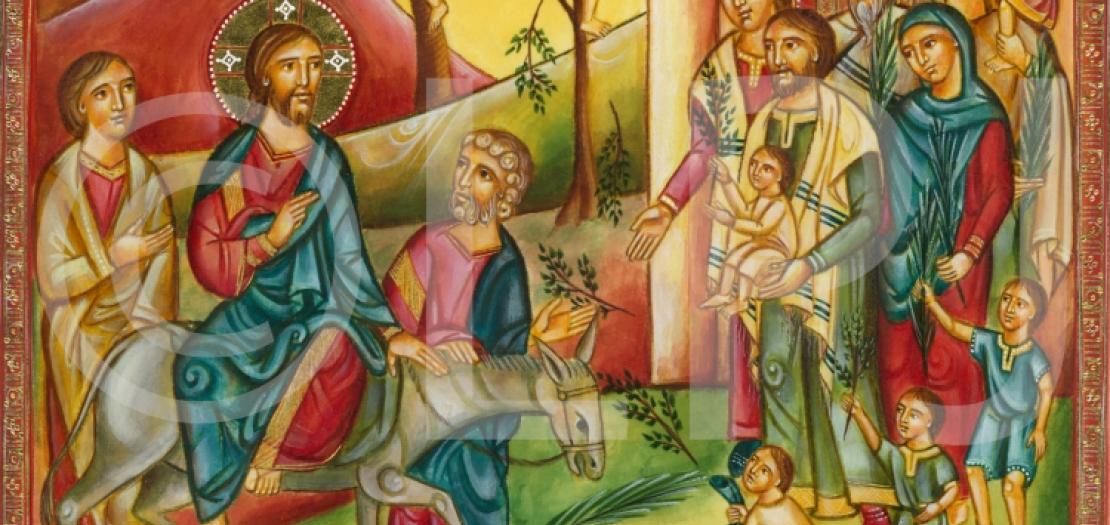
Following is the text of the meditation by His Beatitude Cardinal Pizzaballa, Latin Patriarch of Jerusalem, marking Palm Sunday, dated March 29, 2026:
In last Sunday’s Gospel, (John 11:1–45) we saw that there are words capable of restoring life to the dead, of recreating life. These are the words that Jesus speaks to his friend Lazarus, who had been in the tomb for four days: He calls him by name and frees him from the death that holds him captive.
But even in the previous Sundays, Lent has accompanied us in a crescendo of words of life: those of Jesus with the Samaritan woman, (John 4:5–42) words without judgment, that do not label or condemn, that rebuild a broken woman, that lead her back to the truth without humiliating her, and make her become a witness. These are words that cause a spring to well up.
And then there is the story of the man born blind (John 9:1–41): there too, words that free from guilt and restore dignity. Words that open the eyes not only to sight but to faith—words that enable one to see.
In the Passion narrative of Matthew, (Matthew 26:14–27:66) the atmosphere shifts.
It is a narrative where many speak, many shout: The disciples, the Pharisees, the Romans, the crowd.
But they are all words of death, words that sound different from what we got used to hear from Jesus in the past Sundays. The Passion is marked by words that do not give life, but rather kill it.
First of all, we find the words of betrayal.
These are Judas’s words: “What are you willing to give me, if I hand him over to you?” (Matthew 26:15)
It is the word that reduces a person to a price, that turns a relationship into a transaction, that kills trust.
Then we find the words of flight and denial: “I do not know the man!” (Matthew 26:72, 74)
These are the words of Peter, who, out of fear, erases their shared history: it is the word that denies the love received, and it is a word that wounds more deeply than physical violence.
Then we find the words of those in authority that judges: “He has blasphemed!” (Matthew 26:65)
This is the word of the high priest, who condemns without listening. It is the word that uses God to eliminate the other and disguises its own violence under the appearance of irreproachable religious zeal.
There are also words of contempt: “He saved others; he cannot save himself.” (Matthew 27:42)
Many say this: passersby, chief priests, scribes and elders, as well as the criminals crucified beside him. (Matthew 27:44) It is the word that mocks weakness and fails to understand the logic of love.
And there are the words of despair: “I have sinned in betraying innocent blood.” (Matthew 27:4)
These are the words of Judas—true words, but without hope. They are words that do not ask for forgiveness, but surrender to guilt, and they are met with words of cynicism and indifference: “What is that to us? Look to it yourself.” (Matthew 27:4)
The Passion is full of words that kill: words that betray, deny, accuse, mock, and bring despair.
Amid this sea of words of death, Jesus speaks very few words, all of which are words of life.
To Judas, Jesus says “Friend”, (Matthew 26:50) a word that preserves the relationship, that does not humiliate, and that does not return evil for evil.
And then, with Caiaphas and Pilate, Jesus speaks words that reveal the truth without violence, and that refer back to what they themselves had first said: “You have said so” (Mt 27:11) . Finally, there are words that penetrate our deepest depths: “My God, my God, why have you forsaken me?” (Matthew 27:46) It is a word that is nothing but prayer.
Jesus’ words are the words of a meek man, who neither defends himself nor accuses others, who does not use words as a weapon, but as a revelation of himself and of what is in his heart.
There are few words from Jesus, and much silence: “Jesus remained silent.” (Matthew 26:63)
Jesus is silent, not because he has nothing to speak, but because he will not follow the logic of verbal violence. his silence is a refusal to participate in the game of power that crushes, it is a silence that refrains from fueling the cycle of evil, nor does it seek to hurt anyone.
Let us therefore enter Holy Week, remembering that the entire Lenten season has taught us to recognize the voice that gives life: Jesus speaking to the Samaritan woman, to the man born blind, to Lazarus.
Now, in the Passion, those same words of life confront the words of death spoken by man, and pass through them without being silenced.
Holy Week invites us precisely to this: to let ourselves be touched by the Word that does not respond to evil with evil, but transforms it, opening within us a space for the resurrection.
+Pierbattista