
Issued by the Catholic Center for Studies and Media - Jordan. Editor-in-chief Fr. Rif'at Bader - موقع أبونا abouna.org

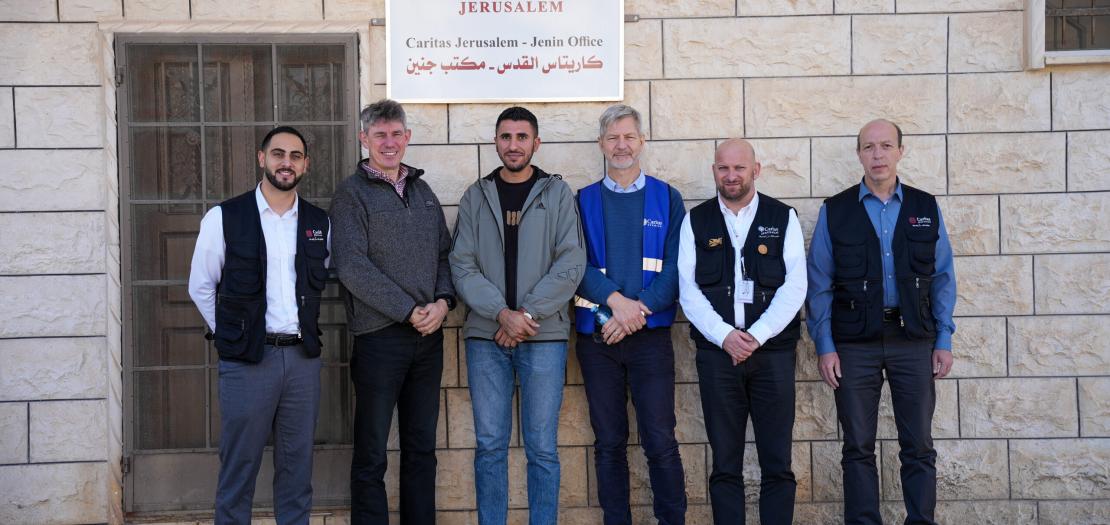
Just one day after the inauguration of the Vehicle of Hope mobile clinic in Bethlehem, Mr. Alistair Dutton, Secretary General of Caritas Internationalis, and Mr. Peter Brune, Secretary General of Caritas Sweden, accompanied by Mr. Anton Asfar, Secretary General of Caritas Jerusalem, joined Caritas Jerusalem’s team on a field visit to the northern West Bank. Their journey to Jenin Governorate offered a deep and unfiltered look into the daily struggle of Palestinian families enduring one of the harshest periods in recent history.
A region under immense pressure
Since the outbreak of the last war, life in the West Bank has been defined by escalating restrictions, tightening socioeconomic hardship, and rising insecurity. New measures implemented after the war now prevent thousands of Palestinian workers from obtaining permits to enter Jerusalem and Israeli-administered areas — a lifeline previously relied on by countless families. The sudden loss of income has pushed communities deeper into poverty, while increased aggression, military incursions, settler violence, and movement restrictions have compounded the challenges faced by households across Zababdeh, Jenin, and the surrounding villages. For many families, this is the most difficult chapter they have lived through.
Witnessing the reality on the ground
During their visit, the delegation met families and beneficiaries of Caritas-supported micro-projects — small but transformative businesses run by women, youth, and vulnerable households. These initiatives, nurtured by Caritas Jerusalem, have become beacons of resilience at a time when economic opportunities are rapidly shrinking.
While visiting the Caritas Zababdeh office, the delegation was only a few kilometers from an ongoing military operation in the Tubas governorate — less than 10 km away. The operation has hindered, and continues to hinder, a Caritas colleague from reaching the Zababdeh office from Tubas.
During the visit, Alistair and Peter also observed Israeli surveillance drones circling over the area, a stark reminder of the daily instability that communities must navigate.
From agricultural activities to youth entrepreneurship, each micro-project carried a story of hope, perseverance, and profound determination to remain rooted in one’s land despite mounting pressure. Communities spoke candidly about the economic collapse triggered by the loss of work permits, the sudden unemployment and inability to provide for their families, the heightened aggression and instability in the northern West Bank, and the unbearable cost of living that is shrinking access to even the most basic needs. For the delegation, these encounters offered an unfiltered understanding of the daily hardships faced by the people of the West Bank.
Solidarity that carries hope
Despite the harsh realities, the delegation was greeted everywhere with warmth, strength, and remarkable generosity — qualities that define Palestinian communities even in the darkest times. Both Alistair Dutton and Peter Brune expressed deep admiration for the courage of families living under severe pressure and the resilience of local communities, as well as the dedication and professionalism of the Caritas Jerusalem teams and the tangible impact of micro-projects that continue to restore dignity and livelihoods. Their presence sent a powerful message to communities who often feel forgotten: you are not alone, and the Caritas family walks beside you.
Caritas Jerusalem’s ongoing mission
In the face of deteriorating humanitarian conditions, Caritas Jerusalem remains steadfast in its mission to accompany the most vulnerable. The organization continues to provide health services and medical support — including through the newly launched Vehicle of Hope mobile clinic — while also offering mental health and psychosocial support, multipurpose cash assistance, livelihood and micro-business support, and protection, advocacy, and community-based resilience programs. Caritas is committed to providing not only services but also presence — standing with families in their grief, their resilience, and their hope.
 Cardinal Pizzaballa ordains two deacons from the Koinonia John the Baptist Community in Tiberias
  Caritas Internationalis, Caritas Sweden visit West Bank after launching the Vehicle of Hope