Issued by the Catholic Center for Studies and Media - Jordan. Editor-in-chief Fr. Rif'at Bader - موقع أبونا abouna.org

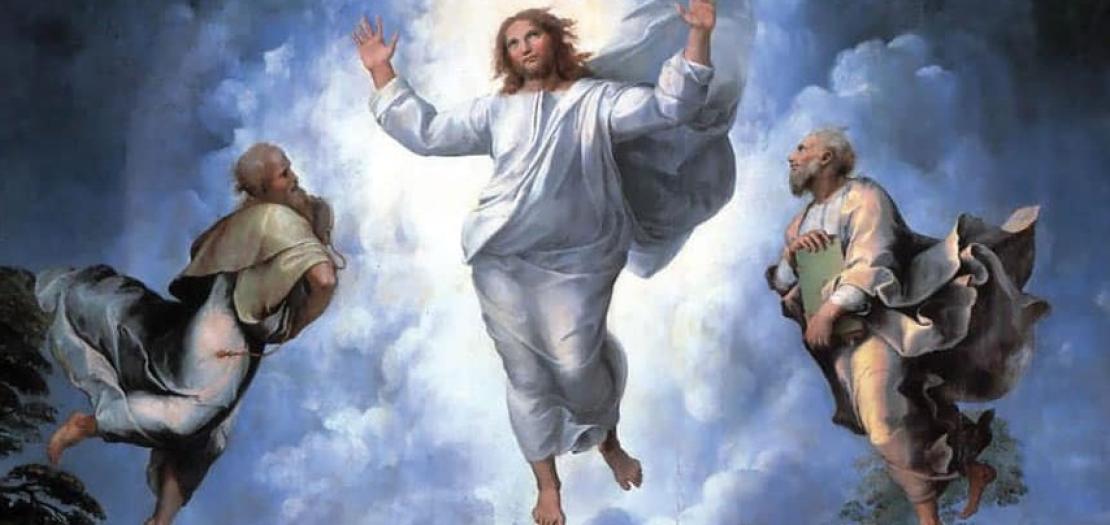
At that time: Jesus took with him Peter and James and John his brother and led them up a high mountain by themselves. And he was transfigured before them, and his face shone like the sun, and his clothes became white as light. And behold, there appeared to them Moses and Elijah, talking with him. And Peter said to Jesus, 'Lord, it is good that we are here. If you wish, I will make three tents here, one for you and one for Moses and one for Elijah.' He was still speaking when, behold, a bright cloud overshadowed them, and a voice from the cloud said, 'This is my beloved Son, with whom I am well pleased; listen to him.' When the disciples heard this, they fell on their faces and were terrified. But Jesus came and touched them, saying, 'Rise, and have no fear.' And when they lifted up their eyes, they saw no one, but Jesus only. And as they were coming down the mountain, Jesus commanded them, 'Tell no one the vision, until the Son of Man is raised from the dead.'
Reflection on the drawing
The Feast of the Transfiguration of the Lord celebrates one of the most extraordinary moments in the Gospels, when Jesus allows three of his disciples to glimpse his divine glory. The event is recorded by the three Synoptic Evangelists (Matthew, Mark and Luke) while Saint John does not recount the Transfiguration directly, although many scholars see echoes of it in his declaration that, "We have seen his glory." (John 1:14)
Matthew closely follows Mark's account, which is generally considered the earliest, yet he shapes it in his own distinctive way. More than the other Evangelists, Matthew always presents Jesus as the fulfilment of the Old Testament. He carefully highlights the presence of Moses, representing the Law, and Elijah, representing the Prophets, both bearing witness that everything God had promised now reaches its fulfilment in Christ.
Matthew also places particular emphasis on Jesus' divine identity and kingly authority. He describes Christ's face shining "like the sun" and his clothes becoming "white as light", language that evokes both Moses' radiant face after encountering God on Mount Sinai and the dazzling glory of God himself. When the bright cloud overshadows them (a familiar Old Testament biblical sign of God's presence) the Father's voice repeats the words first heard at Jesus' baptism but adds a new command: "Listen to him." That final instruction is uniquely at the heart of Matthew's account. The Transfiguration is not merely a spectacular revelation of Christ's glory; it is a summons to discipleship!
J. M. W. Turner's Lecture Diagram 10: Proportion and Design of Part of Raphael's Transfiguration is a fascinating glimpse into the mind of one of Britain's greatest painters. Rather than copying Raphael's famous masterpiece in the Vatican, Turner strips away almost all of its detail to reveal the hidden geometric framework that underpins the composition. As Professor of Perspective at the Royal Academy, Turner used this drawing to demonstrate to his students that great art is never accidental! With a network of intersecting triangles, diagonals and pyramidal forms, he analyzed how Raphael carefully organised the figures of Christ, Moses and Elijah on the mountaintop, showing that the harmony and balance of the painting arise from precise design rather than chance. Turner argued that such mathematical order was one of the secrets of Raphael's genius.
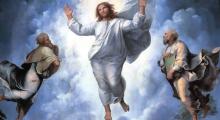
Although highly simplified, the drawing still allows us to recognize the principal figures. Christ stands gloriously at the summit, his outstretched arms forming the apex of the great triangular composition. Beside him are Moses and Elijah, while below them the three astonished Apostles - Peter, James and John - collapse in awe at the vision before them. Turner deliberately omits the dramatic lower half of Raphael's painting, where the remaining disciples struggle to heal the possessed boy, because his purpose was not to retell the Gospel story but to uncover the architectural structure of the upper scene. His diagram reminds us that behind every great work of art lies careful planning: beauty is not merely inspired, but thoughtfully constructed, with geometry serving the higher purpose of revealing divine glory.