Issued by the Catholic Center for Studies and Media - Jordan. Editor-in-chief Fr. Rif'at Bader - موقع أبونا abouna.org

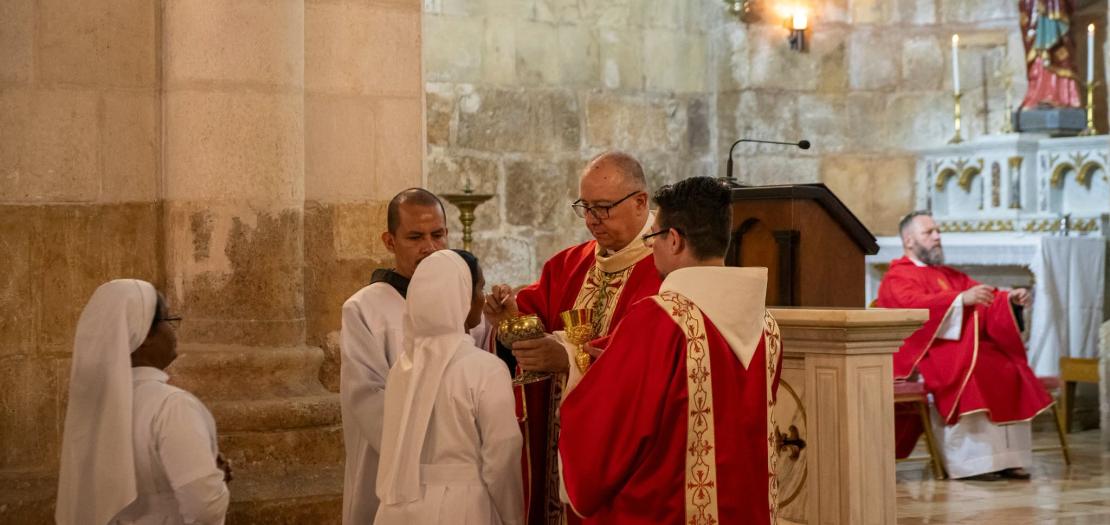
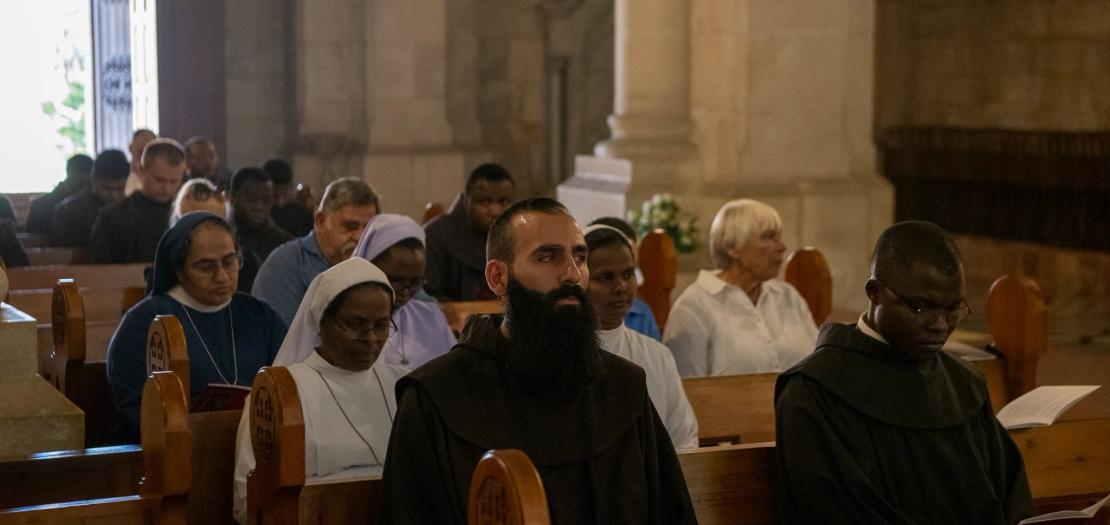
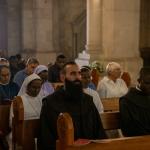
On the day dedicated to the memory of Saints Simeon and Cleopas, the friars of the Custody of the Holy Land gathered at the Convent of Saint Cleopas in Emmaus (El-Qubeibeh). In this village nestled about 11 kilometers northwest of Jerusalem, beyond the separation wall surrounding the West Bank, the Sunday liturgy of September 27 transformed the Gospel remembrance into a living testimony of faith and fraternal communion.
The Franciscan friars, welcomed by the Superior of the local community, Fr. Sebastiano Eclimes, and by the local faithful, shared a moment of festive conviviality, renewing the grace of hospitality in the name of the two disciples of the Gospel.
El-Qubeibeh, whose Arabic name recalls the image of a small dome, preserves for Christian tradition the memory of ancient Emmaus, the village toward which the two disciples Cleopas and Simeon set out after the events of the Passion. Here, where a Roman road once ran, the foundations of the Crusader-era basilica and the remains of the dwelling venerated as the “house of Cleopas” are preserved today. Purchased in 1861 by Marchioness Pauline de Nicolay and donated to the Friars Minor, the sanctuary now stands within a predominantly Muslim community, serving as a tangible sign of dialogue and Christian presence in the heart of the Palestinian territories.
The heart of the day was opened by the words of the Custos of the Holy Land, Fr. Francesco Ielpo, who in his greeting message offered a meditation on the Gospel icon of the wayfarers: “prayer reminds us first of all that the risen Jesus begins to converse with Cleopas and Simeon along the way. The Risen One reaches them, along the way, while they are going in the wrong direction, while they are moving away from Jerusalem and from the community, disappointed and hopeless. God enters right inside that journey.”
An image that touches every believer marked by disenchantment: facing the collapse of human expectations, it is not man who seeks the Savior, but Christ himself who takes the initiative, joining the loneliness and pain of those groping in the dark. Thus, the Eucharistic gesture of breaking the bread reignites hope and recomposes the wounded community.
For the universal Church, the celebration of El-Qubeibeh is thus renewed as an announcement of consolation: even when the night grows darker, the risen Jesus does not cease to walk alongside his children, illuminating the darkness through the gesture of the broken bread.