Issued by the Catholic Center for Studies and Media - Jordan. Editor-in-chief Fr. Rif'at Bader - موقع أبونا abouna.org

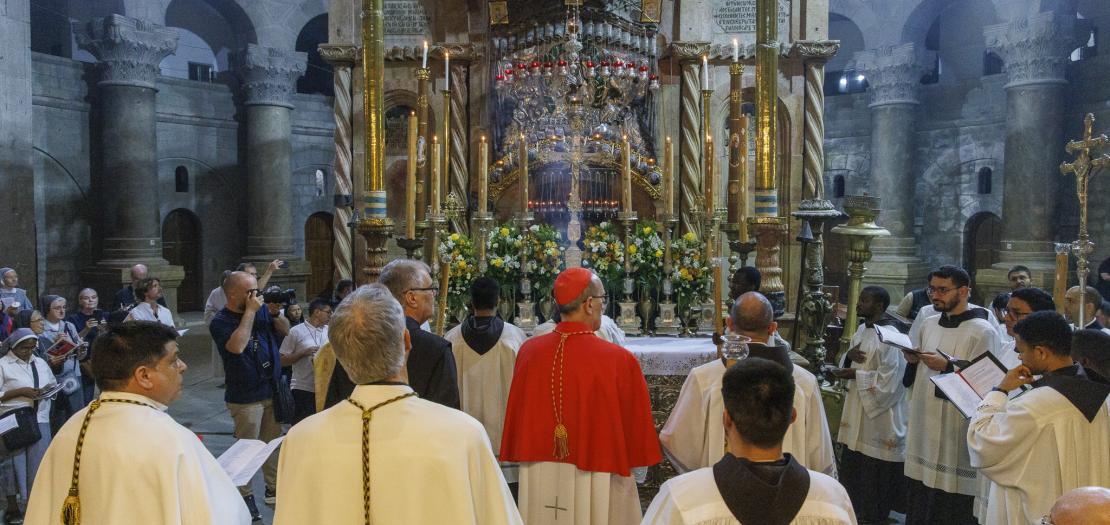
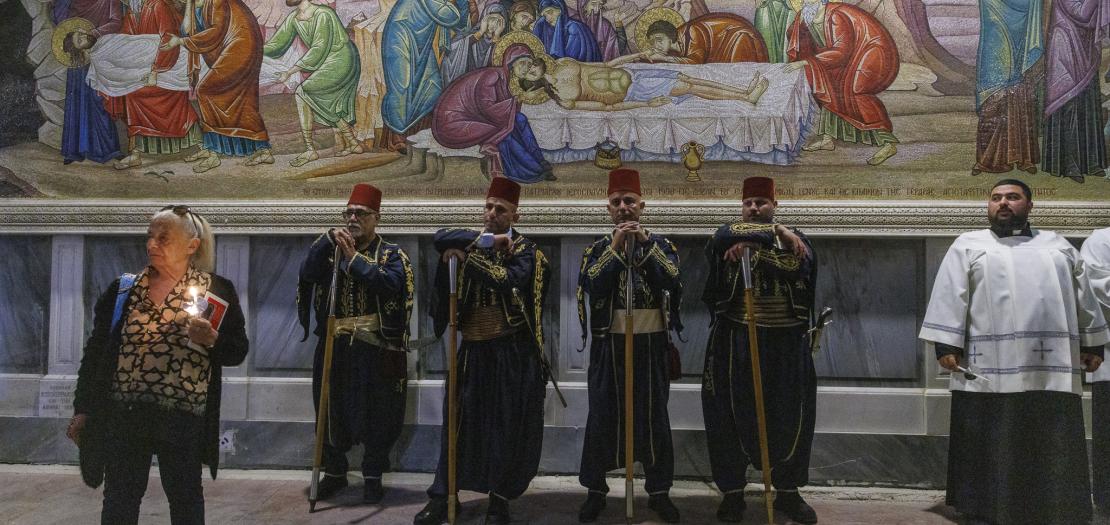
Thursday June 4, in the Basilica of the Holy Sepulcher, heart of Christianity, the solemnity of Corpus Christi was celebrated again this year according to the ancient customs of the Status Quo sixty days after Easter, on a Thursday, in an atmosphere of recollection and deep prayer.
The celebrations were presided over by His Beatitude the Latin Patriarch of Jerusalem, Cardinal Pierbattista Pizzaballa. In the afternoon of Wednesday, the Patriarch made his solemn entry into the Basilica, accompanied by the friars of the Custody of the Holy Land, according to the traditional ceremonial. A gesture that recalls a living and continuous presence of the Church in the place of the Resurrection.
In front of the Edicule of the Holy Sepulcher, the first solemn vespers were celebrated, followed by the daily procession inside the Basilica. The afternoon celebrations concluded with the recitation of compline, the last prayer of the liturgy of the hours of the Catholic tradition, prayed in front of the tomb of Christ.
During the night, the friars of the Custody celebrated the Office of Readings, presided over by the Custos of the Holy Land, Fr. Francesco Ielpo, prolonging the prayer in the continuity of the liturgical tradition that characterizes the great solemnities at the Holy Sepulcher.
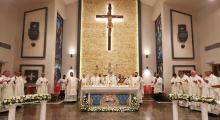
On Thursday morning, the Patriarch presided over the solemn Holy Mass, concelebrated by about fifty priests and religious, including the Apostolic Nuncio, the auxiliary Bishops of the Diocese and the abbot of the Benedictine monastery of the Dormition. The Eucharist, heart of the feast of Corpus Christi, was experienced with particular intensity, even in a context marked by a reduced participation. The Patriarch in his homily recalled the great miracle of every Eucharist, during which we relive the gift of Christ for us as on that day on Calvary, a complete gift of all of himself for love of his Church.
The absence of pilgrims and the fact that the faithful of the local parishes will celebrate Corpus Christi on the following Sunday made the liturgies more intimate, with a contained presence of the faithful. However, over the years, these celebrations have aroused a growing curiosity also among the local population.
The eucharistic procession, with its distinctive signs, the monstrance, the canopy and the path around the Sepulcher, represents in fact a moment of strong visible testimony. Not infrequently, Israeli friends and numerous photographers attend the celebrations, documenting the rituals and sharing them on social media.
This attention translates into a new and significant form of encounter: through images and stories, many discover aspects of the Catholic liturgy and of the Christian presence in Jerusalem. A contemporary way to make known, also to the Jewish world, the richness of the Christian tradition kept in the Holy Places.
The eucharistic procession carried out inside the basilica concluded with the triple blessing that the Patriarch imparted to the faithful present in front of the tomb, at the altar of the encounter with Mary Magdalene and inside the chapel of the Franciscans.
In this context, the solemnity of Corpus Christi at the Holy Sepulcher continues to be not only a moment of adoration and faith, but also a sign of dialogue and silent testimony in the heart of the Holy City.