Issued by the Catholic Center for Studies and Media - Jordan. Editor-in-chief Fr. Rif'at Bader - موقع أبونا abouna.org

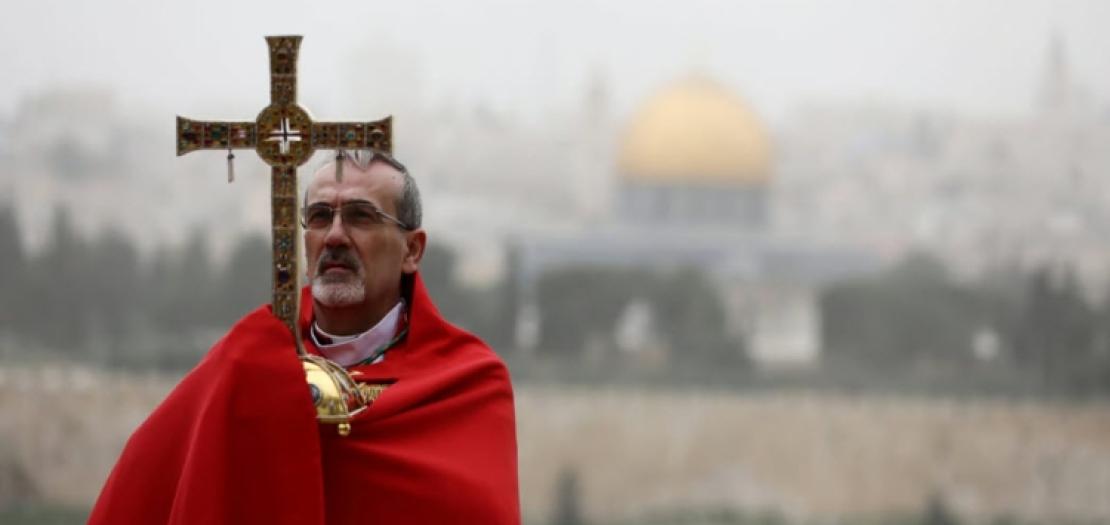
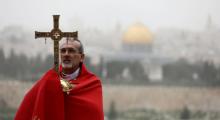
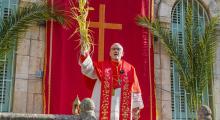
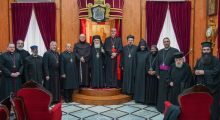
Following is the text of the meditation by His Beatitude Cardinal Pizzaballa, Latin Patriarch of Jerusalem, for Palm Sunday at Gethesmane, Jerusalem, marking Palm Sunday, dated March 29, 2026:
Dear brothers and sisters in Christ, may the Lord give you peace.
We are here at Gethesmane, the place where Jesus, having reached the culmination of his journey to Jerusalem, paused and wept. His gaze did not rest on the majestic walls or the splendor of the Temple; it penetrated the heart of the city he loved, and there he saw its struggle in recognizing the time of grace.
In this afternoon of Palm Sunday we gather without a procession, without palms waving through the streets. This absence is not merely a matter of formalities. It is the war that has interrupted our festive journey, making even the simple joy of following our King difficult. Our brothers and sisters of the Holy Land cannot fill the streets this Sunday nor join their voices to the festive procession. Their absence is not empty before the Lord. He does not seek triumphal roads, but enters where the door is left ajar, where daily fidelity is the daily bread. We are certain that the Crucified and Risen One does not cease to walk among us: even when the road is blocked, He dwells in the heart of those who have not stopped following Him. Yet precisely in this imposed silence, the liturgy becomes more authentic. The cry of “Hosanna” does not need branches to rise to heaven, and faith does not falter when outward rites are stripped away.
Today Jesus weeps once more over Jerusalem. He weeps over this city, which remains a sign of both hope and sorrow, of grace and suffering. He weeps over this Holy Land, still unable to recognize the gift of peace. He weeps for all the victims of a war that seems without end: for divided families, for shattered hopes. But the tears of Jesus are never fruitless. They open our eyes, challenge us, and reveal the truth.
The Passion Gospel we have just heard tells us how Jerusalem responded to that love. We heard of Judas’ betrayal, Peter’s denial, Pilate’s silence, and the crowd’s cry for the cross. We saw the Lord stripped, crowned with thorns, nailed between two criminals, mocked by those who passed by. Darkness seems to have the final word. And yet, running through those pages there is a bright and unbroken thread: Jesus remains faithful to the end. He entrusts his spirit into the hands of the Father; the earth trembles, the rocks split, and at that dramatic moment the centurion proclaims, “Truly this was the Son of God!” (Mt 27:54)
This detail continues to challenge us today. The centurion is a soldier, a man shaped by the logic of force, by a power that imposes itself. By profession, he measures success by domination, by victory, by control. And yet, standing before this man nailed to the cross – before a love that does not defend itself, before a fidelity that does not retreat even in death – his criteria collapse. He discovers that true power lies not in violence or in the sword that kills, but in a life freely given. And so, he makes the highest confession: this man is the Son of God. At the very moment when death appears to triumph, truth is revealed, love is manifested, and salvation is accomplished.
Today, as war seems to suffocate every word of peace, here – where Jesus wept – we can hear that same confession resound. The final word of God is the empty tomb. It is the Lord who goes before the disciples into Galilee and who goes before us as well, leading us toward a peace that is not an illusion, but the fruit of the cross.
“If you, [Jerusalem], had only known on this day what would bring you peace.” (Lk 19:42) The peace Jesus offers is not a fragile agreement between enemies, but a peace born of the cross – a peace that comes from a God who gives himself completely and has no need of force or weapons. This is the paradox we are called to embrace today.
Jerusalem, the Holy Land, is not merely a geographical place; it is the beating heart of our faith. Every stone here speaks of salvation; every hill bears the memory of the God who chose to draw near. To live faith in this land means to accept the contradiction it embodies: the place of resurrection is also the place of Calvary; the place of God’s embrace is still scarred by too much hatred.
Yet from this holy place we learn to look upon the city with the eyes of Christ. We learn to mourn with him, but also to hope with him. For the same Jerusalem that rejected the Prince of Peace has also witnessed the empty tomb. War will not erase the resurrection. Grief will not extinguish hope.
Today we do not carry palms in procession. Instead, we carry the cross – a cross that is not a useless burden, but the source of true peace. We do not wave olive branches; rather, we choose to become builders of reconciliation, through every gesture, every word, every relationship.
Brothers and sisters, in this land that continues to wait for peace, we are called to be witnesses to a love that never gives up. May our journey of faith, even today, be a journey of hope. And may our lives, even amid the harshness of the present moment, bring the love of Christ and his light wherever darkness seems to prevail.
Amen.