Issued by the Catholic Center for Studies and Media - Jordan. Editor-in-chief Fr. Rif'at Bader - موقع أبونا abouna.org

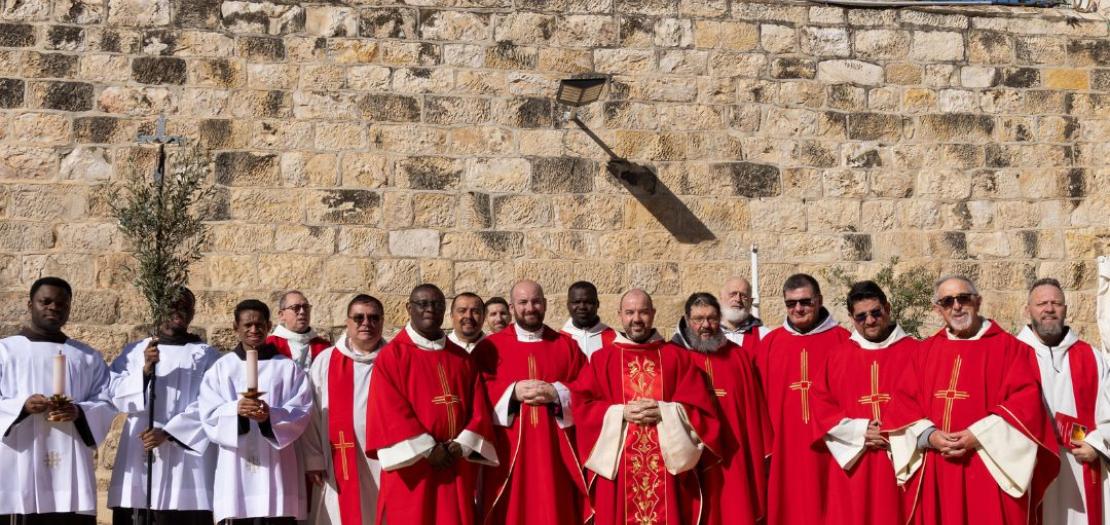
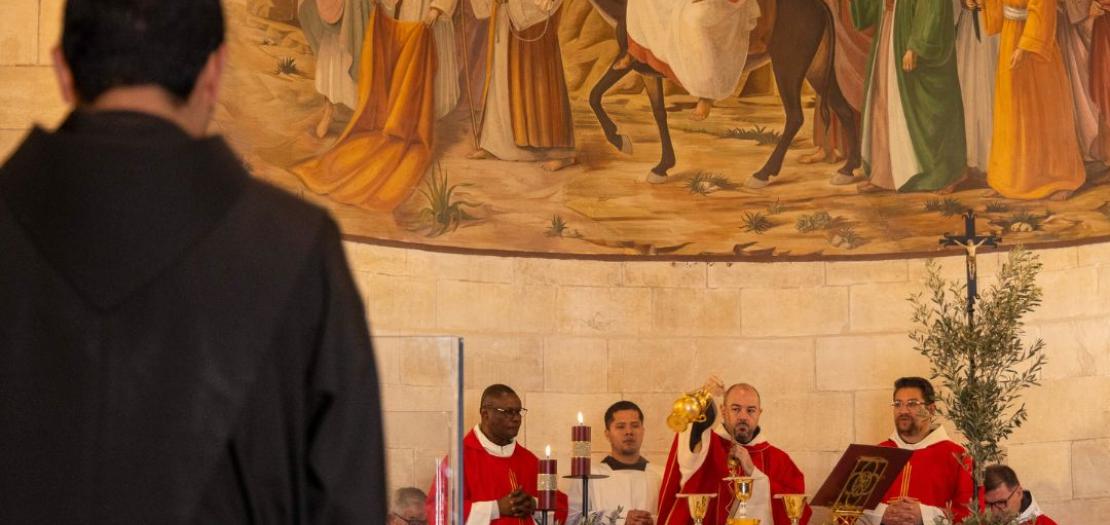
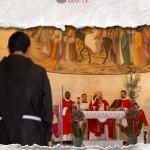
Jerusalem once again accompanied the Lenten journey of the Custody of the Holy Land with its traditional Station Masses, experienced as the final and intense stages of preparation for the great mysteries of the Paschal Triduum. Three celebrations, in three emblematic places of the Passion and of the messianic entry of Jesus, marked the days immediately preceding Holy Week, inviting the friars and the faithful to contemplate the mystery of the kingship of Christ, the redemptive suffering of the Cross and the peace proclaimed by the humble King.
At the Litostropt: the Mocked King and the mystery of true kingship
The first celebration took place on the evening of Thursday, March 26, at the Church of the Flagellation, presided over by Fr. Claudio Bottini, professor emeritus of the Studium Biblicum, in the place of the Lithostrotos, where tradition places the trial of Jesus before Pilate.
In this strongly evocative context, the reflection focused on Christ as King, but of a kingship completely different from the worldly one. The preacher, Fr. Piermarco Luciano, Discrete of the Holy Land, recalled how the trial before the Roman procurator was marked by a political logic and compromise, Pilate attempts to resolve the matter with "common sense", hoping that a scourged Jesus might be enough to appease the crowd, but he ends up handing him over to crucifixion, fearing otherwise to appear an enemy of Caesar.
The kingship of Jesus, however, is never a caricature nor a mere provocation, "My kingdom is not of this world", and precisely for this reason his authority "comes from Elsewhere". A kingship that is manifested in service, Christ "is among his own as one who serves", and his royal power is revealed in the total gift of his life. In the gesture of the washing of the feet, as recalled in the homily, the entire mission of the Son is summed up, laying aside the garments as laying down his life, and taking them up again as a sign of the resurrection and of the sovereign freedom of the Lord.
At Calvary: Mary of Sorrows and the faith that crosses the night
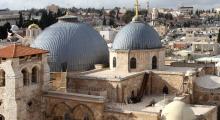
The second Station Mass was celebrated on the morning of Friday, March 27, at Calvary, at the Basilica of the Holy Sepulchre. The liturgy, presided over by the Vicar of the Custos, Fr. Ulise Zarza, took place in a particularly recollected atmosphere, due to security measures imposed by the war, participation was limited to the friars who live in the basilica and the celebration took place behind closed doors.
In the silence of Golgotha, the Custody commemorated the Blessed Virgin Mary, Our Lady of Sorrows, contemplating her as Mother and disciple, present until the Cross. The homily led those present into the mystery of Simeon’s prophecy, when in the Temple he announces that the Child will be a "sign of contradiction" and that a sword will pierce the Mother’s soul.
The preacher emphasized how that "sword" is not only an announcement of suffering, but a revelation of a journey of faith, Mary is called to believe beyond all evidence, to hope against all hope. Her suffering does not become closure or despair, but expectation, because even on Calvary she already guards "the fragile flame of the dawn of the resurrection".
Mary’s figure was also proposed as an image of the persecuted Church, the sword that pierces the Mother is the same that wounds the members of the Church when it suffers for the name of Jesus. In this time marked by violence and war, the prayer raised from Calvary became intercession for the persecuted, for the victims of injustice and for all those who bear in body and spirit the weight of suffering.
At Bethphage: the just and humble king who proclaims peace
The last stationary Mass was held on Saturday morning, March 28, at the shrine of Bethphage, a place linked to Jesus' entry into Jerusalem in the procession on the Sunday before the Passion.
Here the liturgy, presided over by the Secretary of the Holy Land, Fr. Alberto Joan Pari, in the presence of a few concelebrants, invited people to contemplate the Messiah announced by the prophet Zechariah: a "just and humble" King, who enters the Holy City not by force of arms, but with the meekness of one who fulfills the Father's will. Biblical justice," was reminded by preacher Fr. Piermarco Luciano, "does not coincide with a simple moral rectitude, but is first and foremost the search for and adherence to God's will. Christ is the Righteous One because he can say, "I came down from heaven not to do my own will, but the will of him who sent me."
From this obedience comes the radical humility of the Son, who "empties himself" by becoming a servant. A humility that continues to be renewed in the mystery of the Eucharist: the Lord gives Himself totally and asks His disciples to keep nothing for Himself, as St. Francis writes: "Look, brothers, at the humility of God... Nothing, therefore, of you do keep for yourselves."
Finally, the homily emphasized the third aspect of the Messianic King: herald of peace. A peace that is not a superficial feeling, but a gift from God and a task entrusted to those who want to follow Christ. It is a peace that comes at a price: it requires conversion, forgiveness, patience and renunciation of greed. And precisely in this time wounded by war, the call to become "peacemakers" has resounded with particular force, as a call to resemble the Son of God.
Toward the Triduum: entering with Christ into the mysteries of salvation
In a context marked by uncertainty and the limitations imposed by war, the prayer of the Church in the Holy Places has once again become a silent yet eloquent testimony, here, where salvation was accomplished, the Franciscan friars continue to guard the living memory of the Passion, death and resurrection of the Lord.