Issued by the Catholic Center for Studies and Media - Jordan. Editor-in-chief Fr. Rif'at Bader - موقع أبونا abouna.org

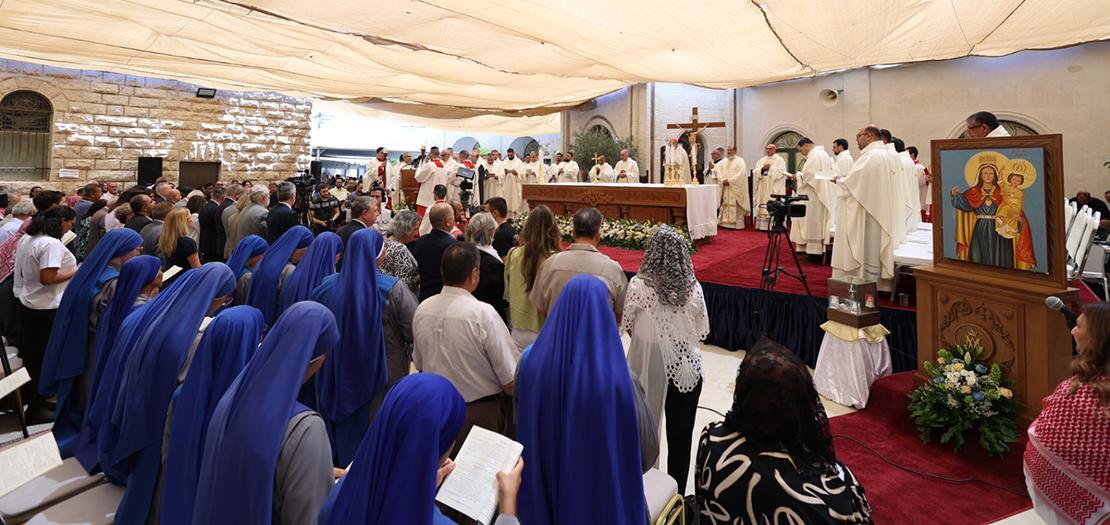
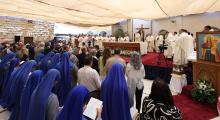
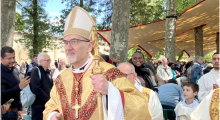
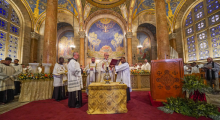
Following is the text of the homily delivered by His Beatitude Cardinal Pierbattista Pizzaballa, Latin Patriarch of Jerusalem, during the annual pilgrimage to the Grotto of Our Lady of teh Mount in Anjara, dated June 19, 2026:
Dear brothers and sisters,
May the Lord give you peace!
We are gathered in one of the Holy Places of Jordan recognized by our Church – a special place of devotion and care that has recently received attention from the Royal Court, with the direct support of His Royal Highness Prince Ghazi Bin Muhammad, the Ministry of Tourism and Antiquities, and many faithful from across Jordan.
We are all preparing for the year 2030, when we will celebrate the Jubilee of the Baptism of Jesus, which took place 2,000 years ago here in present-day Jordan, at the Maghtas – a place of faith and spirituality not only for us, but for the whole world. His Majesty the King, through the Jordan 2030 Initiative, wishes to give special attention to this unique and important place for the faith of all Christians. We, the Church in Jordan, will also do our part to strengthen the vocation of this land as a land of faith and a meeting place of history and civilization.
Today, we are here to ask for the support and help of the Blessed Virgin for all of us, for our country, for our families, and for our Church.
The Gospel of the Annunciation that we have just heard, which we know well, invites us to many reflections, but we will focus on only two.
1. The first is to believe that nothing is impossible for God. (Luke 1:37) In the passage, we find two impossible situations: the Virgin Mary becoming pregnant without having known a man (Lk 1:34), and Elizabeth, elderly and barren, already in her sixth month of pregnancy. (Luke 1:36)
Both situations are humanly impossible, yet they occurred through God’s action, without human intervention. Through God, life blossomed where life could not be born. What does this suggest to us?
As the Holy Father recently reminded us, in our time, human intelligence and social development have radically transformed the world; today we can do things that until recently seemed impossible and unattainable in scientific, economic, and commercial fields. Scientific progress makes us more powerful every day and continually opens new and broader perspectives in all areas of personal and social life. We increasingly trust in our own strength and abilities. We feel almost invincible.
But all it takes is an illness affecting a loved one, a sudden death, or a destructive war– and all our certainties of invincibility collapse.
Our sense of power gives way to fear and uncertainty. We become frightened by what the future may hold, full of uncertainties about health, work, children, parents, and so on. Our trust in our own strength is shaken, and we suddenly feel powerless.
The Gospel invites us to lift our gaze and trust in God. Perhaps we have set aside this provident and almighty God too much. We thought we were the sole architects of our destiny and needed nothing and no one else. But this is not so. We need God, because alone we are lost. The awareness of God’s presence in human life and in the world leads us to believe that nothing is impossible for God, that He does not leave us alone. He brings forth life even where it is no longer humanly possible.
In today’s Gospel, Mary teaches us to have faith. To believe is to recognize that the invisible hand of God still works and reaches precisely where human beings cannot. To believe also means remaining in today’s difficult and dramatic situation with Christian hope– the attitude of one who chooses to live in love, who does not withdraw into oneself but offers one’s life, saying “yes” even in the heaviest moments. Believing, then, means listening, welcoming, trusting, and offering oneself.
The difficulties of the present moment and the disorientation that accompanies them must not erase our firm certainty that God does not abandon those who love Him and that we are not alone. We know and believe that “He who raised Christ from the dead will give life also to your mortal bodies through His Spirit who dwells in you.” (Rom 8:11)
Today, here in this sanctuary so dear to all of us, we want to renew our faith in God’s providential work and say together with the evangelist Mark: “I believe, Lord; help my unbelief!” (Mk 9:24)
2. The second reflection we learn from the Virgin Mary, equally important, is to accept entering into the time of gestation – a period of patience, silence, and waiting. Human actions are accomplished instantly; the works of God require time and unfold gradually. For something new to be born, a long gestation is necessary.
Modern people consume time voraciously; they do not know how to wait. They live through social and digital contacts that deliver everything in real time, making us believe that everything can be obtained immediately – healing or the solution to any problem.
But God’s time unfolds over long periods: it digs deep and lays solid foundations. It is the time of all the necessary seasons for the seed to bear fruit.
We can imagine that Mary’s pregnancy was nourished by patience, faith, silence, listening, prayer, and journeying. It led her to see and recognize around her the places and events where God’s hand was at work, doing something new: in her cousin Elizabeth (Lk 1:39–45) and in her husband Joseph. (Mt 1:18–25)
Today we do not understand everything, nor are we able to interpret adequately what is happening in this world torn by wars and so much hatred. This is perhaps one of the elements that disorients us most: not being able to decipher the dramatic present moment, not having the interpretive key that allows us to control events and the present time.
The Gospel teaches us to let our experiences settle, to allow time to foster a calm and free understanding of present events. Only with time will we better understand and see His presence and His work.
Right now, we do not know how to give a “story” to what is happening; we need to let time reveal it, to grow in the intelligence of the heart by listening to God’s silence. In the pain and joy of the days to come, we will reread these events, and I am sure we will find a Word that helps us unveil them, to process them in a meditation that transforms them into new daily life.
For this reason, the certainty that nothing will separate us from God’s love, the security that comes from His faithfulness, cannot fail – and nothing, absolutely nothing and no one, will ever be able to separate us from the love of God.
We might think that the Gospel of the Annunciation is far removed from our lives, too great for each of our small lives. But this is not so. The dynamic of this event– the dynamic of a God who desires to intervene in human life and simply asks to be allowed to do so– is the dynamic of faith, of our daily relationship with God, which not even the drama of the present moment can call into question.
Let us ask the Virgin Mary for the gift of trust in God’s work in us and in the world. Trust in God will give us new life, just like the child conceived in the Virgin’s womb, just like the life that sprang from the Holy Sepulcher. There too, the hand of man had given death, and only the hand of God could restore life – and so it happened.
With Mary, then, let us entrust ourselves once again with confidence to God’s plan.