Issued by the Catholic Center for Studies and Media - Jordan. Editor-in-chief Fr. Rif'at Bader - موقع أبونا abouna.org

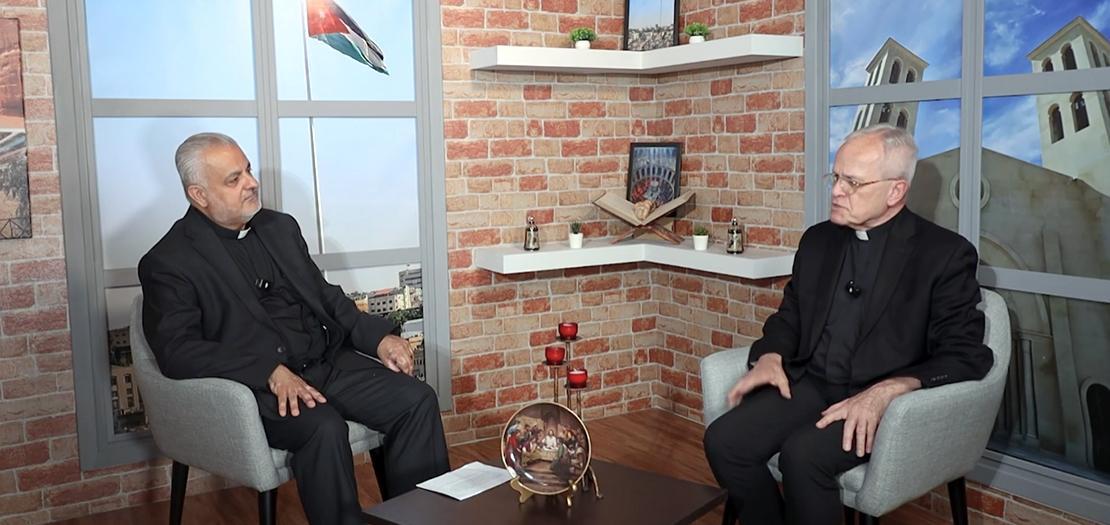
President of the Catholic Near East Welfare Association (CNEWA) Monsignor Peter Vaccari has said that CNEWA marks its centenary at a time when it is more committed than ever to its mission of serving the Eastern Catholic Churches and accompanying people suffering from war, poverty, and displacement. He stressed that the priority remains focused on humans, their dignity, as well as fostering the culture of encounter and dialogue called for by successive Popes.
This was reported during an interview conducted in Amman by Director of the Catholic Center for Studies and Media Fr. Dr. Rif'at Bader, on the occasion of the 100th anniversary of this pontifical organization, which was founded by Pope Pius XI in 1926 to serve the Eastern Catholic Churches.
He pointed out that the CNEWA’s mission currently extends from the Middle East to Ethiopia, Eritrea, and India, while including the Eastern Churches in Ukraine, Georgia, Armenia, and Romania. He stressed that its work is based on partnership with the local Churches and on responding to their pastoral and humanitarian needs.
Monsignor Vaccari noted that CNEWA has historically been associated with peoples affected by conflict, and pointed out that the Pontifical Mission for Palestine, established by Pope Pius XII after the 1948 war, became the organization's executive arm in the region. He added that the current situation in the Middle East makes its mission more exigent than ever, particularly in light of ongoing wars in addition to the humanitarian, psychological, and social crises they have caused.
He pointed out that the CNEWA not only provides food, medicine, water, and shelter, but rather places increasing emphasis on psychosocial support, especially in the aftermath of the COVID-19 pandemic and successive wars. He also referred to the growing threat of human trafficking in conflict zones, considering it as one of the most pressing challenges that requires a comprehensive humanitarian response.
Referring to the situation currently experienced by young people in the Middle East, Monsignor Vaccari said that emigration has become an attractive option for many because of the prevailing unemployment as well as the difficult economic and security conditions. However, he said that the Church is called upon to create real reasons for young people to remain.He continued that CNEWA works with local Churches to enhance education, create employment opportunities, as well as encourage youth and scouting initiatives, which give young people hope for a future in their own countries.
Reflecting on Pope Leo XIV's impressive message to young people during his recent visit to Lebanon, in which he encouraged them to become "builders of hope" and "makers of peace", Monsignor Vaccari stressed that Christians are called upon to be instruments of hope in their communities and to contribute to building a better future for their peoples.
Monsignor Vaccari affirmed that CNEWA’s mission is not confined to serving Catholics but extends to all those in need, based by the culture of encounter and dialogue launched by Pope Benedict XVI, Pope Francis, and Pope Leo XIV. He added that CNEWA works in an ecumenical spirit and encourages dialogue among Churches while also involved in dialogue with followers of other religions and all people of goodwill who are committed to serving humanity and promoting the common good.
He went on to say that CNEWA does not engage in partisan or political activity, as it believes that politics should be based on human dignity and moral values while considering that the Church's mission is designed to further bring about greater impressions of humanity to public life and to remind leaders that people must remain at the center of every decision.
Turning to the preparations for the upcoming Jubilee celebrations in 2030 and 2033, Monsignor Vaccari expressed hope that the Holy Land would restore its security so that it will be able to welcome pilgrims from around the world, especially to the Baptism Site of Jesus Christ in Jordan and to Jerusalem.
In conclusion, he stressed that genuine peace cannot be achieved merely by ending wars, as it must be based on justice, citing Catholic teachings which state that "peace is the fruit of justice." He said that reconciliation and forgiveness can only follow the establishment of justice and genuine peace. He also called on the faithful to continue praying, to support the mission of CNEWA, and to cooperate with CNEWA so that it may continue to serve as a bridge of hope, dialogue, and humanitarian service in the Middle East and throughout the world.