Issued by the Catholic Center for Studies and Media - Jordan. Editor-in-chief Fr. Rif'at Bader - موقع أبونا abouna.org

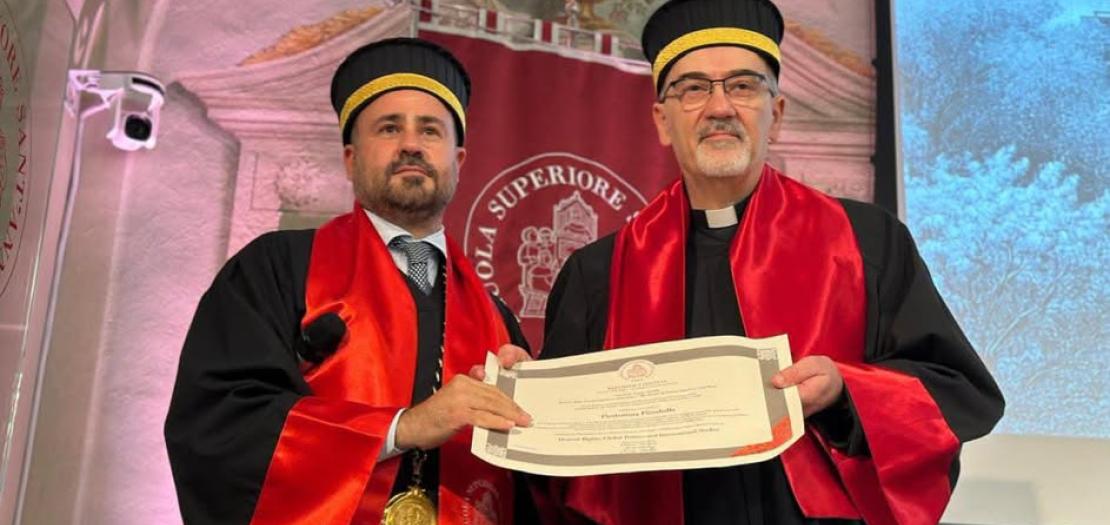
In the Holy Land, violence has broken bonds, uprooting families and destroying places. Yet, even among the rubble, the voice of the Church continues to raise an appeal for dignity and human rights. And in this context of suffering and relentless commitment to peace, the academic recognition granted to Cardinal Pierbattista Pizzaballa, the honorary doctorate (PhD in Human Rights, Global Politics and International Studies), is placed. The Patriarch immediately clarified the deep meaning of this award: "I accept this recognition thinking of the Church of Jerusalem and the people with whom I share the responsibility of safeguarding a Christian presence. I consider this diploma to be attributed not only to myself, but to all those who, together with me in the Church, but also outside, collaborate and work for everything that is being done to save humanity of others."
In retracing the drama of the Holy Land, the Patriarch emphasized how war has profoundly changed daily life: "From the beginning of this war, the land has fallen into a situation whose gravity we still struggle to fully understand. Violence has crossed the lives of families, destroyed places and habits, and changed the world of looking to the future."
In the scenario of a society that continues to suffer, the Patriarch highlights the fundamental task of closeness and empathy of the Church and in the face of war that affects social and interreligious bonds, Pizzaballa lucidly calls for the strength of coexistence and the limit of force: "No order can give up authority and the proportionate use of the necessary tools to protect life and contain violence. But precisely the exercise of force puts a more radical question: if it remains subject to the law and oriented towards the reconstruction of coexistence." The Patriarch firmly warns that "when security is based only on force, every change in the balance of power will end up becoming a new threat... The great temptation of our time is to believe that security can be achieved without the other, that it can be built without the other, and that freedom can be defended without the other. The experience of the Holy Land teaches us something different: one day we will discover that the future we have denied to others ends up impoverishing us too."
And the Christian testimony never isolates itself, but opens up to universal dialogue: "My Christian faith is at the origin of this conviction, which obliges me to defend the dignity of each person, but does not separate me from those who profess a different faith or belong to another culture. On the contrary, it makes me available to collaborate with anyone who shares the same ideals of justice and humanity." Alongside the commitment to peace and the denunciation of the consequences of war, the Patriarch has emphasized the concrete value of daily coexistence and to truly "speak the languages of people, understand the sensitivities, measure oneself with the questions that accompany every day," Pizzaballa especially emphasizes the importance of the dialogue of life: that which arises spontaneously "between neighbors, among colleagues, among parents, among people who share a job or a responsibility."
It is precisely in this plot of ordinary relationships that "the other takes a name in history, becomes aware of having common concerns, differences are discovered that demand respect, they learn to do something together." As the cardinal points out, "even the most demanding, cultural or religious dialogue, receives strength from this daily experience." A clear example of this closeness is found where "Christian and Muslim children grow and study together, during the decisive years of their formation," sharing tables, hardships and goals. In these contexts, "each one maintains their belonging and learns day by day that the life of the other can be close to their own," laying the foundations for how, as adults, they will know how to inhabit society.
In conclusion, the appeal that rises from Jerusalem is an invitation to all of us to hope and never give up on resignation: "Hope takes shape in the possibilities of starting an activity again, of resuming study, of taking on a responsibility, of trusting someone again. For me, this hope has a foundation in faith and takes shape in the bonds with people I care about."