Issued by the Catholic Center for Studies and Media - Jordan. Editor-in-chief Fr. Rif'at Bader - موقع أبونا abouna.org

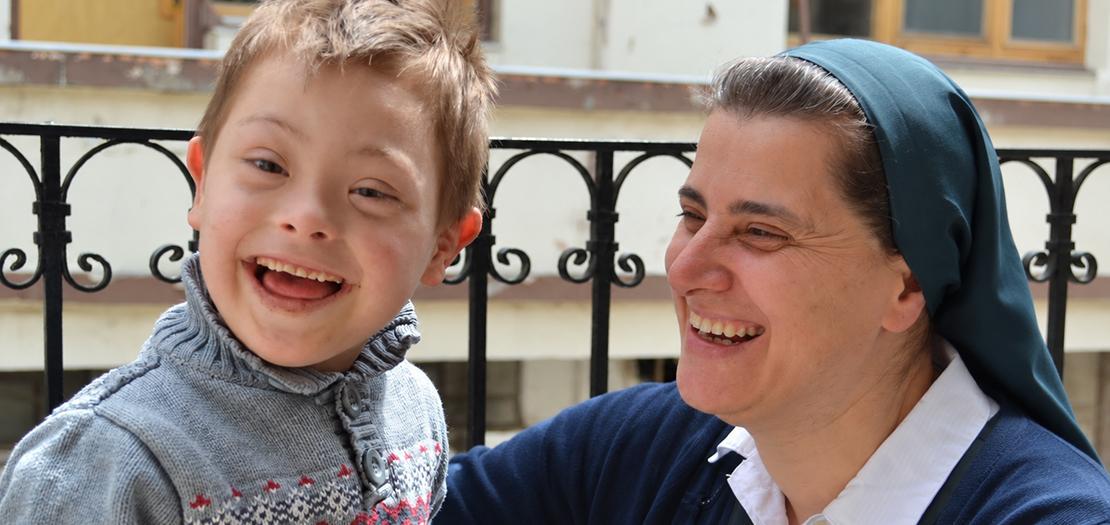
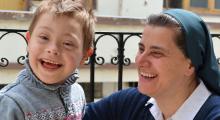
Sister Samia knows Homs well, having lived there for nearly twenty years. When she arrived in the city in 2006, she founded the Le Sénevé center, dedicated to children and young people with disabilities. At the time, suitable facilities were scarce, and many people remained confined to their homes. The superior of the Community of the Sacred Hearts of Jesus and Mary aimed to help them break out of isolation, develop their abilities, and find their place in society. Today, the center welcomes children as young as three and young adults up to thirty, both Christian and Muslim. Visiting France with L'Œuvre d'Orient, Sister Samia came to share her experiences of the realities she has encountered in Homs.
At the center, this support takes very concrete forms. The days are structured around learning, but also around activities that allow each person to build self-confidence. The older residents participate in woodworking, candle-making, and sewing workshops. "Everyone does what they can," explains Sister Samia with a smile. It's her way of reminding everyone that people with disabilities are not defined by their limitations, but also by all that they are capable of achieving. Every year, the center organizes a large festival to which the residents of Homs are invited. "They're the ones who do everything!" the nun proudly adds.
Over the years, Le Sénevé has also expanded its support to older, isolated people with disabilities, including those whose parents have passed away, by creating a dedicated home for them. Here again, Sister Samia wants to offer more than just a roof over their heads. "I want this home to be like a real family, with caregivers by their side," says the Syrian nun.
Beyond the Mustard Seed, Sister Samia is working to rebuild the city. When war broke out in 2011, her convent and center were at the heart of the fighting. The building was destroyed by bombing, and the community had to leave the neighborhood. In 2014, after the liberation of Homs' Old City, the nun returned to her convent, then in ruins. A massive reconstruction project began, which continues to this day. "Each year, I rebuild a little bit," she explains.
At the same time, Sister Samia also helps displaced families find their way back to their homes. During the war, she launched a housing rehabilitation project so that families could return to Homs. And because the needs don't stop at housing, the nun also participated in the creation of a clinic for the most destitute. Medicines, operations, medical care… the requests are numerous. "Health is essential, a need that cannot be ignored," she emphasizes.
Giving back more than just material aid
In all these projects, Sister Samia nevertheless refuses to reduce her work to mere material assistance. One story in particular illustrates this. After the war, she met a widow whose husband had disappeared and whose house had been completely destroyed. "When I first saw her, she was a very sad woman," she recalls. The superior first helped her find housing before offering her a job at the clinic. "Little by little, this woman rediscovered her zest for life," the nun recounts. Beyond a salary, the work allowed her to break out of her isolation and find her place in society again. "Work changes a person on every level," Sister Samia affirms. "It provides not only a salary, but also dignity, relationships, and a reason to get up every morning."
This conviction permeates all her actions. For Sister Samia, simply being there and listening is already a form of support. "When they need to talk, I'm there," she explains. Some people come to see her simply to share their weariness, their difficulties, or their story. This listening alone can restore courage. "Sometimes, giving hope is more than giving material things," the nun emphasizes.
"Why would I leave?"
Today, Syria continues to face profound challenges. In Homs, the cost of living is rising, access to healthcare remains difficult, and the security situation remains fragile. Even more concerning is the exodus of young people, which worries Sister Samia most of all. "All the young people, and even entire families, now see their future elsewhere," she laments. Many are seeking opportunities outside Syria that they can no longer find in their own country. Since the fall of Bashar al-Assad's regime, the situation has not yet allowed everyone to regain sufficient stability to look to the future with any peace of mind.
So why stay? Sister Samia's answer is simple. "I stay because I have a mission." During the war, she didn't leave Homs, and even today, she wants to be with those who are still there. Her presence thus takes on a special dimension in a city where so many people have known fear, destruction, and exile. "In our work, in our presence, we give hope to the young people who remain," she affirms.
Over the years, Sister Samia has learned to move forward without losing sight of the foundation of her commitment. "For me, the most important thing is prayer," she confides. It is in prayer that she finds the strength to endure hardships and remain with those who suffer. In Homs, Sister Samia continues to move forward, one project after another, one encounter after another. In a city still scarred by the wounds of war, she chooses to stay, to serve, and to pray. For her, it is a way to sow hope among those who are there and to help them still believe in tomorrow.