Issued by the Catholic Center for Studies and Media - Jordan. Editor-in-chief Fr. Rif'at Bader - موقع أبونا abouna.org

Following is the text of the meditation by His Beatitude Cardinal Pizzaballa, Latin Patriarch of Jerusalem, on the fourth Sunday of Lent dated March 15, 2026:
The Lenten journey proposed to us in this liturgical Year A brings us, after the Sundays of the Temptations and the Transfiguration, to three passages from John’s Gospel: the story of the Samaritan woman, which we heard last Sunday; the story of the man born blind, which we read today; (John 9:1-41) and the story of Lazarus, which we will hear next Sunday.
Today, we find ourselves at the center of these three Sundays. This very Sunday can help us find a key to understanding the other two and, together, prepare us to enter Passion Week, to go up with Jesus to Jerusalem. Today we are told that to celebrate Easter, we need to be able to look and see what the Lord is doing for us.
Last Sunday, we saw that the Samaritan woman is helped to look at and embrace her own story, and to see that her story is a place to encounter the Lord, to worship the Lord in spirit and truth. Jesus sees this woman with a new gaze, and this gaze, which welcomes without condemning, becomes for her the possibility of a new beginning.
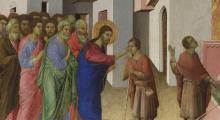
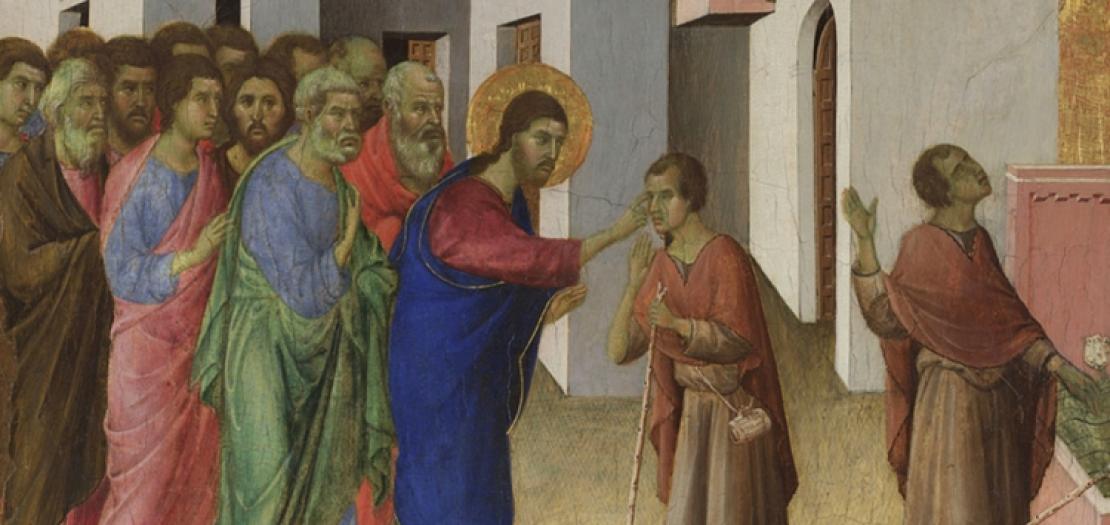
Today’s Gospel also begins with a gaze: as He passed by, Jesus saw a man blind from birth. (John 9:1) The blind man cannot see Jesus, but Jesus sees him. This is how the story of this man’s healing begins, for just as with the woman of Samaria, here too Jesus’ gaze is liberating. While the disciples, as common religious thinking suggested, were inclined to interpret this man’s story as one of sin (“Who has sinned, this man or his parents?” (John 9:2) Jesus reads it as a story of sorrow and salvation: “Neither he nor his parents sinned, but it is so that the works of God might be made visible through him.” (John 9:3)
The theme of sin and evil returns several times throughout the passage: in verse 34, after the exhausting questioning of the man who has recovered his sight, the Pharisees want to confine him to a story of sin: “You were born entirely in sins, and you are trying to teach us?” (John 9:34) The same theme also returns on Jesus’ lips at the conclusion of the passage. Addressing those same Pharisees, who wanted to see the sin of others but not their own, Jesus tells them, “If you were blind, you would have no sin; but because you say, ‘We see,’ your sin remains.” (John 9:41)
The passage presents us with two types of people. On one side is the blind man, who does not see and knows that he does not see. On the other are the Pharisees, who do not see and do not accept that they do not see. Sin is not being blind, but pretending to see and, therefore, preventing the Lord from enlightening, speaking to, and healing us. Sin is self-sufficiency, which keeps God out of one’s story.
The blind man, who knows he cannot see, is willing to allow himself to be healed. He does not demand, claim, justify, or accuse. He obeys the word of Jesus and sets out to be healed (“Jesus said to him, “Go wash in the Pool of Siloam” (which means Sent). So, he went and washed, and came back able to see”. (John 9:7) He simply recognizes what has happened to him: before, he could not see, and now he sees (“One thing I do know is that I was blind and now I see.” (John 9:25)
The Pharisees, on the other hand, who do not see their own sin, close themselves off from the manifestation of God’s work and remain blind. Acknowledging one’s sin, in Johannine language, does not mean making a list of one’s mistakes or feeling guilty. For John, sin is only one thing: unbelief, not seeing in Jesus the Messiah who came to reveal the Father, the Lamb who takes upon himself the sin of the world.
The culmination of the blind man’s healing is not when he regains his sight after washing in the pool of Siloam, but when he can fix his gaze on the Lord and say, “I believe.” (“Who is he, sir, that I may believe in him?” Jesus said to him, “You have seen him and the one speaking with you is he.” He said, “I do believe, Lord,” and he worshiped him.” (John 9:37-38)
To celebrate Easter, therefore, it is necessary to have a humble heart that allows itself to be saved. Only then can one go up to Jerusalem and see the wonder of God: the wonder by which human evil, our distance from God, is taken by Jesus upon his own shoulders. Then one will be able to see in that gesture the eternal love with which God loves each person’s story, he who first believes in humanity and its possibility of beginning a new life.
Like the Samaritan woman, like the man born blind, like Lazarus.
+Pierbattista