Issued by the Catholic Center for Studies and Media - Jordan. Editor-in-chief Fr. Rif'at Bader - موقع أبونا abouna.org

Dear brothers and sisters,
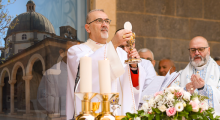
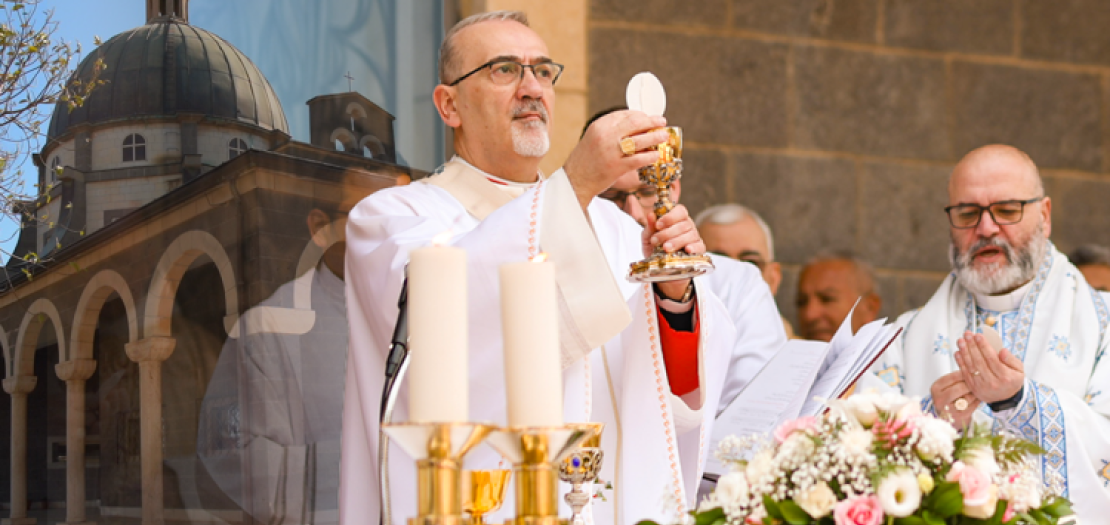
We are on the Mount of Beatitudes, where Jesus delivered what is known as the “Sermon on the Mount,” which begins with the Beatitudes just proclaimed. This mountain is actually a small hill, not very high, a place that neither dominates nor overwhelms. Jesus begins his ministry right here, where people live, on one of the trade and life routes of that time. This discourse, therefore, is addressed to a population immersed in daily life, within a fragile and concrete reality. Jesus does not choose a place of power, but one from which life can be seen. He climbs this hill, sits down, and speaks: he does not denounce, accuse, or propose political solutions. He speaks of happiness. This is the first paradox: he does not say what to do, but who is blessed; he points to a way of life rather than strategies for action. He speaks of beatitude in a land marked at that time by hardship, poverty, tension, fear, and injustice – a land that knew well the violence and difficulty of living together.
With the Beatitudes, Jesus describes reality as seen by God.
Even today, here, we find ourselves in a context that is not very different: we live in a beautiful and wounded land, loved and contested, blessed and weary. We are small and fragile Christian communities that have chosen to remain, to protect and serve, often without seeing immediate results. We know the temptation of discouragement, of closure, of defense. Right here, in this Holy Place and at this moment in history, the Gospel of the Beatitudes resounds for us and is spoken to us again, the Church of the Holy Land, as a necessary, concrete, and immediate word.
The Beatitudes are a description of life when God is taken seriously: they go beyond a list of moral precepts, a ranking of virtues, a catalog of heroism, or an ideal for the few. In this wounded land, where pain has many faces and languages, everyone bears wounds: those who have lost someone, security, trust, or a future. Fear risks becoming a criterion, defense an identity. Listening to the Beatitudes is not easy: they may seem out of place, naive, even offensive. Yet Jesus speaks to us precisely within this reality.
They are neither an unattainable ideal nor a reward for the best, nor a consolation for the losers; they are a new way of looking at life. They do not deny evil, nor do they explain or justify it; they go through it.
Let us allow ourselves to be challenged by some of them.
“Blessed are the poor in spirit.”
Here in the Holy Land, poverty is a daily reality for many: lack of work, freedom of movement, and stability. It means dependence on decisions made elsewhere. According to Jesus’ teaching, it is precisely in such circumstances that access to God and the realization of His Kingdom become possible, provided the heart remains open, poverty does not generate bitterness, and deprivation does not turn into hatred. For us, this beatitude is a call not to let fear control us, not to reduce ourselves to a community that merely survives, but to one that bears witness. It is not an exaltation of misery, but the freedom of those who do not possess themselves, who do not close themselves off, and who know that life is entrusted to them.
“Blessed are those who mourn”
Today, the weeping is real: the weeping of victims, children, and broken families, but also the silent weeping of those who are weary, disillusioned, and tempted to leave or withdraw. Jesus does not say that weeping will soon disappear; he affirms that it is not useless. God does not become accustomed to pain, even when we risk doing so. This beatitude prevents us from normalizing suffering, accepting it as inevitable, or considering it merely “part of the conflict.” Jesus welcomes tears: he does not eliminate, explain, or justify them; tears are not wasted or forgotten by God. This beatitude prevents resignation and cynicism: believers do not deny pain, but they do not give up hope; they remain in tears without turning them into anger.
“Blessed are the meek”
In a context marked by force, armed response, and the logic of revenge, meekness appears scandalous, yet it is one of the most necessary Beatitudes today. Meekness is the refusal to be defined by hatred, the choice not to dehumanize others, and fidelity to one’s own humanity when everything urges its loss. For Christians in the Holy Land, meekness is a high form of spiritual resistance: it means remaining present without aggression and continuing to believe that others are not reducible to the evil they do or suffer. Meekness is restrained strength – the ability not to respond to evil with evil – the opposite of weakness. In a land marked by conflict, meekness is a radical, almost scandalous choice: to remain human when everything pushes us to dehumanize others, to see a person even where it is easier to see an enemy. It is perhaps one of the strongest testimonies: a faithful, non-aggressive, non-ideological presence.
“Blessed are those who hunger and thirst for righteousness”
Here, justice is a wounded word – invoked, denied, exploited. Jesus recognizes this hunger as a beatitude, without asking us to renounce it. To hunger for justice means refusing to resign ourselves to injustice, while also avoiding the absolutization of our own idea of justice; it means seeking a justice that does not destroy others, does not build new walls, and does not create new victims. It is an invitation to preserve a free inner space, where justice remains a deep desire for truth and goodness, without crystallizing into ideology. Not an abstract justice, but a concrete one: in relationships, in words, in daily choices. We know well that justice here is not easy, often incomplete, and sometimes seemingly impossible. Yet Jesus says this hunger is already a blessing: those who hunger for justice refuse to become accustomed to injustice, to normalize or justify it. We are called to preserve this hunger, without turning it into ideology and without extinguishing it out of fear.
“Blessed are the peacemakers”
Here we understand how fragile peace is: it is a process, not a state; a daily effort, not merely an agreement. Being peacemakers often means working in small ways, behind the scenes, without visible results – building relationships, protecting dignity, and keeping channels of dialogue open when everything pushes to close them. Jesus says these are called children of God, not because they are successful, but because they resemble the Father, who never gives up on man. He does not say, "Blessed are those who speak of peace," but "peacemakers": peace is a task – laborious, slow, fragile – requiring perseverance, patience, and the willingness to lose something. Being peacemakers often means working without recognition, without immediate results, sometimes in silence. But Jesus says these are the ones who are called children of God, because they resemble the Father, who continues to believe in man even when man disappoints and betrays.
“Blessed are those who are persecuted”
Jesus does not deceive his disciples: The Gospel has a cost, and today that cost is real – being a minority, misunderstood, and vulnerable. Yet Jesus says the Kingdom is already theirs now, because the Kingdom coincides with faithfulness; it does not await future security.
The Beatitudes promise fulfillment, not rewards. “Blessed... for theirs is the Kingdom of Heaven.” They teach us to recognize the signs of the Kingdom where the world sees only failure. The Kingdom is already at work, even when we do not see it. The Kingdom of God in the Beatitudes is not a distant tomorrow; it is already present every time someone lives this way.
On this mountain, therefore, Jesus promises a new humanity that is possible even in the midst of conflict, not a land without conflict. In this wounded but beloved land, where people speak only of victory, seek immediate results and applause, and cry out for vengeance and violence, we are called to make the Gospel visible, to remain, to bear witness, and to guard our hearts. Perhaps this is our beatitude today.
Here, today, on this mountain, Jesus asks us to trust – to believe that this path, apparently weak, is in reality the only one that truly saves humanity.