Issued by the Catholic Center for Studies and Media - Jordan. Editor-in-chief Fr. Rif'at Bader - موقع أبونا abouna.org

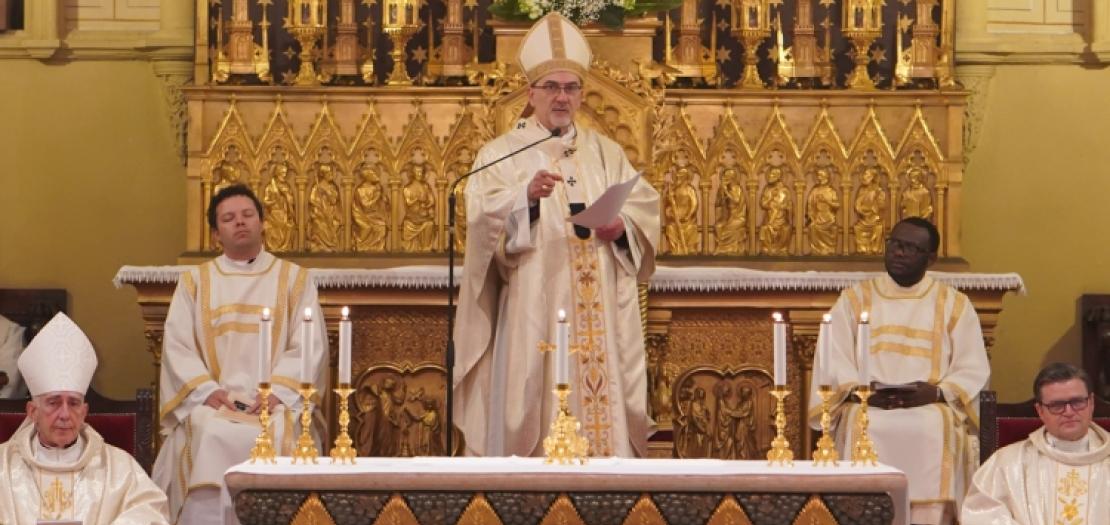
Following is the text of the homily by His Beatitude Cardinal Pizzaballa, Latin Patriarch of Jerusalem, marking the Feast of the Presentation of the Lord/ Day of Consecrated Life dated February 2, 2026:
Dear brothers and sisters,
Today’s liturgy places us at the crossroads of three great horizons: the history of Israel’s salvation, the definitive revelation in Christ, and the prophetic sign of the Church, which is your life as men and women religious. The Presentation in the Temple is not simply an episode from the childhood of Jesus; it is a luminous fulfillment and, at the same time, a turning point.
Mary and Joseph go up to the Temple for two rites linked to the ancient Law (cf. Lev 12; Ex 13:12–13): the purification of the mother and the redemption of the firstborn. It is the gesture of a poor family (they offer two doves, the offering of the poor) that fits with humble fidelity into the long wait of their people. Yet, in this obedience to the Law, something is accomplished that transcends and transfigures it. It is no longer simply man who redeems the firstborn from God, but God himself who, in his Son, offers himself to man. This is the Messiah’s first entry into his House. The evangelist Luke, with great theological wisdom, describes this moment using words that recall Malachi’s prophecy: “And suddenly the Lord whom you seek will come to his temple”. (Mal 3:1) In this Child, the Glory of God– who had left the Temple before the exile (cf. Ezekiel 10)—returns for good. Yet this return happens in an unexpected way: in the weakness of human flesh.
And here we meet the two witnesses of the Spirit: Simeon and Anna. They represent faithful and poor Israel, the one that ‘awaited the consolation of Israel’ (Lk 2:25) and ‘awaited the redemption of Jerusalem.’ (Lk 2:38) They are not the powerful members of the Sanhedrin, but the “poor of the Lord” (the ‘anawim), those who live by faith, expectation and prayer. Their closeness to God is such that they recognize the Messiah when he comes in the humblest form. Simeon, inspired by the Holy Spirit, utters words that are a miniature gospel and a prophecy for the Church and for each one of us.
His canticle (“Nunc dimittis, Domine ...”) is the song of fulfillment. He sees in the flesh of the Child the “salvation” prepared by God for all peoples: “a light to reveal you to the nations” (Lk 2:32). This fulfills Isaiah’s promise to the Servant of the Lord: “I have made you a light for the nations” (Isaiah 49:6). But immediately, the light casts the shadow of the cross. This Child will be “a sign of contradiction” (Luke 2:34). The image is powerful: sēmeion antilegomenon, literally a sign against which one opposes with words. Christ is the ultimate criterion of discernment, the rock of scandal on which hearts clash (cf. 1 Pet 2:7-8; Lk 20:17-18). The revelation of light forces us to come out of darkness, and this is a judgment, a sword. The sword that will pierce Mary’s soul (Lk 2:35) announces her unique involvement in the drama of redemption. She, the Mother of the Savior, will also be the first disciple to follow him to the cross (cf. Jn 19:25), participating in her soul in his offering. Finally, Simeon reveals the purpose of this mystery: “so that the thoughts of many hearts may be revealed.” (Lk 2:35) The presence of Christ reveals the profound truth of man, what dwells in his heart: acceptance or rejection, love or indifference.
And what does all this mean for us, consecrated persons, here in the Holy Land?
We are called to be a kind of “collective Simeon and Anna.” Your life, at its core, is a public profession of waiting. You no longer wait for the Messiah, but for his full manifestation, his glorious return. In a land where promises sometimes seem betrayed by history, your presence is a living sign that God is faithful. Like Simeon and Anna, your authority does not come from power but from your closeness to God in prayer, your faithful waiting, and your ability to recognize the signs of his presence– even where others see only conflict. Anna “served God night and day with fasting and prayer” (Lk 2:37). This is your primary service in this land: to be pillars of prayer, tireless intercessors.
We welcome Christ as he offers himself. Simeon did not welcome a triumphant Messiah, but a child of poor parents. Consecrated life is called to welcome and reveal Christ in his kenosis, in his self-emptying. (Phil 2:7) In a region where identities are often defended with force and claims, your vows are a prophetic counter-witness.
Poverty, in a land marked by inequality and deprivation, proclaims that God is true wealth; it declares that our ultimate identity is not found in land or nationality, but in being children of one Father.
Chastity, in a land torn apart by broken relationships, proclaims that faithful and gratuitous love is possible; it builds a universal fraternity that overcomes every ethnic and confessional barrier, showing a love that does not possess but gives itself.
Obedience, in a context of conflict and opposition, shows that history is not left to chaos. Instead, it can become a story of listening and discernment. Obedience also testifies that true freedom comes from listening to a Will of Love that precedes us. It offers an alternative to self-sufficiency and conflict.
Every day, with your simple and faithful gestures, you allow Christ to enter his Temple once again. Like Simeon and Anna, you too recognize the Lord and serve him where he is most needed:
Education:
Through schools and training centers, you prepare the “lights for the peoples” of tomorrow. Educating here means teaching young people to emerge from the darkness of prejudice and resentment, revealing to them the profound truth of humanity, which is acceptance and love.
Assistance:
In homes for the elderly, in hospitals, and in welcoming the poor, you touch the flesh of Christ in his weakness. Like Mary and Joseph who offered the gift of the poor, your charity is the daily redemption of those who are forgotten, making visible the “consolation of Israel.”
Contemplation:
You are like Anna, who “served God night and day with fasting and prayer.” The contemplative communities of our Church are pillars of tireless intercession. Your spiritual “abiding” is a powerful image of God’s faithfulness in not abandoning his people.
We bring light, knowing it generates contradiction. The light we are called to reflect is not reassurance, but judgment on the darkness of the world. Your very presence, if authentic, will be a “sign of contradiction.” You will be misunderstood by those who seek only political or military solutions. You will be questioned by those who do not understand a fruitfulness that is not demographic or immediately successful. As with Mary, this can be a sword that pierces your heart. But it is precisely this participation in Christ’s contradiction that gives credibility to your witness.
Let us remain in the Temple. The Temple is the place of encounter, sacrifice, and prayer. Your consecrated life is called to be a “spiritual Temple” in this land (cf. 1 Pt 2:5). Your physical and spiritual “remaining” in the Holy Land, especially in the most difficult places, is a powerful image of God’s faithfulness, who does not abandon his people. This is not a passive way of remaining. Rather, it is remaining “in Him,” (Jn 15:4) like branches joined to the vine. In this way, you bear fruit– the fruit of love, forgiveness, reconciliation, education, and care– which no politics can produce.
Dear friends, today the Church not only thanks you but recognizes in you a sacramental mystery: you are a visible sign of the Church-bride awaiting her Spouse, of the Church-poor living on providence, of the Church-obedient listening to the Word. In the Holy Land, you embody in a particularly intense way the Church’s vocation to be “light of the nations.”
Today, with Mary and Joseph, we present our lives to the Father. We ask for Simeon’s courage to embrace the Lord in his reality, even when he carries the cross. We ask for Anna’s perseverance in serving God with joy. We entrust ourselves to Mary, the Mother of the Savior and Daughter of Zion, who kept everything in her heart. (Lk 2:51) May she, who knew the sword of sorrow, teach us to remain faithful. Even a single lamp, fueled by the oil of faith and charity, is enough to keep hope alive through a very long night.
And the dawn of Easter will come.