Issued by the Catholic Center for Studies and Media - Jordan. Editor-in-chief Fr. Rif'at Bader - موقع أبونا abouna.org

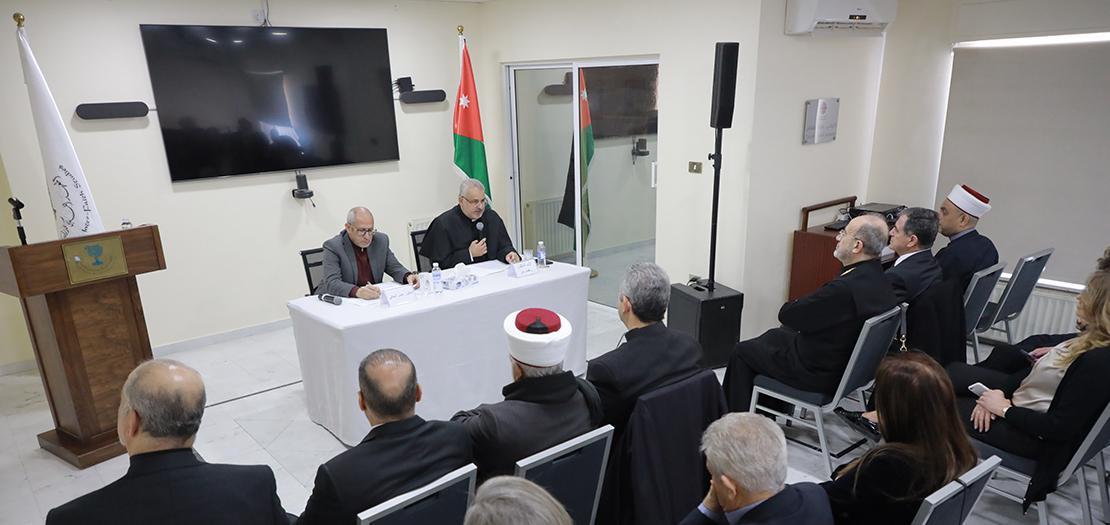
On Wednesday, February 4, 2025, the Royal Institute for Inter-Faith Studies (RIIFS) held an intellectual seminar marking the World Interfaith Harmony Week and the International Day of Human Fraternity, in the presence of a distinguished group of academics and experts in interreligious dialogue.
Opening the seminar, RIIFS Director Dr. Taghreed Odeh stressed the importance of restoring the values of human fraternity as embodied in the thought of the late Pope Francis and Grand Imam of Al-Azhar Dr. Ahmed Al-Tayeb. She stressed that this seminar aims at deepening these principles and activating them in our current reality.
In an intervention, Director of the Catholic Center for Studies and Media (CCSM) Fr. Dr. Rif’at Bader addressed the concept of human fraternity in the thought of Pope Francis, and referred to the World Interfaith Harmony Week, which was endorsed by the United Nations in 2010 following a proposal made by His Majesty King Abdullah II Ibn Al-Hussein.
He said that the International Day of Human Fraternity was added to this week which is observed annually on February 4. Fr. Bader reviewed the most important documents that have consolidated the concept of human fraternity, including the Document on Human Fraternity for World Peace and Living Together (2019) and the encyclical Fratelli Tutti (2020). He added that human fraternity is based on recognizing the shared dignity of all human beings, as well as on transcending religious and cultural affiliations, while pointing out that fraternity is not merely a moral sentiment but rather a practical commitment reflected in policies, as well as social and economic relations.
He also reflected on the historical and religious context of Pope Francis’ message by referring to global challenges such as terrorism, poverty, migration, and environment. Furthermore, he accentuated the importance of continued dialogue between Al-Azhar and the Vatican as a means of confronting extremism and building peace.
Father Bader continued that the Document on Human Fraternity and the encyclical provide a practical framework for promoting dialogue and global peace, as well as for transforming ethical principles into tangible actions in society, politics, and economy. He underscored the role of education, environment, as well as the protection of the rights of migrants and the poor in entrenching the values of human fraternity, while affirming that social and humanitarian work is an essential part of attaining these values.
He concluded his intervention by stating that human fraternity is a common life project and a necessary choice in time of divisions. He also called for adopting Pope Francis’ vision in order to build a more just and peaceful world through dialogue based on respect and the search for common denominators.
For his part, Dr. Amer Al-Hafi, academic advisor at the RIIFS, presented an in-depth analysis of human fraternity in the thought of His Eminence the Grand Imam of Al-Azhar, Dr. Ahmed Al-Tayeb, where he affirmed that the document signed by the Imam of Al-Azhar and Pope Francis in 2019 marked a turning point in the procession of interfaith dialogue and has become a global roadmap for promoting mutual respect and confronting extremism.
Dr. Al-Hafi referred to the “Egyptian Family House” initiative founded by Imam Al-Tayeb in cooperation with Pope Tawadros II, patriarch of the Coptic Orthodox Church, and the heads of other churches, stating that human fraternity is based on genuine partnership among religions and cultures, while turning ethical principles into practical reality through legislation, education, media, as well as the management of diversity and differences.
Stressing that Islam is a religion of peace and human fraternity, and that relations between Muslims and Christians are based on respect and cooperation, he acknowledged freedom of belief and the necessity of respecting differences in their capacity as a divine law. Furthermore, he emphasized that aggression in Islam is confined to defending the oppressed and protecting legitimate rights.
Dr. Al-Hafi concluded his address by affirming that human fraternity is not merely a moral feeling, but rather a practical project expressed through social, political, and cultural engagement. He also called for strengthening the values of tolerance, citizenship, and equality among the entire human beings in a way that consolidates peace and harmony within society.
The seminar concluded with an open discussion between the speakers and attendees, focusing on means to promote the values of fraternity and encounter in schools, universities, and modern media platforms.